Deflationary Tokens and Their Benefits: What Holders Get
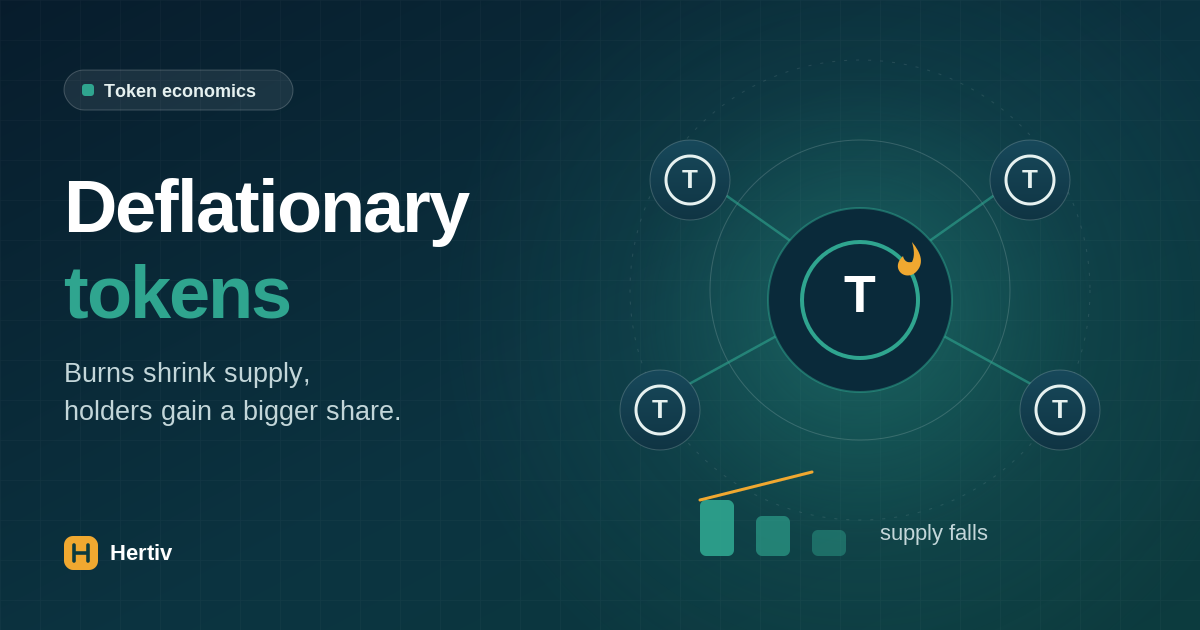
Deflationary tokens shrink supply through burns, so each remaining token is a larger share of the total. Here are the benefits, and the limits to know first.
On this page
Short answer
A deflationary token is a crypto token whose total supply falls over time because a share of every transfer, trade or fee is burned, or removed from circulation for good. Supporters value them because a shrinking supply can support the token's value and reward long-term holders, but the effect depends on real demand, honest burn rules and a project that keeps building.
What is a deflationary token?
A deflationary token is a crypto token designed so its total supply falls over time, usually because a small share of every transfer or trade is burned, meaning it is sent to an address nobody can spend from. Each burn makes the remaining tokens a slightly larger share of the total.
This is the opposite of an inflationary token, where new tokens are minted as rewards and the supply grows. A deflationary design does not create value on its own; it changes how the supply behaves while demand does the rest. The supply design is one part of how tokenization works end to end.
The common burn mechanisms are:
| Mechanism | How supply falls | When it happens |
|---|---|---|
| Burn on transfer | A share of each transfer is burned | Every transaction |
| Fee burn | Part of each fee is burned | Each trade or swap |
| Buyback and burn | Project buys tokens and burns them | On a schedule, from revenue |
| Scheduled burn | A fixed amount is burned | Monthly or quarterly |
Burn rules live in the token's smart contract, so anyone can read them and check that burns actually happened. How to create a deflationary token explains the mechanics in detail; this article covers what holders and projects get from the design.
What are the benefits for holders?
The benefits for holders of a deflationary token are a growing share of the total supply, a built-in reason to hold rather than trade, and a supply story that is easy to verify on chain. None of these guarantees a higher price, but they shape how holding behaves.
The main benefit is the share effect. If you hold 100,000 tokens out of 10,000,000, you own 1% of the supply. If burns cut the supply to 8,000,000 while your balance stays the same, you now own 1.25% of the total, without buying more.
A second benefit is the holding incentive. A burn on transfer takes a small cut from every sale, which makes frequent trading slightly costly and long-term holding slightly more attractive. The effect is small per trade, but it points behaviour in one direction.
A third benefit is transparency. Burns are public transactions, so holders can check the supply falling over time instead of trusting a promise. That checkability is part of the appeal, and it is also how holders spot a project that quietly stops burning.
How does a shrinking supply support value?
A shrinking supply supports value only when demand holds steady or grows, because price follows the balance of buyers and sellers, not the supply number alone. Scarcity helps when people want the token; it does nothing when they do not.
Think of it as two levers. The burn lever reduces supply a little at a time, while the demand lever is the product, the users and the reasons to hold. If demand is flat, a smaller supply means the same buyers chase fewer tokens, which can lift the price. If demand falls faster than supply shrinks, the price falls anyway.
Burns also act as a signal. A project that burns tokens from real revenue is showing that the product earns money and that the team is willing to spend it on holders rather than on itself. A project that burns tokens it minted for free is signalling nothing, because the burn cost it nothing.
That is why experienced holders look past the burn rate and ask where the burned tokens came from. Tokenomics explains how supply, demand and incentives fit together, and burns are only one piece of that picture.
What benefits do projects get from a deflationary design?
Projects get three benefits from a deflationary design: a clear story to tell holders, a tool for managing supply after a large mint, and a way to share revenue with holders without paying it out directly.
The story matters because a token needs a reason to exist beyond speculation. A burn schedule gives the community a number to watch and a simple explanation for why supply falls, which is easier to communicate than a complex staking model.
Supply management is the practical benefit. A project that minted a large supply for rewards or a sale can use burns to bring the circulating supply down over time, instead of leaving a large overhang that weighs on the price.
Revenue sharing is the third benefit. When a project uses fee income to buy back and burn tokens, every holder gains a slightly larger share, which works like a dividend that needs no payout system and no tax event at the project level. The trade-off is that the money spent on buybacks cannot fund development, so the split between burning and building has to be deliberate.
Example (hypothetical): one holder's share after a year of burns
Example (hypothetical): a token launches with a supply of 10,000,000 and a burn of 100,000 tokens per month, paid from trading fees. After 12 months the total burned is 12 times 100,000, or 1,200,000 tokens, so the supply falls to 8,800,000.
A holder who owns 100,000 tokens starts with 100,000 out of 10,000,000, which is 1% of the supply. After a year of burns, the same 100,000 tokens out of 8,800,000 is about 1.14% of the supply, because 100,000 divided by 8,800,000 is 0.0114.
That gain is real but small, and it says nothing about price. If demand for the token halved over the same year, the holder's larger share would still be worth less. The burn helped the share; only demand can lift the value.
The example also shows why the burn rate matters less than people think. A 1% monthly burn sounds large, yet after a full year the holder's share grew by only about a seventh. Burns are a slow lever, not a quick one.
What are the limits and risks?
The limits of deflationary tokens are that burns cannot create demand, high burn rates can choke trading, and a shrinking supply can concentrate ownership in a few hands. A burn schedule is a design choice, not a safety net.
The first limit is demand. A token with no users and no product will fall in price however fast it burns, because nobody wants to buy it. Burns amplify demand that exists; they cannot replace it.
The second limit is friction. A burn on transfer takes a cut from every move, including moving tokens to a wallet or an exchange. Set the rate too high and holders stop moving tokens at all, which hurts liquidity and makes the token harder to trade.
The third limit is concentration. If burns reward holders while new users stay away, the supply ends up held by a smaller group, and a single large sale can move the price sharply. Check how widely a token is held before judging its burn story.
Finally, burns are hard to reverse. A contract that burns on every transfer cannot be paused by a vote, so a bad rate stays bad until the token is replaced. Read the burn rules in the contract before buying, not after.
What are the common mistakes?
The most common mistakes with deflationary tokens are treating the burn rate as a price forecast, ignoring where burned tokens come from, and holding a token for its burn schedule instead of its product.
- Reading burns as a price promise. A falling supply does not mean a rising price. Demand decides the price; burns only change the supply side.
- Ignoring the burn source. Burns paid from real revenue mean something. Burns of freshly minted tokens cost the project nothing and prove nothing.
- Chasing the highest burn rate. Very high rates choke trading and push users away. A modest, steady burn usually works better than an aggressive one.
- Forgetting the contract. Burn rules are code. If you have not read them, you do not know when burns happen or whether they can stop.
- Holding for the schedule, not the product. A token with a great burn schedule and no users is still a token with no users. Judge the product first.
- Skipping the holder spread. A token held by a handful of wallets can swing hard on one sale. Check the distribution before you buy.
Key takeaways
- A deflationary token burns part of its supply over time, so each remaining token is a larger share
- The holder benefit is a growing share of supply, not a guaranteed higher price
- Burns support value only when demand holds steady or grows
- Burns paid from real revenue mean more than burns of freshly minted tokens
- High burn rates can choke trading and concentrate ownership
- Read the burn rules in the contract before buying, not after
Frequently asked questions
What is a deflationary token?
It is a crypto token whose total supply falls over time because a share of every transfer, trade or fee is burned, or removed from circulation for good. The burn rules live in the token's smart contract, so anyone can read them and verify that burns happened.
Do deflationary tokens always go up in price?
No. Price follows the balance of buyers and sellers, and burns only change the supply side. If demand falls faster than supply shrinks, the price falls anyway. A shrinking supply helps when demand holds steady or grows.
What is a token burn?
A burn sends tokens to an address nobody can spend from, removing them from circulation permanently. Burns happen on transfer, on trades through fees, through buybacks paid from revenue, or on a fixed schedule set in the contract.
How do I check that a token is really burning?
Read the burn rules in the token's smart contract and check the burn address on a block explorer. Burns are public transactions, so you can see the supply falling over time and spot a project that quietly stopped burning.
Are deflationary tokens better than inflationary ones?
Neither is better in general. Inflationary tokens can fund rewards and growth, while deflationary tokens reward holding and limit supply. The right design depends on what the token is for, and a good product matters more than the supply model.
What should I check before buying a deflationary token?
Check the product and its users first, then the burn rules in the contract, where burned tokens come from, the burn rate, and how widely the token is held. A token with no users and a high burn rate is still a token with no users.