How to Create a Deflationary Token, Step by Step
A deflationary token is built by writing a burn rule into its contract, then testing, auditing and deploying it. Here is the full sequence and the maths behind it.
On this page
Short answer
A deflationary token is a token whose total supply falls over time because a rule in its smart contract destroys, or burns, a share of tokens on transfers, trades or a schedule. Creating one means choosing a chain and a standard, writing the burn logic, testing it, getting an audit and deploying it with a plan for liquidity.
What is a deflationary token?
A deflationary token is a token whose supply decreases over time, because its smart contract burns a share of tokens whenever a defined event happens. Burning means sending tokens to an address nobody controls, so they leave circulation permanently.
The idea is the opposite of an inflationary token, where new tokens are minted as rewards or emissions. With a deflationary token, the total supply only goes down, so each remaining token represents a larger share of the total. That does not guarantee the price rises, because demand can fall faster than supply, but the supply side of the equation is fixed in code.
Burns usually happen in one of four ways: a percentage of every transfer is burned, a fee on trades is used to buy back and burn tokens, a fixed amount is burned on a schedule, or tokens are burned when a specific action happens, such as a user redeeming a reward.
The choice of mechanism shapes how fast the supply falls and who pays for it. For the basics of token design, see coin versus token development.
How do burn mechanisms work?
A burn mechanism is a rule in the contract that destroys tokens on a trigger. The mechanism decides how much is burned, who pays the cost and how predictable the supply schedule is.
| Mechanism | How it burns | Supply effect |
|---|---|---|
| Burn on transfer | A percentage of every transfer is destroyed | Falls with usage; more activity means faster burns |
| Buyback and burn | Protocol revenue buys tokens and burns them | Falls with revenue; tied to real income |
| Fee burn | Transaction fees are burned instead of paid to validators | Falls with network usage |
| Scheduled burn | A fixed amount is burned on a calendar date | Predictable; the schedule is public |
| Redemption burn | Tokens are burned when redeemed for a good or service | Falls with product use |
Burn on transfer is the most common for new tokens because it is simple to write, but it has a cost: every transfer loses value, which discourages trading and can break integrations with exchanges and wallets that expect the full amount to arrive. Buyback and burn avoids that problem but only works if the protocol actually earns revenue.
Which chain and standard should you use?
The chain and token standard decide your costs, your tooling and your audience. Most deflationary tokens are built on an existing chain rather than a new one, because launching a chain is a different project entirely.
| Option | Standard | Why teams pick it |
|---|---|---|
| Ethereum | ERC-20 | Largest tooling and exchange support; higher gas fees |
| BNB Chain | BEP-20 | Low fees and fast blocks; large retail audience |
| Solana | SPL | Very low fees and fast settlement; different tooling |
| Polygon | ERC-20 | Ethereum-compatible with lower fees |
ERC-20 is the most widely supported standard, and most audit firms, wallets and exchanges know it well. If you need a step-by-step guide to the standard itself, how to create an ERC-20 token covers the contract and deployment. The burn logic is the same idea on any of these chains; only the tooling changes.
How to create a deflationary token, step by step
Creating a deflationary token follows the same sequence as any token, with the burn rule added to the contract and tested before deployment. Skipping a step is how teams end up with a contract they cannot fix.
- Define the supply and the burn rule. Set the initial supply, the burn percentage or schedule, and the maximum supply after burns. Write down the numbers before writing code.
- Choose the chain and standard. Pick the chain your users already use, and the standard its wallets and exchanges support.
- Write the contract. Start from a reviewed template such as OpenZeppelin, add the burn function, and keep the logic simple. A burn that is easy to read is easy to audit.
- Test the burn maths. Run transfers of different sizes on a testnet and check the burned amount, the received amount and the total supply after each one.
- Get an audit. An independent audit checks the burn logic, the access controls and the supply accounting. Fix the findings before deploying.
- Deploy and verify the contract. Deploy to mainnet, verify the source on a block explorer, and publish the burn schedule so holders can check it.
- Provide liquidity and monitor. Add the token to a decentralised exchange, watch the burn events, and publish the supply figures regularly.
Once deployed, the burn rule cannot be changed unless the contract was written with an upgrade path, and upgradeable contracts carry their own risks. Decide the rule before launch, not after.
Example: a burn-on-transfer supply schedule
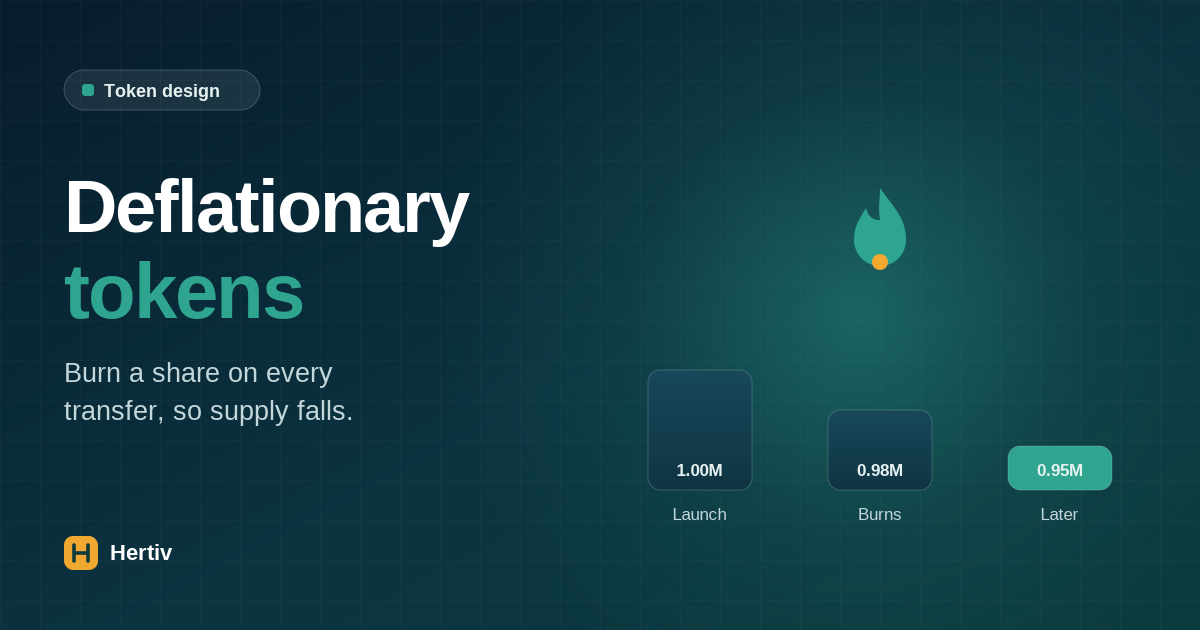
Example (hypothetical): a team launches a token with an initial supply of 1,000,000 tokens and a burn of 2% on every transfer. The team wants to know how fast the supply falls if the token is used heavily.
Take 100 transfers of 10,000 tokens each. Each transfer burns 2% of 10,000, which is 200 tokens, so 100 transfers burn 100 x 200 = 20,000 tokens. The total supply after those transfers is 1,000,000 - 20,000 = 980,000 tokens.
Now compare that with a scheduled burn of 5,000 tokens per month. After four months the scheduled burn has destroyed 20,000 tokens, the same amount as the 100 transfers above. The difference is predictability: the schedule is fixed, while the transfer burn depends on how much people actually trade.
The numbers are illustrative and the burn rate is a planning figure, not a recommendation. The point is to test the maths before launch, because a burn rate that looks small on one transfer can remove a large share of the supply over a year of heavy trading.
What are the risks and limits?
The biggest risk with a deflationary token is that the burn rule breaks how the token is used. A burn on transfer means the receiver gets less than the sender sent, which can confuse accounting, break automated systems that expect exact amounts, and push users to wrap the token to avoid the fee.
There are other limits. A falling supply does not create demand, so a token with no use case still falls in price even as supply shrinks. Burns also concentrate supply among holders who never move their tokens, which can make the distribution look worse over time.
And in some jurisdictions, a token whose value depends on a burn mechanism can face the same regulatory questions as any other token, so the burn does not change the legal analysis.
Tokenomics, the study of how a token's supply and incentives work, is the right frame for these decisions. See what tokenomics is before fixing the numbers.
What are the common mistakes?
The most common mistakes with deflationary tokens are setting the burn rate too high, writing burn logic that cannot be audited, and promising price effects the burn cannot deliver.
- A burn rate that is too high. A 10% burn on every transfer makes the token expensive to use and pushes trading to wrapped versions that skip the burn.
- Burn logic nobody can read. Complex burn rules hide bugs. Keep the mechanism simple and publish the maths.
- Promising price rises. Supply is only half of price. A falling supply with falling demand still means a lower price.
- No audit. Burn functions touch every transfer, so a bug in them is a bug in everything. Audit before deploying.
- Forgetting exchanges. Some exchanges and wallets reject tokens whose transfer amount changes. Check integration requirements early.
- No upgrade plan. If the burn rate turns out wrong and the contract cannot be changed, the team is stuck with it.
Key takeaways
- A deflationary token destroys supply through a burn rule in its contract
- Burn on transfer, buyback and burn, fee burn and scheduled burn are the main mechanisms
- The chain and standard decide costs, tooling and exchange support
- Test the burn maths and get an audit before deploying
- A falling supply does not create demand on its own
Frequently asked questions
What is the difference between a deflationary token and a token with a fixed supply?
A fixed-supply token never changes its total supply. A deflationary token starts with a supply that falls over time because its contract burns tokens on transfers, trades or a schedule, so the total only goes down.
How much should the burn rate be?
There is no standard rate. A small rate, such as 1% or 2% per transfer, is common because it is noticeable without making the token expensive to use. Test the effect over a year of expected trading volume before fixing the number.
Can a deflationary token be inflationary later?
Only if the contract allows minting. A contract with no mint function can never increase supply. If the contract has a mint function or an upgrade path, holders should read the code or the audit to see who controls it.
Do burns make the price go up?
Not on their own. Price depends on supply and demand together. A falling supply helps only if demand stays the same or grows; if demand falls faster, the price falls even while supply shrinks.
Which chain is best for a deflationary token?
Ethereum has the widest tooling and exchange support, BNB Chain and Polygon are cheaper to use, and Solana is fast with very low fees. Pick the chain your users already hold assets on, rather than the one with the lowest fees.
Do I need an audit for a deflationary token?
Yes. The burn function runs on every transfer, so a bug in it affects the whole token. An independent audit is the standard way to check the burn logic, access controls and supply accounting before deployment.


