Coin vs Token Development: Which Attracts More Investors?
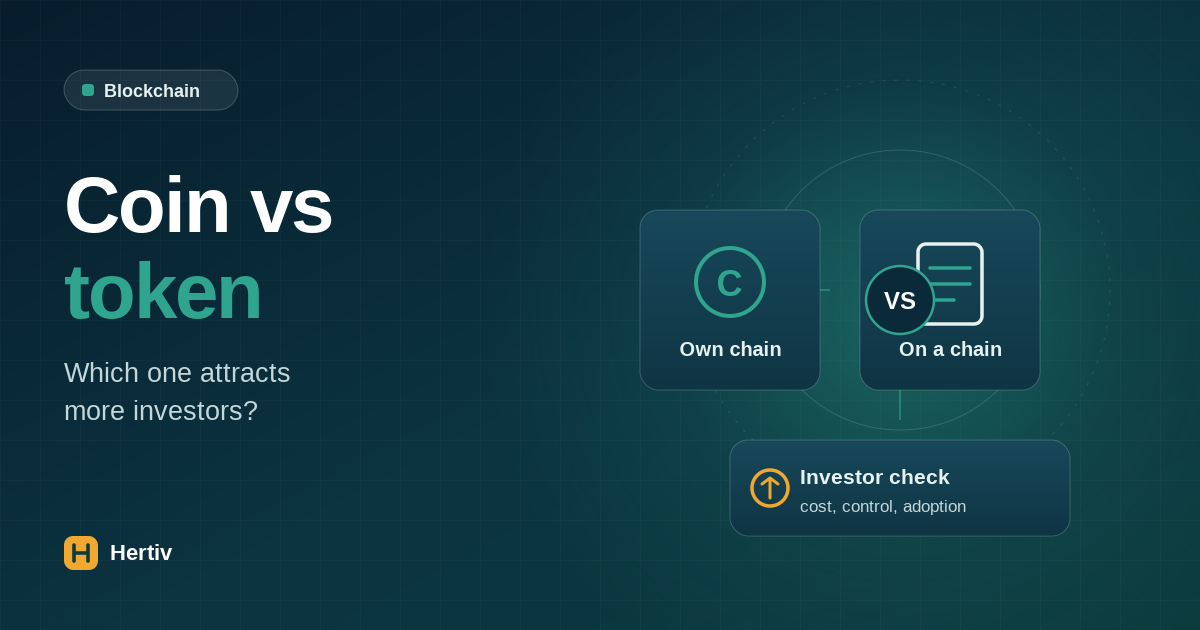
A coin runs on its own blockchain; a token runs on someone else's. That one difference shapes cost, control and which kind of investor pays attention.
On this page
Short answer
A coin is the native currency of its own blockchain, while a token is built on an existing blockchain using that chain's rules. Tokens attract more investors in number, because they are cheaper and faster to build and the pitch is easier to explain. Coins attract larger cheques from fewer investors, but only when the team can show a real reason for a new chain.
What is the difference between a coin and a token?
A coin is the native currency of its own blockchain. Bitcoin runs on the Bitcoin blockchain, and Ether runs on Ethereum. A token is built on top of an existing blockchain, following that chain's rules. Most tokens today are ERC-20 tokens on Ethereum or BEP-20 tokens on BNB Chain.
The difference is who owns the rails. A coin team builds and maintains the whole network: consensus, validators, upgrades and security. A token team rents someone else's network and spends its effort on the product, the token rules and the community around it.
A useful comparison is transport. A coin is building your own railway: expensive and slow to start, but you set the timetable and the fares. A token is running a train on an existing railway: you move faster and cheaper, but you follow the railway's rules and pay its fees.
- Coins: Bitcoin, Ether, Solana, each the native asset of its own chain.
- Tokens: USDT, UNI, LINK, each running on a chain built by someone else.
- Stablecoins are tokens too, even when they are worth more than many coins.
How does coin development work?
Coin development starts with a new blockchain or a fork of an existing one. The team picks a consensus method, writes the node software, sets the rules for new coins, and tests the network with validators before anyone can use it.
Security is the hard part. A new chain needs enough validators to resist attack, and it needs wallets, block explorers and exchanges to support it. That is why most new coins start with a small group of trusted validators and open up over time.
Costs are high and timelines are long. A coin team pays for protocol engineers, audits, validator incentives and exchange listings. A realistic first version takes many months, and the network only becomes useful once enough people run it and build on it. For teams weighing this path, how businesses build a crypto coin sets out the two main routes in more detail.
- Design the consensus method and the supply rules.
- Build and test the node software on a test network.
- Recruit validators and run the network with them.
- Launch the main network and support wallets and exchanges.
- Keep upgrading the protocol as the network grows.
How does token development work?
Token development starts with a choice of chain and token standard. On Ethereum the usual standard is ERC-20 for fungible tokens; on other chains there are matching standards. The team writes a smart contract that sets the supply, who can mint or burn, and any transfer rules.
Testing and audit come next. The contract is tested on a test network, then reviewed by an external auditor before real money touches it. A single bug can drain a contract, so this step is not optional for a token that holds value.
After launch, the work shifts to distribution and use. The team lists the token on exchanges, adds it to wallets, and gives holders a reason to use it inside a product. The chain handles security and settlement, so the team can focus on the product itself. Typical costs are covered in what token development costs.
- Pick the chain and the token standard.
- Write the smart contract with the supply and transfer rules.
- Test on a test network and get an external audit.
- Deploy the contract and verify it on a block explorer.
- List the token and give holders a reason to use it.
Coin vs token: a side-by-side comparison
The table below compares the two paths on the points investors ask about first: cost, time, control and risk.
| Aspect | Coin | Token |
|---|---|---|
| Runs on | Its own blockchain | An existing blockchain |
| Time to first version | Many months | Weeks |
| Build cost | High, often six figures and up | Low to moderate |
| Control over rules | Full control | Limited to the contract |
| Security burden | The team secures the network | The chain secures the network |
| Best for | New infrastructure, new consensus | Products, apps, communities |
No row on its own decides the question. A coin wins on control and independence; a token wins on speed, cost and access to an existing user base.
Which one attracts more investors?
There is no single winner, because different investors want different things. Infrastructure investors back coins: they bet on the network itself becoming widely used. Product investors back tokens: they bet on an app or service that people will pay for.
Coins can raise larger rounds, but they face a higher bar. An investor must believe the new chain will attract developers, validators and users away from chains that already work. That is a hard case to make, and most new coins never reach it.
Tokens raise faster and in smaller rounds, because the pitch is simpler: here is the product, here are the users, here is what the token does inside it. The risk is different. A token depends on its host chain, and if the product stalls, the token has little reason to exist. Teams planning a regulated sale should also read how to launch a security token before choosing a structure.
The honest answer: tokens attract more investors in number, because more teams can build them and more investors understand the pitch. Coins attract larger cheques from fewer investors, but only when the team can show a real reason for a new chain. Blockchain development partners usually test that reason before writing any code.
Example (hypothetical): two teams, two raises
Example (hypothetical): two teams each want $2,000,000. Team Token builds a utility token for a trading app. It spends $120,000 on the contract, audit and launch, and sells 20% of its supply for $2,000,000. That implies a $10,000,000 value for the whole supply.
Team Coin builds a new chain for fast payments. It spends $800,000 on protocol work, audits and validator incentives, and sells 10% of its supply for $2,000,000. That implies a $20,000,000 value for the whole supply, twice Team Token's.
Team Token keeps $1,880,000 of the raise for the product after build costs. Team Coin keeps $1,200,000. The coin team also needs ongoing spending on validators, while the token team pays only chain fees. The coin's higher implied value comes with higher costs and a harder story to sell.
What are the common mistakes?
The most common mistakes are choosing the wrong form for the idea, skipping the audit, and promising investors returns the product cannot support.
- Building a coin when a token would do. A new chain is a product in itself; if the idea is an app, build the app.
- Launching a token with no use. A token that only trades is a bet, not a product.
- Skipping the audit to save money. One bug can end the project and the raise.
- Promising returns. Returns depend on adoption, not on the token design.
- Ignoring the rules. Securities law, tax and exchange requirements differ by country and by token type.
Key takeaways
- A coin is the native asset of its own blockchain; a token runs on someone else's chain.
- Coins give full control but cost more and take months to launch.
- Tokens are faster and cheaper, and they borrow the host chain's security.
- Tokens attract more investors in number; coins attract larger cheques from fewer.
- Pick the form that fits the idea: a new network needs a coin, a product needs a token.
Frequently asked questions
Is a coin better than a token?
Neither is better in general. A coin fits a new network that needs its own rules and security. A token fits a product or app that can run on an existing chain. Judge the choice by what the project needs, not by which one raised more money.
Can a token become a coin later?
Yes, some projects start as a token and later launch their own chain, moving holders across. It is a large job: new node software, validators, wallets and exchange support. Most projects never need to make the move.
Do investors prefer coins or tokens?
It depends on the investor. Infrastructure funds look at coins and networks. Product and app investors look at tokens tied to real usage. Both ask the same question in the end: who will use this, and why will they keep using it?
How much does it cost to launch a token?
A simple token with an audit can cost tens of thousands of dollars; a token with complex rules, legal work and exchange listings costs far more. The chain, the contract complexity and the audit scope set the price. See vendor site for current audit rates.
What is the biggest risk of building a coin?
The biggest risk is an empty network. A chain with few validators is easy to attack, and a chain with few users gives developers no reason to build on it. Security and adoption have to grow together, and both are expensive.
Do I need a coin to raise money for my app?
No. Most app teams raise with a token or with ordinary equity. A coin only makes sense when the product itself is a new network. If the app could run on an existing chain, a token is the simpler and cheaper route.


