How Businesses Can Build a Crypto Coin: 2 Main Ways
Businesses can build a crypto coin as a token on an existing blockchain or as a new blockchain of their own. Here is how the two ways compare on cost and time.
On this page
Short answer
Businesses can build a crypto coin in two main ways: launch a token on an existing blockchain, which is fast and cheap, or build a new blockchain, which gives full control but costs far more and takes months. Most businesses should start with a token.
What are the two main ways to build a crypto coin?
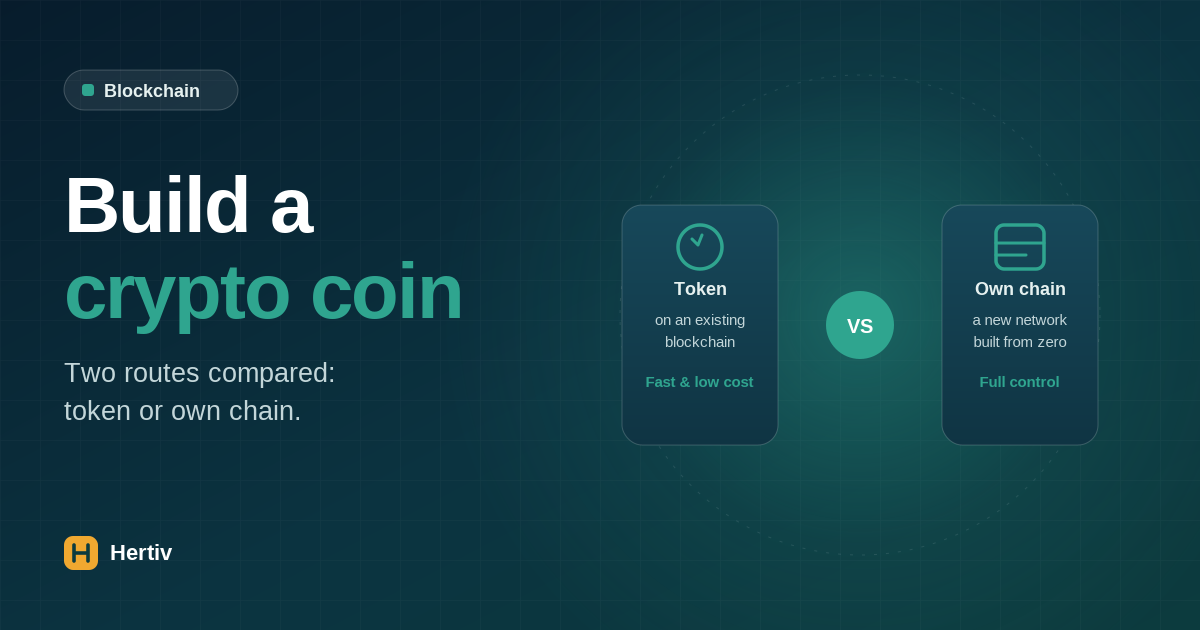
Businesses can build a crypto coin in two main ways: launch a token on an existing blockchain, or build a new blockchain of their own. The first way is faster and cheaper; the second gives full control over the rules of the network.
| Aspect | Token on an existing chain | Own blockchain |
|---|---|---|
| Time to launch | Days to weeks | Months |
| Build cost | Low | High |
| Control over rules | Limited by the host chain | Full control |
| Security | Inherited from the host chain | Must be built and tested |
| Team needed | Small, smart contract skills | Large, protocol skills |
| Best for | Payments, rewards, fundraising | New networks, custom consensus |
| Maintenance | Light | Heavy, ongoing |
| Examples of the approach | Tokens on Ethereum or Solana | Standalone chains |
Most businesses start with a token. Building a chain only makes sense when the product needs rules that no existing chain can provide.
Before either route, check the legal position. A coin sold to raise money can fall under securities rules in many countries, and the rules differ by where buyers live. Get legal advice before launch, and design the token so its purpose inside the product is clear from the start. That advice is cheaper than fixing a launch that broke a rule.
Launch a token on an existing blockchain
1. Launch a token on an existing blockchain: best for speed and low cost
Launching a token means writing a smart contract on a chain such as Ethereum or Solana that creates a fixed supply of tokens and defines how they move. The token rides on the host chain's security, wallets and exchanges, so the business does not need to run any network infrastructure of its own.
The work is mostly design and audit: decide the supply, the distribution, what the token does in the product, and how it is governed. Then write the contract, test it, have it audited by a third party and deploy it. How to create a cryptocurrency covers the token design choices in more detail.
The build and audit steps follow the usual pattern for smart contract development: write tests first, review the code, then hand it to an independent auditor before deployment.
- Pros: fast to launch; low cost; inherits the host chain's security and wallet support.
- Cons: limited control over fees and rules; dependent on the host chain's future.
Build your own blockchain
2. Build your own blockchain: best for full control
Building your own blockchain means creating a new network with its own consensus rules, token economics and validator set. The business controls the block time, the fees, the governance and the upgrade path, which suits products that need behaviour no existing chain offers.
The cost is steep. A new chain needs protocol engineers, a security audit of the consensus code, validators willing to run it, wallets and tooling, and a plan for upgrades. It also needs users: a chain with no activity has no security, because its value depends on the validators securing it.
Forking an existing chain's code is a middle path that keeps some control while reusing tested software, but it still leaves the team running a network.
- Pros: full control over rules, fees and upgrades; no dependence on another chain.
- Cons: high cost and long timeline; security and adoption must be built from zero.
What does each way cost and how long does it take?
A token launch is the cheaper path. Design, contract development, testing and a third-party audit for a straightforward token usually take a few weeks with a small team. Costs vary with the audit scope, so get quotes from auditors and see vendor site for current development rates.
The token's running costs are also modest. The business pays network fees on transactions and for any ongoing contract maintenance, but it does not pay to run validators or maintain node software. A token team can often be two or three people after launch, focused on the product rather than the network.
A new blockchain is a different scale of work: protocol design, consensus development, testing, audit, validator setup and tooling take months and a larger team. The ongoing cost is higher too, because the team must run upgrades, monitor the network and support validators. For most businesses, the token path delivers the product months earlier at a fraction of the cost.
Example (hypothetical): a token project budgets $15,000 for contract development, $25,000 for an audit and $10,000 for launch and listing work, a total of $50,000.
A new-chain project budgets $300,000 for protocol work, $80,000 for audit and $70,000 for tooling and validators, a total of $450,000. The gap is why the token route is the default choice.
How to choose between the two ways
The choice comes down to what the product needs the chain to do. Work through these steps before committing to either path.
- Write down what the coin must do. Payments, rewards, access and fundraising all work as tokens; only custom consensus or fee rules need a new chain.
- Check existing chains first. If a chain already offers the speed, fees and wallets you need, a token is the right answer.
- Count the team. A token needs smart contract skills; a chain needs protocol engineers, validators and ongoing operations.
- Price the audit. Both paths need a third-party audit, but a chain audit is far larger and more expensive.
- Plan the launch. A token can list on a decentralized exchange quickly; a new chain must attract validators and liquidity first.
If any step points to a token, build the token. Only build a chain when a specific rule cannot be met any other way.
Common mistakes when building a crypto coin
The most common mistake is building a coin before the product needs one. A token with no use inside a working product is hard to explain to users and hard to keep alive.
Other mistakes include skipping the audit, copying a token contract without understanding it, and promising fixed returns or guaranteed prices. A further mistake is choosing the chain route for a product that only needs a token, which burns months and budget on infrastructure instead of the product. Start with the smallest thing that works, audit it, and grow from there.
Key takeaways
- A token on an existing chain is the fast, low-cost route and suits most business uses.
- A new blockchain gives full control over rules and fees but needs a large team and months of work.
- Both paths need a third-party security audit before launch.
- A coin needs a real use inside a working product; build the product first.
- Never promise returns or a fixed price for a coin.
Frequently asked questions
What is the cheapest way to build a crypto coin?
Launching a token on an existing blockchain is cheapest. It needs a smart contract, testing and an audit, but no network infrastructure, validators or protocol team.
Do I need to build a blockchain to have a coin?
No. Most business coins are tokens on Ethereum, Solana or a similar chain. You only need your own chain when the product needs rules no existing chain provides.
How long does it take to launch a token?
A straightforward token usually takes a few weeks from design to deployment, including testing and audit. A new blockchain takes months.
Is a token as secure as a coin on its own chain?
A token inherits the security of its host chain, which is usually stronger than a new chain with few validators. A new chain must build its security from zero.
What is the biggest mistake when building a crypto coin?
Building the coin before the product needs one, and skipping the audit. Start with a working product, design the token around it, and audit the contract.
Can a token move to its own chain later?
Yes. Several projects start as tokens and migrate to their own chain once they have users and a clear need for custom rules.


