What Does Token Development Cost? A Clear Breakdown
Token development cost depends on the token type, the complexity of its rules, the chain, the audit and the legal work. Here is what each part costs.
On this page
Short answer
Token development cost depends on the token type, the complexity of its rules, the chain it runs on, the depth of testing and audit, and the legal work around it. A simple fungible token costs far less than a token with staking, governance, vesting and compliance checks, and the audit and legal rows are the ones teams most often underestimate.
What is token development?
Token development is the work of designing, building and launching a digital token on a blockchain, including the smart contract that defines it, the rules for how it is issued and used, and the systems that let people hold, transfer and redeem it. A token can represent a currency, a share in a fund, a loyalty point, a ticket, or a unit of a real-world asset.
The work covers more than writing a contract. It includes deciding the token's supply, who can mint or burn it, how it moves between wallets, and what legal and accounting rules apply. A token that is technically sound but has no clear purpose or legal basis is a liability, not a product.
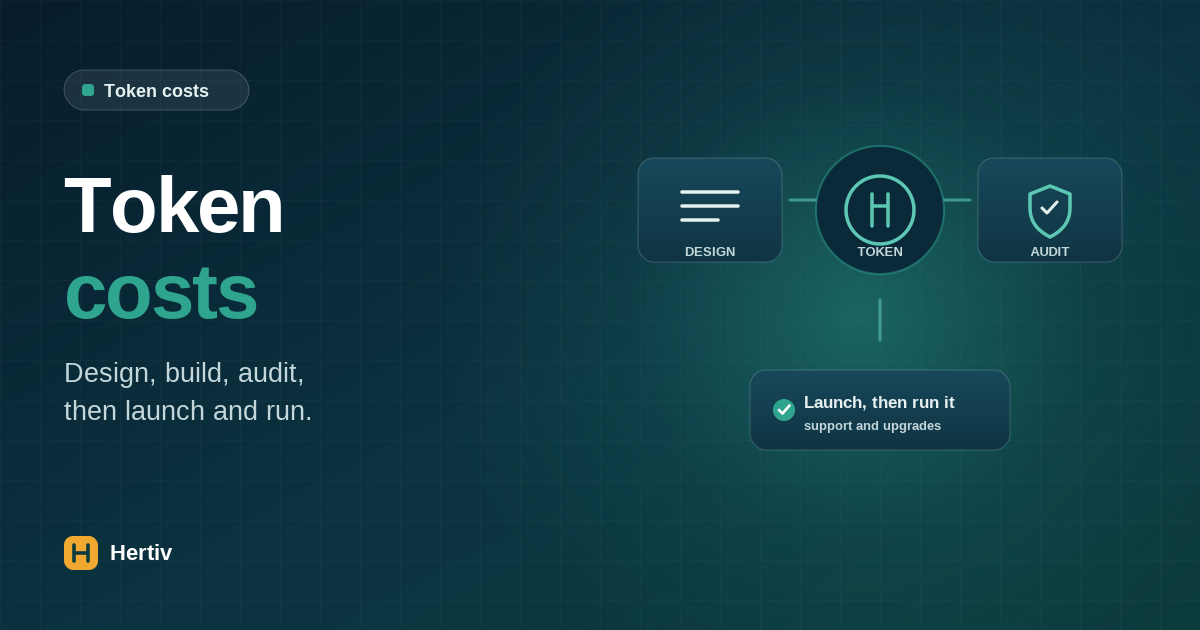
Most token projects follow the same shape: a design phase that settles the economics and the rules, a build phase that writes and tests the contracts, an audit phase that checks them independently, and a launch phase that covers deployment, wallets, exchanges and support. Blockchain development covers the wider build process.
What decides how much token development costs?
Token development cost is decided by the token's type, the complexity of its rules, the chain it runs on, the depth of testing and audit, and the legal work around it. A simple fungible token with fixed supply costs far less than a token with staking, governance, vesting and compliance checks.
| Cost part | What it covers | What changes it |
|---|---|---|
| Design and tokenomics | Supply, distribution, utility and rules | Complexity of the economics |
| Smart contract build | Writing and testing the contracts | Number of features and custom logic |
| Security audit | Independent review of the contracts | Scope, firm and number of rounds |
| Legal and compliance | Structure, disclosures and licences | Jurisdiction and token type |
| Wallets and integration | Custody, transfers and dashboards | Number of systems to connect |
| Launch and listing | Deployment, liquidity and support | Exchanges and market making |
| Running costs | Monitoring, support and updates | Volume and number of holders |
The audit and legal rows are the ones teams most often underestimate. An audit can cost as much as the build itself for a complex token, and legal work varies widely by jurisdiction, so both need a budget line of their own. Smart contract audit explains what an audit covers.
How do token types change the price?
Token types change the price because each type adds different rules to the contract and different obligations around it. A simple token is a few hundred lines of tested code; a token with staking, vesting and compliance checks is several contracts that must work together.
| Token type | Typical complexity | Main cost driver |
|---|---|---|
| Simple fungible token | Low | Design and basic testing |
| NFT collection | Low to medium | Metadata, minting and marketplace integration |
| Governance token | Medium | Voting, delegation and timelocks |
| Staking and rewards token | Medium to high | Reward math, lockups and security |
| Asset-backed token | High | Custody, compliance and reporting |
| Stablecoin | High | Reserves, redemption and regulation |
Asset-backed tokens and stablecoins cost the most because the token is only one part of the system: custody of the underlying asset, proof of reserves, redemption flows and reporting all need building and maintaining. Token development use cases shows what each type is used for.
How to estimate and control the budget
You estimate a token budget by pricing each cost part separately, adding the audit and legal rows as their own lines, and keeping a reserve for fixes found in testing. A single lump sum hides where the money goes and makes it easy to overspend on the build and run out before the audit.
- Write the token rules in one page. Supply, distribution, minting, burning, vesting and governance, with nothing left vague.
- Price design, build and test separately. Ask for a breakdown per phase, not a single number, so you can see where the cost sits.
- Budget the audit as its own line. Set aside funds for the audit and for fixing what it finds, which usually takes a second round.
- Get legal advice early. A short review before the build is cheaper than restructuring a finished token.
- Choose the chain before the build. Fees, tooling and wallet support differ by chain, and switching later is expensive.
- Plan the running costs. Monitoring, support, contract upgrades and holder communication continue after launch.
Keep a reserve of roughly a fifth of the build budget for fixes and changes found in testing and audit. Teams that spend the whole budget on the build usually ship late or skip the audit, which is the worst place to save. Smart contract development covers the build and testing approach.
Example: a small team launches a fungible token
Example (hypothetical): a small team wants to launch a fungible token for a loyalty programme, with fixed supply, a vesting schedule for the team allocation, and a simple rewards rule. The team prices the work in three parts before starting.
Design and build take 320 hours at $90 an hour, which is $28,800. An independent audit costs $18,000, and legal review costs $6,000. The total before launch is $28,800 plus $18,000 plus $6,000, which is $52,800.
After launch, monitoring and support cost $400 a month. Over the first year that is 12 times $400, which is $4,800, bringing the first-year total to $52,800 plus $4,800, which is $57,600. The team keeps a separate reserve for fixes found in the audit, and the audit does find two issues that take an extra week to fix, which the reserve covers without delaying the launch.
Where do token projects overspend?
Token projects overspend most often on scope that grows during the build, on audit rounds caused by late changes, and on launch work that was never budgeted. Each of these is preventable with a frozen design and a realistic plan.
- Scope growth. Adding staking, governance or a marketplace halfway through the build rewrites contracts that were already tested.
- Late changes before audit. Changing the contracts after the audit starts means paying for a second audit round.
- Unbudgeted launch work. Liquidity, listings, wallets and holder support are often forgotten until launch week.
- Cheap audit, expensive fix. A light review that misses issues costs more later than a thorough audit costs now.
- Ignoring running costs. Monitoring, support and upgrades continue for years, and a token with no running budget slowly breaks.
The pattern is consistent: the teams that stay on budget are the ones that freeze the design early, audit once, and treat launch and running costs as part of the project from day one. Cost of launching an ICO covers the launch-side costs in more detail.
What are the common mistakes?
The most common mistakes are starting the build before the economics are settled, skipping the audit to save money, and launching with no plan for support and upgrades. Each of these is cheap to avoid early and expensive to fix after launch.
- Building before the design is settled. Changing supply or distribution after the contracts are written means rewriting and retesting them.
- Skipping the audit. A token with unaudited contracts asks users to trust code nobody independent has checked.
- No legal review. A token that turns out to be a regulated instrument in its market creates problems that no amount of code can fix.
- Copying another token's code. Borrowed contracts carry assumptions and bugs from a project with different rules.
- No plan for holders. Launching without support, communication and a clear redemption or utility path leaves holders stranded.
- Forgetting upgrades. Contracts that cannot be fixed or improved become a liability as soon as the first bug appears.
Token projects also need clear ownership of the contracts, the keys and the compliance work, which is where blockchain development and your legal advisers should be involved from the start.
Key takeaways
- Cost is decided by token type, rule complexity, chain, audit depth and legal work
- Price design, build, audit and legal as separate lines, not a single lump sum
- Asset-backed tokens and stablecoins cost the most because custody and reporting add work
- Keep a reserve for fixes found in testing and audit
- Scope growth and late changes before audit are the biggest sources of overspend
Frequently asked questions
How much does it cost to create a simple token?
A simple fungible token with fixed supply is the cheapest kind to build, since the contract is short and well understood. The cost still includes design, testing, deployment and basic support, and prices vary by vendor and chain, so ask for a breakdown per phase and see vendor sites for current rates.
Is a security audit really necessary for a token?
Yes. An independent audit checks the contracts for bugs that could let someone mint unlimited tokens, drain funds or freeze transfers. Skipping it saves money once and risks far more later, and most serious partners and exchanges expect an audit before they work with a token.
What is the most expensive part of token development?
It depends on the token. For simple tokens the build is usually the largest line; for complex or asset-backed tokens the audit and legal work can cost as much as the build. Launch work, such as liquidity and listings, is a separate cost that teams often forget to budget.
Does the choice of blockchain affect the cost?
Yes. Fees, tooling, wallet support and developer availability differ by chain, and switching chains after the build means rewriting and retesting the contracts. Choose the chain before the build, based on where your users and wallets already are.
Can I launch a token without a lawyer?
You can write the code, but the legal position of a token depends on its design and market, and getting it wrong can create serious problems. A short legal review before the build is far cheaper than restructuring a finished token.
What are the ongoing costs after a token launches?
Monitoring, support, contract upgrades, holder communication and reporting continue after launch. Budget a monthly amount for these, since a token with no running budget slowly breaks as chains, wallets and rules change.


