How Much Does It Cost to Launch an ICO?
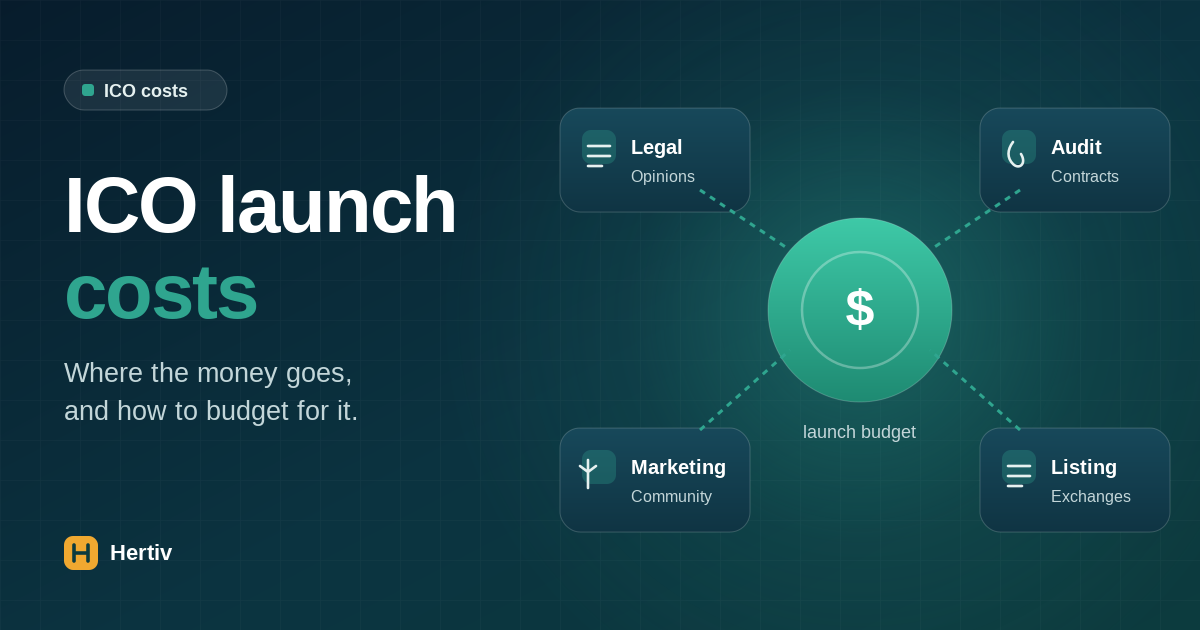
Launching an ICO usually costs a five- or six-figure sum once legal work, audits, marketing and listings are added up. Here is where the money goes.
On this page
Short answer
Launching an ICO typically costs a five- or six-figure sum in total. The largest items are usually legal structuring, a smart contract security audit, tokenomics design, marketing and community work, and exchange listings. The final figure depends on the jurisdictions you sell into, the complexity of the token contracts, and how much work your team does in-house.
What does launching an ICO cost?
The cost of launching an ICO is the total of legal work, smart contract development and audits, tokenomics, marketing and exchange listings, and it usually reaches a five- or six-figure sum. The final figure depends on the jurisdictions you sell into, how complex the token contracts are, and how much of the work your team does in-house.
There is no single price for an ICO because the work is not one job. It is a legal project, an engineering project and a marketing project running at the same time, and each part has its own suppliers, timelines and risks. A small sale in one friendly jurisdiction costs far less than a global sale with several legal opinions.
| Cost item | What it covers | Rough planning range |
|---|---|---|
| Legal structuring | Entity, counsel, legal opinions | $20,000–$80,000 |
| Smart contracts and audit | Token contracts and security audit | $30,000–$100,000 |
| Tokenomics and whitepaper | Allocation design and documents | $10,000–$40,000 |
| Marketing and community | Content, events, community staff | $30,000–$150,000 |
| Exchange listings | Listing fees and market making | $20,000–$200,000 |
| KYC and operations | Identity checks, sale platform, support | $10,000–$40,000 |
The ranges above are rough planning figures, not quotes. Get a written quote for each item before you set a budget, and keep a reserve of 15 to 20 percent for surprises. For the full launch sequence behind these costs, read how to launch an ICO.
What does the legal work cost?
The legal work is usually the first cost and the hardest to cut, because it decides whether your sale is lawful in the markets you target. Expect to pay for a law firm that understands token offerings, not a general corporate lawyer learning the field on your budget.
Typical legal items include choosing the issuer entity and jurisdiction, drafting the sale terms, reviewing marketing material, and producing a legal opinion that exchanges and banks will ask for. Each jurisdiction you add means more review, because securities rules differ from place to place.
A single-jurisdiction sale with a simple token can cost $20,000 to $40,000 in legal fees. A sale aimed at several regions, with a token that may be treated as a security, can pass $80,000 quickly. Legal opinions alone often cost $5,000 to $15,000 each.
Budget legal work before marketing, not after it. Changing the token structure late means re-doing the opinion, the sale terms and any material already published, and that rework costs more than getting the structure right the first time.
What do smart contracts and audits cost?
Smart contract work covers the token contract, the sale contract and any vesting or lock-up logic, plus a security audit by an independent firm. This is the part of the budget where cutting corners is most likely to end the project, because a contract bug can drain funds or freeze the sale.
A competent developer can write a standard token and sale contract in a few weeks, but the audit is a separate cost and takes time of its own. Audit firms charge by the size and complexity of the code, and a thorough audit of a sale contract usually costs $20,000 to $60,000. Complex contracts with custom vesting, refunds or governance can cost more.
Add time for fixes. The audit will find issues, and the fixes need to be re-checked before you deploy. Plan for at least two audit rounds and a freeze on contract changes once the final version is deployed.
Before you budget this part, read what a smart contract audit is so you know what the audit fee actually buys.
What does marketing and community cost?
Marketing and community work is often the largest variable cost, because it runs for months and scales with ambition. It includes the whitepaper and website, content, social channels, community managers, events and paid promotion, and it starts well before the sale opens.
A modest campaign with a small team, regular content and one or two events can cost $30,000 to $60,000. A large campaign with an agency, influencer work, paid ads and a multi-city roadshow can pass $150,000. The number that matters is not the spend but the cost of reaching real buyers who pass KYC and complete a purchase.
Community management is a running cost, not a one-off. A token sale attracts questions, scams and support requests around the clock, so a team that stops answering after the sale closes will see trust fall fast.
Keep marketing honest. Promising returns or hiding risks is the fastest way to attract regulator attention, and a fine or a forced refund costs far more than any campaign.
What do exchange listings cost?
Exchange listings are the most unpredictable cost in an ICO budget, because fees vary widely by exchange size and by market conditions. A small exchange may list a token for a modest fee, while a large exchange can charge six figures plus a market-making deposit.
Typical listing costs include an application and due diligence fee, a listing fee, and a market-making arrangement so the token trades with reasonable liquidity. Some exchanges also ask for a token allocation instead of, or in addition to, cash. Read every term before you agree, because listing terms can lock up funds for months.
Do not budget for a top-tier listing as a certainty. Large exchanges reject most applications, and a team that has spent its budget chasing one listing may have nothing left for the product. A sound plan lists on one or two credible exchanges first and earns a bigger listing later.
Listing costs also continue after the sale. Market making, exchange compliance checks and token holder support are running costs that last for as long as the token trades.
Example (hypothetical): a $250,000 launch budget
Example (hypothetical): a startup plans an ICO with a $250,000 launch budget and a three-month timeline. It splits the budget across the six cost items so that no single item can eat the whole fund.
The split is: legal structuring $60,000, smart contract development and audit $45,000, tokenomics and whitepaper $15,000, marketing and community $65,000, exchange listings $40,000, and KYC plus operations $10,000. That adds to $235,000, leaving a $15,000 reserve, which is 6 percent of the budget.
Two months in, the audit finds a flaw in the vesting logic. The fix and re-audit cost $8,000, which comes out of the reserve and leaves $7,000. The team also cuts one paid event worth $5,000 to keep the reserve above zero.
The lesson is simple: a budget that spends every dollar on day one has no room for the audit findings, legal changes and delays that almost every launch meets. Keep a reserve and decide in advance what you will cut first.
What are the common mistakes?
The most common ICO budgeting mistakes are treating the sale as a marketing project, under-budgeting legal work and audits, and spending the raise before the product is built.
- Skipping the legal opinion. Exchanges and banks ask for it. Without one, listings stall and partners walk away.
- Budgeting one audit round. Audits find issues. Plan for fixes and a re-check, or the launch date slips.
- Paying for hype, not buyers. Follower counts do not convert. Track KYC completions and purchases instead.
- Forgetting running costs. Listing, market making and support continue after the sale closes.
- No reserve. A budget with no margin turns every surprise into a crisis.
For a fuller picture of the risks behind these costs, read smart contract vulnerabilities before you commit to a launch date.
Key takeaways
- An ICO launch is three projects at once: legal, engineering and marketing, each with its own budget
- Legal work and the smart contract audit are the hardest costs to cut, because they decide whether the sale is lawful and safe
- Marketing is usually the largest variable cost, and it should be judged on KYC completions and purchases, not follower counts
- Exchange listing fees vary widely, so plan for one or two credible listings first and earn a bigger one later
- Keep a reserve of 15 to 20 percent, because audit findings and legal changes almost always add cost
Frequently asked questions
Do I need a lawyer to launch an ICO?
Yes, in practice. A lawyer who understands token offerings structures the sale, reviews the token classification and produces the legal opinion that exchanges and banks ask for. Selling without legal advice risks fines, forced refunds and delisting.
How long does an ICO launch take?
A focused launch usually takes three to six months from decision to sale close. Legal structuring and the audit take the longest, and both should finish before marketing peaks, because changing the token structure late forces rework across every document.
What is the cheapest part of launching an ICO?
The token contract itself is often the cheapest part, because standard token code is well understood. The expensive parts are the legal work, the audit, marketing and listings, which is why a team that budgets only for development runs out of money.
Can I launch an ICO without an exchange listing?
Yes, you can sell directly from your own sale contract, but buyers then have no easy way to trade the token. Most teams plan at least one listing, because liquidity affects whether buyers participate and whether the token holds any value after the sale.
Do audit costs depend on the blockchain?
Partly. The chain affects tooling and developer rates, but the main driver is code size and complexity. Custom vesting, refund and governance logic costs more to audit than a standard token and sale contract on any chain.
What happens to leftover ICO funds?
That depends on the sale terms and the tokenomics you published. Teams usually allocate leftover funds to development, treasury or a reserve, and the allocation should be stated in the whitepaper before the sale opens so buyers know where the money goes.


