Token Development Use Cases: 10 Worth Building
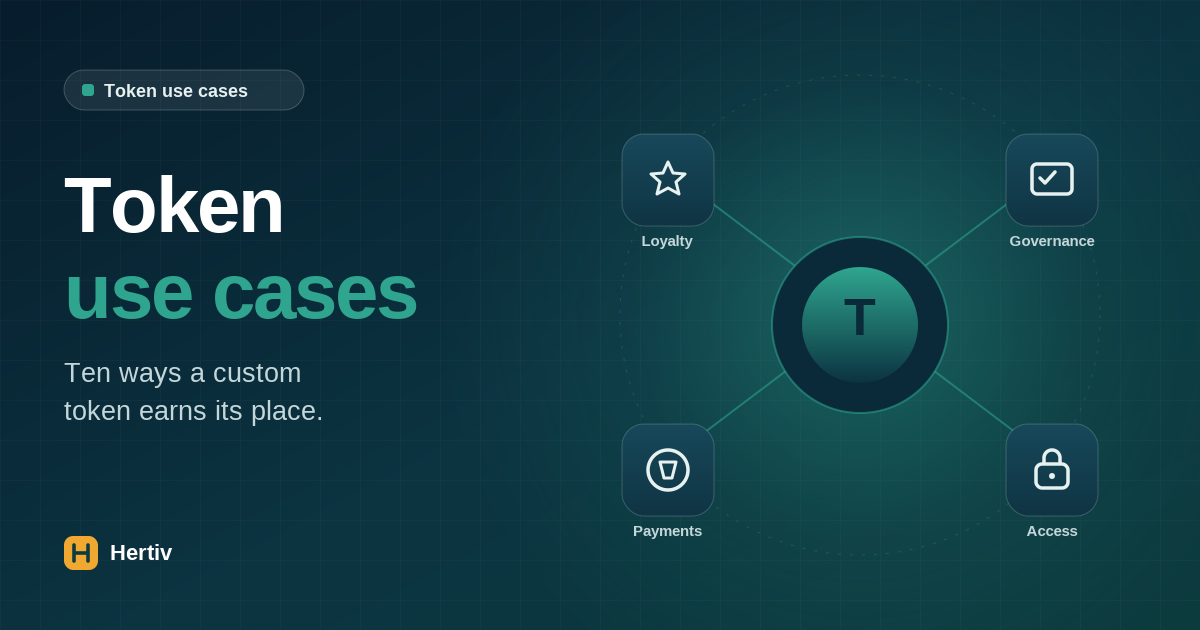
Token development goes far beyond fundraising. These ten use cases - loyalty, governance, payments, access and gaming - show where a custom token earns its place.
On this page
Short answer
The strongest token development use cases are loyalty and rewards, governance, payments and settlement, fundraising, access and membership, in-app currency, asset-backed tokens, supply-chain provenance, creator tokens and stablecoins for business payments. A token works when it gives holders a clear right or reward that is hard to deliver without one.
What are the best token development use cases?
The best use cases give token holders something concrete: a discount, a vote, a payment, access or a share of revenue. If a plain database row could do the same job, a token adds cost without value.
Use this comparison to shortlist. Each use case below explains who holds the token and what it lets them do.
| Use case | Who holds the token | What it gives them |
|---|---|---|
| Loyalty and rewards | Customers | Points that can be spent or traded |
| Governance | Community members | Votes on proposals |
| Payments and settlement | Buyers and sellers | Fast, low-cost transfers |
| Fundraising | Early backers | A stake in the project |
| Access and membership | Members | Entry to gated content or events |
| In-app currency | Players and users | Spending inside the app or game |
| Asset-backed tokens | Investors | A claim on a real asset |
| Supply-chain provenance | Partners and buyers | Proof of origin and handling |
| Creator and community | Fans and supporters | Perks and a share of upside |
| Business stablecoins | Businesses | Stable-value payments |
Start with one use case, not five. A token that does one job well is easier to explain, easier to regulate and easier to keep valuable.
Loyalty, rewards and governance tokens
1. Loyalty and rewards tokens: best for repeat customers
A loyalty token turns points into something customers can keep, spend or trade. Unlike points locked in one shop, a token can move between partners, which makes it more useful and harder to forget.
It fits retailers, airlines and apps with repeat buyers. The token needs a clear earn-and-spend loop, or holders will stop caring about it.
2. Governance tokens: best for community-run projects
A governance token gives holders a vote on proposals: fee changes, feature priorities, treasury spending. It fits DAOs and community projects where decisions should not sit with one team.
Voting only works if holders actually vote, so keep proposals few and meaningful. Low turnout is the most common failure in governance tokens.
Payments, settlement and fundraising tokens
3. Payments and settlement tokens: best for fast transfers
A payment token moves value between buyers and sellers without banks in the middle. It fits marketplaces, freelancers and cross-border trade, where settlement speed and fees matter.
The token needs liquidity and a stable way in and out of fiat, or users will avoid holding it. Most payment tokens therefore pair with a stablecoin or an exchange listing.
4. Fundraising tokens: best for early backers
A fundraising token lets a project raise money from early supporters in exchange for a token with a defined role. It fits startups that want community funding without giving away equity.
Fundraising is the most regulated use case on this list. Get legal advice before selling a token, because the rules differ by country and by token design.
Access, membership and in-app currency tokens
5. Access and membership tokens: best for gated communities
An access token works like a membership card: hold it and you can enter a group, an event or a content library. It fits clubs, courses, conferences and creator communities.
It works best when the membership itself is valuable and the token is just the key. A token that gates nothing worth reaching will not hold its value.
6. In-app currency tokens: best for games and apps
An in-app currency token lets users buy items, open new features or tip creators inside an app or game. It fits games, social apps and creator platforms with an internal economy.
The supply must be managed carefully: too many tokens and prices collapse, too few and users cannot play. A clear sink, such as spending on items, keeps the economy balanced.
Asset-backed and supply-chain tokens
7. Asset-backed tokens: best for fractional ownership
An asset-backed token represents a claim on a real asset, such as property, bonds or commodities. It fits investors who want smaller stakes in assets that are usually hard to divide.
This is the most paperwork-heavy use case, because the token is only as good as the legal claim behind it. See the real-world asset tokenization use cases guide for the details.
8. Supply-chain provenance tokens: best for traceability
A provenance token records each step a product takes from origin to buyer. It fits food, luxury goods and pharmaceuticals, where buyers want proof of origin and handling.
The token is only useful if the data entered at each step is honest. Pair it with inspections or sensor data, or the chain records whatever was typed in.
Creator, community and stablecoin tokens
9. Creator and community tokens: best for fan economies
A creator token lets fans support an artist, writer or streamer and receive perks in return: early access, votes on content, a share of revenue. It fits creators with a loyal audience and a clear perk list.
It fails when the perks are vague or the creator stops engaging. Holders are buying a relationship, not just a token.
10. Business stablecoins: best for stable-value payments
A stablecoin token keeps a steady value, usually tied to a currency, so businesses can pay and receive without price swings. It fits payroll, supplier payments and cross-border trade.
Stablecoins need reserves, audits and compliance work, which is why most businesses use an existing stablecoin rather than issuing their own. See how to launch a stablecoin before building one.
How to choose a token development use case
Choose by the right the token grants, not by the hype around it. If you cannot state the right in one sentence, the use case is not ready.
- List the rights holders need: vote, discount, access, payment or ownership.
- Check whether a database could deliver the same right more cheaply.
- Confirm the legal position for your country and your token design.
- Map the earn-and-spend loop so the token keeps moving.
- Pick one use case for a pilot with a small, real user group.
Before writing code, read what tokenomics is and how supply, distribution and incentives fit together.
If you are building a token for fundraising, how to create a cryptocurrency covers the practical steps.
Common mistakes in token development
Most token projects fail on economics and law, not on code. Teams launch a token before they know who wants it or what it is allowed to do.
- No clear right. A token with no defined benefit is just a coupon with extra steps.
- Skipping legal review. A token sold to the public can be treated as a security in many countries.
- Unbalanced supply. Too much supply kills the price; too little stops people using it.
- No liquidity plan. Holders need a way to buy and sell, or the token is stuck.
- Launching five use cases at once. Each use case needs its own economics; start with one.
For the security angle, what a security token is explains when a token falls under securities rules.
Key takeaways
- A token earns its place only when it grants a clear right: a vote, a discount, access or ownership
- Loyalty, governance and payment tokens are the most proven use cases
- Fundraising and asset-backed tokens carry the most legal weight, so get advice first
- In-app and creator tokens need a working earn-and-spend loop to keep value
- Start with one use case and a small real user group before expanding
Frequently asked questions
What is the most common token development use case?
Loyalty and rewards tokens are the most common, because they fit any business with repeat customers. Governance tokens are close behind for community projects, and payment tokens lead in marketplaces and cross-border trade.
Do I need a token if a database would work?
No. If the right can be delivered with a database row, a token adds cost, complexity and legal risk without value. Build a token only when holders need to transfer, trade or prove the right outside your system.
How much does it cost to develop a token?
Costs vary by chain, audit needs and legal review, and they are hard to quote without a scope. A simple token contract is cheap to write; the audit, liquidity and compliance work cost far more. Get a scoped quote for your use case.
Which blockchain should I build a token on?
It depends on your users, fees and tooling. Ethereum and its layer-2 networks suit most use cases, while Solana, BNB Chain and Polygon fit others. Pick the chain your users already use, not the one with the lowest fees on paper.
Are tokens legal to issue?
It depends on the country and the token design. Some tokens are treated as securities and need registration or an exemption. Get legal advice before selling a token to the public in any country.
What is the difference between a token and a coin?
A coin runs on its own blockchain, such as Bitcoin or Ether, while a token is built on an existing chain using a standard such as ERC-20. Most use cases on this list are tokens, not coins, because they are faster and cheaper to build.


