How Tokenization Works: From Asset to On-Chain Token
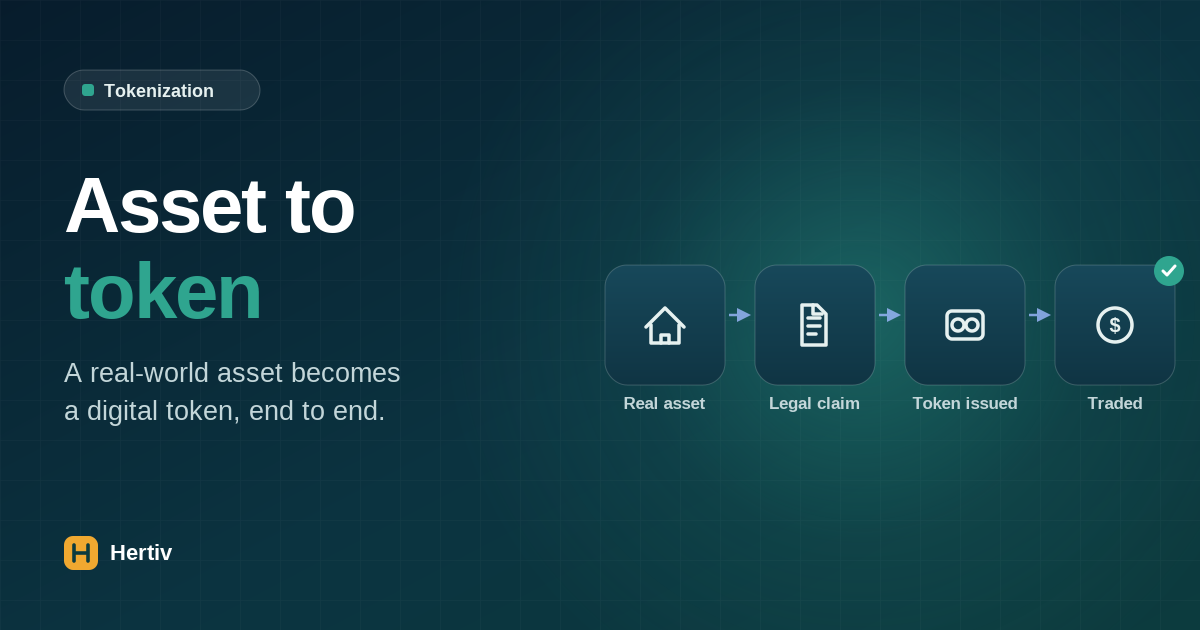
Tokenization turns a real-world asset into a digital token backed by a legal claim. Here is how the process works end to end, and where projects fail.
On this page
Short answer
Tokenization is the process of creating a digital token that represents a claim on a real-world asset, such as a fund share, a commodity or a property. It combines a legal structure, an issuance and registry layer, and on-chain tokens that record ownership and allow transfer.
What is tokenization, in plain terms?
Tokenization is the representation of a real-world asset as a digital token on a blockchain or distributed ledger, where the token carries a legal claim on that asset. The asset does not move on-chain; the record of who owns it does.
The token is only as strong as the structure behind it. A fund share token works because a fund vehicle issues shares and a transfer agent keeps the register. A gold token works because a vault holds bars and an auditor confirms they exist. Remove the legal wrapper or the custody arrangement and the token becomes a number with no claim attached.
That is why teams that treat tokenization as a smart contract task tend to stall. The contract is the visible part. Underneath sit entity setup, offering documents, custody agreements, investor onboarding, tax treatment and reporting. Get those right and the technical layer is usually straightforward.
Use this as a working definition for internal discussions: tokenization is the pairing of an enforceable claim with a transferable digital record, kept consistent over time.
How does the tokenization process work end to end?
The process runs in five stages: define the asset and the claim, build the legal and custody structure, design the token and its rules, connect the registry and issuance systems, then operate and report. Each stage has a gate that should be cleared before the next begins.
- Define the asset. Decide exactly what a token represents: a whole asset, a fraction, a share class, a revenue right or a debt claim. Write down the rights holders get, including cash flows, voting and redemption.
- Build the structure. Set up the issuing entity, prepare offering or subscription documents, choose custody for the underlying asset, and confirm the regulatory path with counsel in each target jurisdiction.
- Design the token. Choose the standard, the chain, divisibility, transfer restrictions, identity requirements and how forced transfers or freezes would be handled if legally required.
- Connect systems. Integrate the token with the cap table or registry, investor onboarding, payment rails and reconciliation, so on-chain supply always matches the official record.
- Operate. Run distributions, corporate actions, audits and reporting, and keep the token supply aligned as assets are added, redeemed or written down.
Example: a hypothetical issuer tokenizes a receivables pool of 200 invoices. Each token represents one unit of a claim on the pool, the registry lists 200 units, and the issuer reconciles on-chain supply against the servicer report monthly. The arithmetic is simple: total tokens outstanding must equal units recorded in the register at all times.
What are the main building blocks of a tokenization platform?
A working platform has four blocks: a token and contract layer, an identity and permission layer, a registry and reconciliation layer, and an operations layer for distributions and reporting. Weakness in any one block shows up later as an operational or compliance problem.
The contract layer holds the token logic. Depending on the asset this can be a standard token, a security token standard with transfer restrictions, or a custom contract. For most regulated assets, upgradeability and admin controls need careful design and independent review.
The identity layer decides who may hold and transfer. Allowlists, investor accreditation checks, jurisdiction blocks and transfer approval hooks are common. This is where tokenization connects to existing know-your-customer and onboarding processes rather than replacing them.
The registry layer keeps the official record of holders in step with the chain. Some issuers run the register on-chain, others keep an off-chain transfer agent system and mirror it. Either way, reconciliation must be automatic and auditable.
The operations layer covers distributions, redemptions, corporate actions and statements. It is unglamorous and it is where most day-two effort goes. A platform team planning this work usually benefits from an experienced partner; Hertiv's RWA tokenization platform development work covers these blocks together.
Which assets are commonly tokenized?
The most common categories today are funds and securities, private credit and receivables, commodities such as gold, real estate interests, and carbon credits. Each has a different legal centre of gravity.
| Asset type | What the token represents | Typical data needed | Main difficulty |
|---|---|---|---|
| Money market or private funds | A share class in the fund | Register, NAV, subscription docs | Transfer agent integration |
| Private credit | A claim on loan cash flows | Loan tape, servicing reports | Reporting and default handling |
| Gold and commodities | A claim on vaulted metal | Vault attestations, bar lists | Custody and audit frequency |
| Real estate | Equity or debt in a property vehicle | Title, valuations, rent rolls | Jurisdiction and liquidity |
| Carbon credits | A retired or held credit | Registry serial numbers | Double-counting prevention |
| Carbon and energy assets | Rights to output or savings | Metering, certification | Data quality from devices |
Fund structures are furthest along because the register and NAV processes already exist. Commodities work when custody and attestation are strong. Real estate and carbon depend heavily on local rules and registry integration. If you are working in a specific vertical, the RWA tokenization guide walks through issuer decisions in more depth.
What legal and compliance questions decide the design?
Four questions drive most design choices: what the token legally is, who may hold it, how it can be transferred, and which regulator has an interest. Answer them before writing contracts.
First, is the token a security, a commodity-like instrument, a payment token or something else in each target market? The answer changes offering documents, marketing rules and secondary trading options.
Second, who is allowed to hold it? Retail, professional and institutional access differ sharply. Transfer restrictions in the contract should mirror the legal restrictions, not invent new ones.
Third, how will transfers be approved and recorded? Some structures require an approved transfer agent to sign off. Others allow peer-to-peer movement within an allowlist. Choose the model that matches the legal documents.
Fourth, what happens on redemption, default or forced transfer? Courts and regulators can require actions that a purely on-chain system cannot perform alone. Admin keys, legal override procedures and clear governance reduce this risk.
Where do tokenization projects usually go wrong?
Most failed or stalled projects go wrong on structure, reconciliation or operations, not on chain choice. The technical build is often the shortest part of the programme.
- No clear legal claim. The token exists but holders cannot point to an enforceable right. Fix this before launch, not after.
- Reconciliation by spreadsheet. On-chain supply drifts from the register, and audits become painful. Automate the match.
- Ignoring the transfer agent. Existing registrars and administrators have real processes. Integrate with them rather than routing around them.
- Underestimating day-two operations. Distributions, statements, tax reporting and redemptions need owners and systems.
- Over-customising the contract. Novel token logic adds audit cost and risk without helping holders.
- Skipping independent review. A smart contract audit is cheap compared with a broken distribution event.
How should a team start a tokenization project?
Start with one asset, one jurisdiction and one investor type, and prove the full cycle from issuance to distribution and redemption. Scope discipline matters more than platform ambition.
A practical sequence looks like this:
- Pick an asset where the register, cash flows and custody are already well understood.
- Confirm the legal treatment and transfer rules with counsel in the launch jurisdiction.
- Map current operations: onboarding, register, distributions, reporting and reconciliation.
- Choose build versus buy for each block, and decide which parts must integrate with existing systems.
- Run a limited pilot with real but small volumes, then expand asset classes or markets.
Budget expectations vary widely with scope, jurisdiction and integration depth; platforms that touch regulated distribution and legacy registries cost materially more than simple issuance tools. Hertiv's breakdown of tokenization platform cost sets out the main cost drivers. Teams that want a second opinion before committing can use a blockchain consulting review to pressure-test the structure.
Key takeaways
- Tokenization is a legal and operational project before it is a technical one
- The token is a record of a claim; the claim itself comes from contracts and custody
- A registry or transfer agent integration keeps on-chain supply matched to real assets
- Permissioned transfer rules and identity checks decide who can hold the token
- Most failures come from unclear legal treatment, not from smart contract bugs
Frequently asked questions
Is tokenization the same as digitization?
No. Digitization converts records into digital form, such as a scanned certificate or a database entry. Tokenization adds a transferable digital token that carries a legal claim on an asset, with ownership recorded on a ledger.
Does a token always mean the asset is owned on-chain?
Not necessarily. Many tokens represent a beneficial interest held through an issuer or custodian rather than direct legal title. The token documents and the issuing structure define what holders actually own and can enforce.
Which blockchain should a tokenization project use?
The choice depends on the asset and audience. Permissioned enterprise ledgers suit regulated distribution with known counterparties, while public networks help with liquidity and interoperability. Compliance, cost and integration needs usually matter more than raw throughput.
How long does a tokenization project take?
A focused pilot on a well-understood asset can take a few months. Full platforms that integrate registries, onboarding and reporting across jurisdictions typically take considerably longer, and legal review often sets the pace rather than engineering.
Can existing investors be moved onto a tokenized structure?
Yes, but migration needs care. The register must be reconciled, consents collected where required, and both records kept consistent during the transition. Plan a period where the old and new registers run in parallel.
What does tokenization not solve?
It does not create liquidity by itself, remove regulatory obligations, or fix weak asset quality. Secondary trading depends on buyers, market rules and disclosure. Treat tokenization as infrastructure, not as a demand generator.


