What Is the Role of Blockchain in Politics?
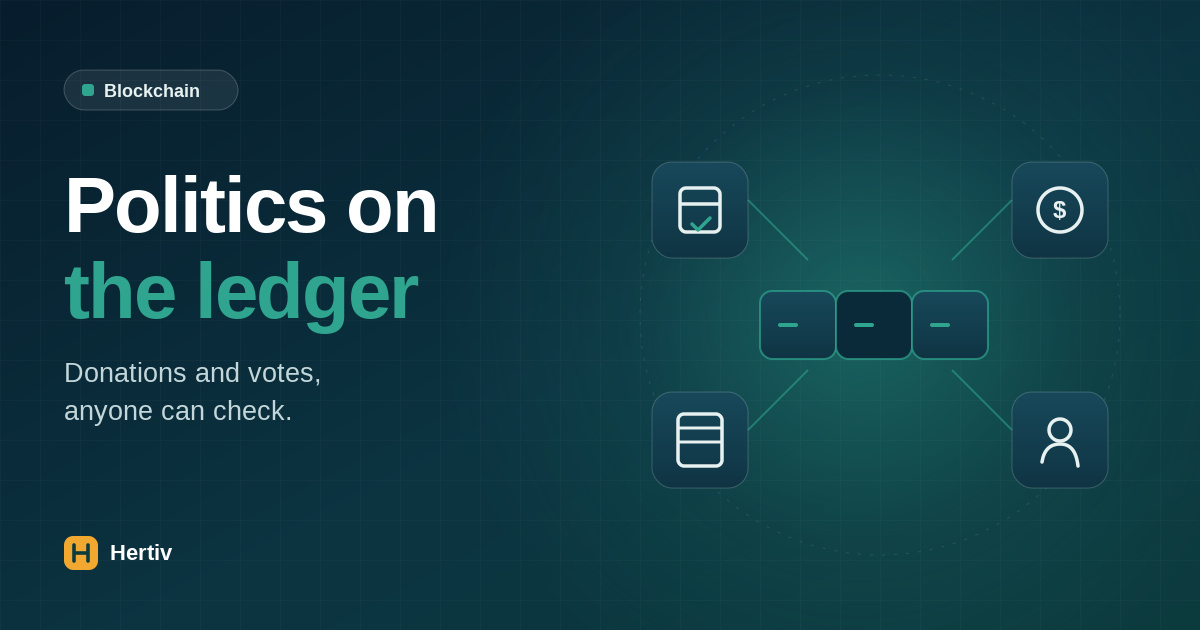
Blockchain in politics is about trust: transparent campaign donations, verifiable voter rolls, auditable party votes and public records that are hard to alter.
On this page
Short answer
Blockchain's role in politics is to make political processes easier to check: it can record campaign donations, voter registrations and party votes on a shared ledger that is hard to alter. It does not run elections on its own, and most uses today are pilots or narrow tools rather than national systems.
What is the role of blockchain in politics?
Blockchain in politics is the use of shared, tamper-resistant ledgers to record political activity — donations, votes, registrations and public records — so that anyone can check what happened. The ledger is the point: instead of trusting a single organisation's database, voters, journalists and watchdogs can verify the record themselves.
Politics runs on trust, and trust is exactly what is hard to prove. A donation record that can be edited after the fact proves little. A record on a public ledger, time-stamped and linked to the records before it, is much harder to change quietly. That is why the first political uses of blockchain are about records and receipts, not about replacing elections.
| Political use | What the ledger records | Who can check it |
|---|---|---|
| Campaign donations | Donor, amount, date | Voters, journalists, regulators |
| Voter registration | Registered voters, changes | Election officials, voters |
| Party votes | Member votes, results | Party members |
| Public spending | Contracts, payments | Watchdogs, citizens |
| Campaign promises | Pledges, deadlines | Voters, media |
Most of these uses are still pilots. No country runs national elections on a blockchain, and the technology sits alongside existing systems rather than replacing them. Blockchain in government covers the public-service side — land records, identity and procurement — while this article covers the political side.
How does blockchain make campaign donations more transparent?
Blockchain makes campaign donations more transparent by recording each donation on a shared ledger as it arrives, with the donor, the amount and the date. Anyone can read the ledger and add up what a campaign received, without asking the campaign to publish a report.
The practical benefit is timing. Traditional donation reports come out weeks or months after the money arrives, and errors surface late. A ledger-based record is visible as donations land, so journalists and regulators can spot unusual patterns — a burst of large donations just before a vote, for example — while the campaign is still running.
The limits are real. A ledger shows what was recorded, not whether the donor is who they claim to be — that still needs identity checks. And a donation routed through an intermediary can still hide its source. Transparency helps, but it does not remove the need for campaign-finance rules.
How is blockchain used in voter registration and elections?
Blockchain is used in voter registration and elections mainly as a record-keeping layer: a tamper-resistant list of who is registered, and a verifiable trail of votes cast. The vote itself is usually counted by existing systems; the ledger adds a check that the count matches the record.
A few places have run small pilots — overseas voters, party primaries and local ballots — where the ledger let voters confirm their own vote was recorded. These pilots are small by design, because elections need to work for everyone, including voters without smartphones or reliable internet. How blockchain voting systems work explains the mechanics step by step.
The risks are well documented: lost keys can lock voters out, a bug in the voting software is harder to fix once votes are on a ledger, and public ledgers can leak information about who voted. That is why pilots stay small and why no country has moved a national election onto a blockchain.
How do political parties use blockchain internally?
Political parties use blockchain mainly for internal votes: leadership elections, policy ballots and candidate selection. Members vote through an app or a web page, and the result is recorded on a ledger that members can check, which reduces disputes about the count.
Parties also use it for membership records and for tracking who is allowed to vote in an internal ballot. A shared membership list is harder to pad with fake members than a spreadsheet held by one office, and it gives local branches the same record as headquarters.
These uses are smaller and easier than national elections, which is why they came first. A party controls its own membership and its own rules, so it can run a pilot without changing any law. The main risk is the same as in public elections: if members lose access to their keys or the software has a bug, the vote is hard to rerun.
Example (hypothetical): a city tracks campaign donations
Example (hypothetical): a city council election has 12 candidates, and the election office asks each campaign to record donations on a shared ledger. Over the campaign, 1,200 donations are recorded, totalling $480,000 — an average of $400 per donation.
Midway through, a watchdog notices that one candidate received 40 donations of $500 each — $20,000 — in a single week, all from donors at the same address. The ledger shows the pattern clearly, and the election office asks the campaign for an explanation. Without the ledger, the pattern would only have appeared in a report filed after the election.
After the election, the office publishes the full ledger. Journalists check the totals: $480,000 recorded, $472,000 in donations under $1,000 and $8,000 in donations of $1,000 or more. The numbers add up, and the public can verify them without asking the office for a copy.
What are the limits and risks?
The limits of blockchain in politics start with the same problem as any record system: the ledger is only as honest as the data put into it. A false donation recorded on a ledger is still false; the ledger only proves it was not changed afterwards.
- Identity. The ledger does not prove a donor or voter is who they claim to be.
- Access. Voters without phones or internet cannot use ledger-based voting.
- Keys. A lost key can lock a voter or member out of a ballot.
- Cost. Running and auditing a ledger system costs more than a spreadsheet.
- Law. Most election law was written before blockchains and does not mention them.
Governments are cautious for these reasons, and most are still at the pilot stage. Why governments are exploring blockchain voting explains what they hope to gain and what holds them back.
What are the common mistakes?
The most common mistakes about blockchain in politics are assuming the ledger guarantees truth, confusing a pilot with a national system, and forgetting the voters who cannot use the technology.
- Treating a ledger record as proof the underlying claim is true
- Calling a small pilot a working national system
- Designing for smartphone users and forgetting everyone else
- Ignoring election law and assuming the technology overrides it
- Publishing a ledger nobody is assigned to read or check
The fix is to treat the ledger as one tool among many. Identity checks, election law and human oversight do the work the ledger cannot do, and the ledger's job is to make that work checkable.
Key takeaways
- Blockchain in politics is about verifiable records: donations, registrations, party votes and public spending
- Campaign donations are the most practical use today, because the ledger shows money as it arrives
- Voter registration and elections use blockchain as a check on existing systems, not a replacement
- The ledger proves a record was not changed, not that the record was true in the first place
- Most uses are still pilots; election law and access for all voters remain the binding limits
Frequently asked questions
Does any country run national elections on a blockchain?
No. A few places have run small pilots for overseas voters, party primaries or local ballots, but no country runs a national election on a blockchain. Most uses are narrow tools or trials that sit alongside existing election systems, not replacements for them.
How does blockchain help with campaign donations?
It records each donation on a shared ledger as it arrives, with the donor, amount and date. Anyone can read the ledger and add up what a campaign received. That makes unusual patterns visible while the campaign is running, instead of weeks later when reports are filed.
Can blockchain stop election fraud?
It can make some fraud harder, such as altering a vote count after the fact, because the ledger is tamper-resistant. It cannot stop fraud at the point of entry: a false registration or a coerced vote recorded on a ledger is still false or coerced. Identity checks and oversight remain essential.
What is the difference between blockchain in politics and in government?
Blockchain in government covers public services such as land records, identity and procurement. Blockchain in politics covers political processes: campaign donations, party votes, voter registration and public spending. The technology is similar; the institutions and the rules are different.
Do voters need a smartphone to vote on a blockchain?
In most pilot designs, yes, which is one of the main limits. Elections must work for everyone, including voters without smartphones or reliable internet. Any system that excludes some voters cannot replace existing voting methods, only sit alongside them.
Is a public ledger enough for transparency?
No. A ledger only helps if someone reads it and acts on what it shows. Campaigns, journalists and regulators need to monitor the record and follow up on unusual patterns. A public ledger that nobody checks is no more transparent than a closed database.