Web3 Metaverse Key Challenges: What Still Blocks It
The Web3 metaverse promises open worlds where users own their items, but standards, scale, safety and cost still hold it back. Here are the key challenges.
On this page
Short answer
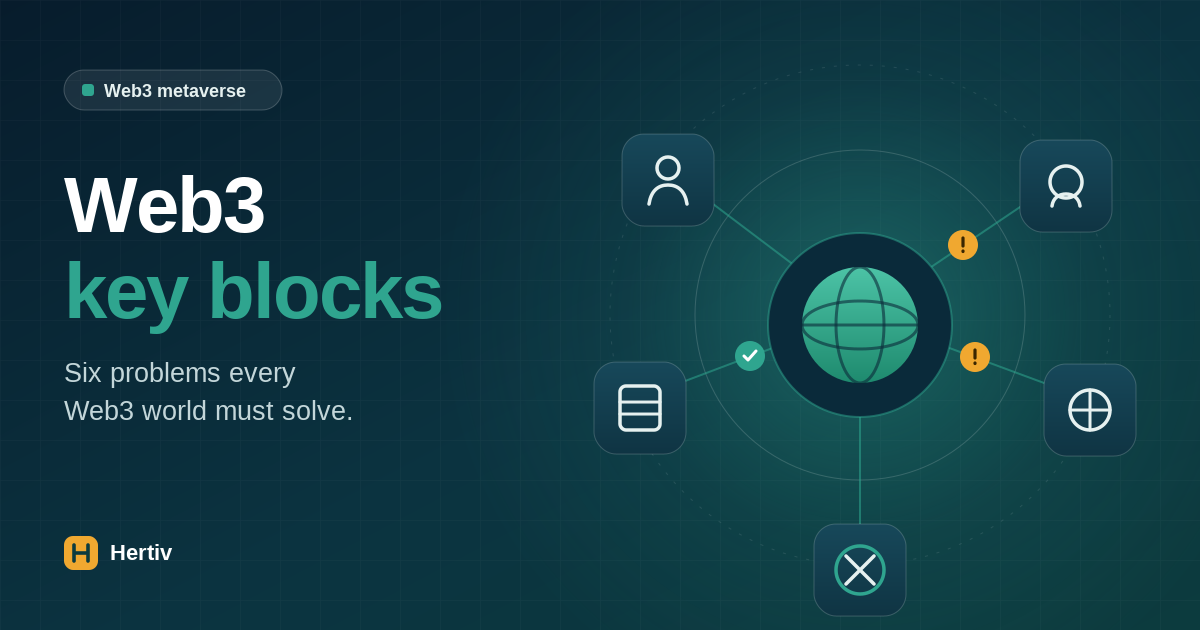
The Web3 metaverse faces a set of linked challenges: assets and avatars rarely move between worlds, networks are slow and costly for real-time use, identity and ownership are hard to prove, and moderation is weak in live 3D spaces. None of these is a single fix; each needs standards, better tooling and honest limits on what a project promises.
What is the Web3 metaverse?
The Web3 metaverse is a set of virtual worlds built on blockchains, where items, land and identities are owned as tokens instead of rented from one company. In a normal online game the company owns your account and can close it. In a Web3 world the items sit in your wallet, so in theory you can take them to another world.
The idea is simple and the execution is hard. Ownership, identity, payments and moderation all have to work across worlds built by different teams with different rules. The challenges below are the ones every serious project runs into.
| Challenge | What breaks | Who feels it | How teams handle it |
|---|---|---|---|
| Interoperability | Items and avatars stay in one world | Users and builders | Shared formats and open standards |
| Identity and keys | Lost keys mean lost assets | Every user | Recovery wallets and social login |
| Scale and cost | Fees and lag in live scenes | Players and hosts | Off-chain play, on-chain settlement |
| Safety | Scams and abuse in live 3D | Users and moderators | Verified contracts and live tools |
| Thin markets | Items with no buyers | Sellers and creators | Smaller drops and real demand |
| Access | Headsets, hardware and bandwidth | New users | Browser and mobile entry points |
None of these challenges means the idea is finished. They mean the useful projects today are narrow ones with a small known audience, such as training and design reviews. How the Web3 metaverse powers the digital economy covers the money side in more depth.
Why is interoperability so hard?
Interoperability is hard because each virtual world is built on its own formats, its own physics and its own idea of what an item is. A jacket that looks right in one world may have the wrong shape, the wrong scale or the wrong texture in another, and the receiving world has no reason to accept it.
The token itself is the easy part. A token can prove you own an item, but it cannot force another world to render it, price it or let you use it. That needs shared file formats, shared item standards and a reason for competing worlds to cooperate. Standards bodies exist, but adoption is slow because each platform wants to keep users inside its own walls.
Teams that take this seriously build for one open format first and accept that items will look simpler in other worlds. They also avoid promising that an item will work everywhere, since that promise is the one most likely to break in front of users.
Who owns identity and assets?
In the Web3 metaverse, identity and assets are tied to a wallet, and the wallet is tied to a private key. Lose the key and you lose the assets, with no support desk to call. That is the sharpest edge of self-ownership, and it is the reason most new users never get past the first step.
Recovery is getting better. Some wallets let a trusted set of contacts or a second device approve a recovery, and some let users sign in with an email while the wallet runs in the background. These designs trade a little control for a lot of safety, and for most consumer projects that trade is worth it.
Ownership also has a fraud problem. Fake copies of popular items, fake shops and links that steal wallet access are common. A buyer should check the contract address and the seller's history before paying, and never sign a transaction they do not understand. For how the two ideas differ, see Web3 vs metaverse. Projects that skip this warning put their users at risk.
Can the networks keep up?
Networks struggle with the Web3 metaverse because live 3D scenes need fast, cheap, constant updates, while blockchains are built for slow, careful settlement. A world with hundreds of players moving, talking and trading at once generates far more data than a chain can record directly.
The common answer is to split the work. The live scene runs off-chain on game servers, and only the important events, such as a sale or a transfer, settle on-chain. That keeps the experience smooth and the costs low, but it also means the world depends on servers run by a company, which weakens the decentralisation claim.
Fees are the other half of the problem. When network fees spike, a small purchase can cost more in fees than the item itself. Teams handle this by batching transactions, using cheaper chains or covering fees for new users, but each fix adds cost or complexity somewhere else.
How do you keep a virtual world safe?
Keeping a virtual world safe is hard because abuse happens live, in 3D, between people who may be anonymous. Harassment, fraud and scams work in virtual worlds too, and moderation is harder when the abuse is a gesture or a voice in a crowd rather than a written message.
Tools help, but they are partial. Block and mute controls let users protect themselves, reporting tools let moderators act after the fact, and age checks keep children out of adult spaces. None of these stops a determined scammer in the moment, so the strongest defence is design: smaller spaces, known audiences and clear rules that are enforced in public.
Privacy is part of safety. A virtual world records where you look, how you move and who you talk to, which is far more personal than a web page visit. A project needs a written policy on what is recorded, who can see it and how long it is kept, and it needs to follow it.
Example (hypothetical): a fashion label sells digital jackets
Example (hypothetical): a small fashion label mints 500 digital jackets at $40 each, hoping to sell them in a Web3 world. In the first month 320 jackets sell, which is $12,800 in sales. The platform takes a 5% fee, which is $640, and network fees add $180, leaving $11,980.
The remaining 180 jackets do not sell. The market is thin: only a few hundred people visit the world each week, and most of them already own a jacket. The label cuts the price by 20% to $32 and sells 90 more, which is $2,880, minus a $144 platform fee and $60 in network fees, leaving $2,676.
Total takings are $14,656 from 410 jackets, with 90 still unsold. The lesson is not that the idea failed. It is that the audience was smaller than the supply, and the fees took about 7% of every sale. A smaller first drop of 200 jackets would have sold out and left buyers wanting more.
What are the common mistakes?
The most common Web3 metaverse mistakes are promising ownership that does not work, ignoring fees, skipping moderation and building for one platform. Each one shows up fast once real users arrive.
- Promising items work everywhere. An item that only renders in your world is not portable. Say where it works and where it does not.
- Ignoring fees. Network fees can exceed the price of a cheap item. Test the full cost of a purchase before launch.
- No moderation plan. A live world without moderators, block tools and clear rules will attract abuse within days.
- No key recovery. If users lose a key and lose everything, they will not come back. Offer recovery from day one.
- Building for one platform. A world that only works on one headset or one chain limits its audience from the start.
Start narrow, with a small known audience and a clear purpose, and grow only when the challenges above have working answers. For the wider picture, what the metaverse is and how it works explains the parts a Web3 world is built from.
Key takeaways
- Interoperability, identity, scale, safety, thin markets and access are the six key challenges.
- Tokens prove ownership, but they cannot force another world to render an item.
- Live scenes run off-chain; only sales and transfers settle on-chain.
- Lost keys mean lost assets, so recovery must exist from day one.
- Start narrow with a small known audience, and grow only when the challenges have answers.
Frequently asked questions
What is the biggest challenge in the Web3 metaverse?
Interoperability is the biggest one, because assets and avatars rarely move between worlds. Each world uses its own formats and rules, so a token that proves ownership cannot force another world to render or accept an item. Shared standards exist, but adoption is slow.
Can I take my items from one Web3 world to another?
Sometimes, but not always. A token can travel with your wallet, yet the receiving world must support the item's format and choose to accept it. Many items only work in the world that sold them, so check where an item works before you buy it.
Why are Web3 metaverse transactions so expensive?
Live scenes need constant updates, while blockchains settle slowly and charge per transaction. When network fees spike, a small purchase can cost more in fees than the item itself. Teams cut costs by batching transactions, using cheaper chains or running the live scene off-chain.
Is the Web3 metaverse safe?
It carries the same risks as any online space, plus wallet theft and fake items. Scams are common, and moderation is harder in live 3D. Check contract addresses, never sign a transaction you do not understand, and use a wallet with recovery options.
What happens if I lose my wallet key?
You lose access to the assets in that wallet, with no support desk to restore them. Some wallets offer recovery through trusted contacts or a second device, so choose a wallet with recovery before you buy anything valuable.
Do I need a headset to use the Web3 metaverse?
Not always. Many worlds run in a browser or on a phone, though the experience is simpler than in a headset. Browser and mobile entry points matter because headsets are expensive and many people feel unwell after an hour inside one.