Web3 vs Metaverse: How They Differ, and Which Fits?
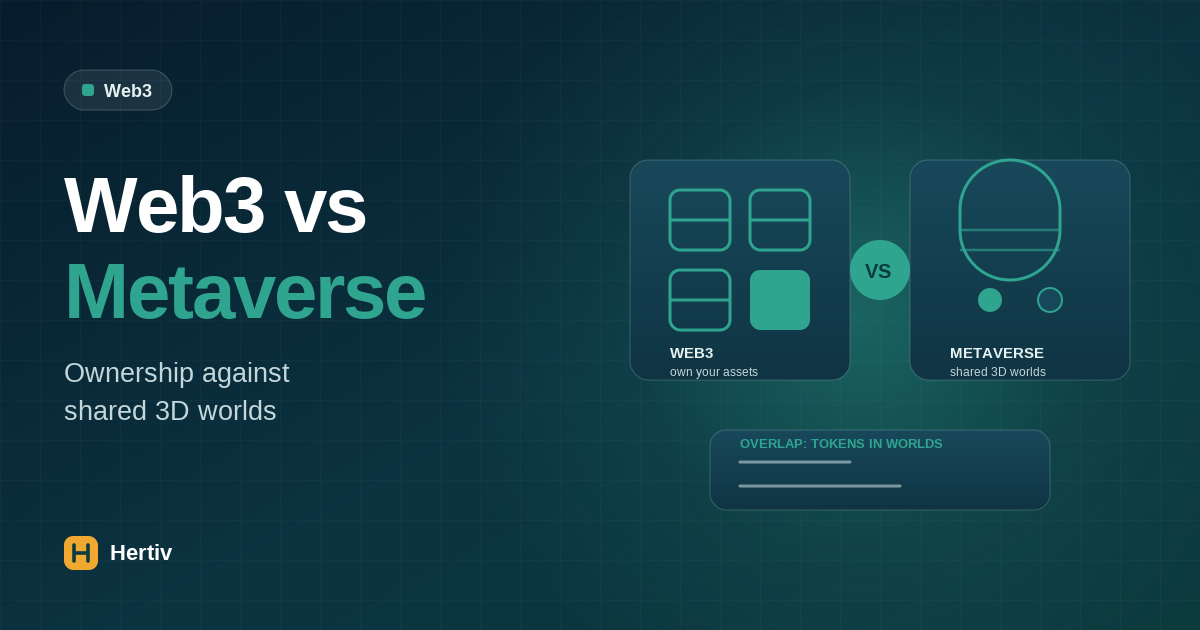
Web3 is about owning data and assets on a blockchain; the metaverse is about shared 3D worlds. They overlap, but they solve different problems.
On this page
Short answer
Web3 and the metaverse are often mentioned together, but they are different ideas. Web3 is a set of blockchain tools that let people own digital assets and control their own data. The metaverse is a set of shared 3D virtual worlds where people meet, play and work. They overlap in places, but they solve different problems.
What is the difference between Web3 and the metaverse?
Web3 is about ownership and control. It uses blockchains, wallets and tokens so people can own digital items, prove who they are, and move assets between apps without asking a central company. The metaverse is about place: 3D worlds where people meet as avatars, attend events, play games and buy virtual goods.
A simple way to tell them apart: Web3 changes who owns and controls digital things, while the metaverse changes where digital life happens. You can use Web3 without any 3D world, and you can build a metaverse world without any blockchain.
| Aspect | Web3 | Metaverse |
|---|---|---|
| Core idea | Own data and assets | Shared 3D worlds |
| Key tech | Blockchains, wallets, tokens | 3D graphics, VR, avatars |
| Main use | Payments, identity, ownership | Meetings, games, events |
| Needs a headset? | No | Often, but not always |
| Central company? | No central owner | Usually one company runs it |
What is Web3?
Web3 is the name for internet apps built on blockchains instead of central servers. Users hold their own wallet, sign in with it, and own their assets as tokens. A token can be money, a membership, a game item or proof of ownership of a real asset.
Web3 matters most where ownership and trust are the problem: payments without a bank in the middle, identity you control yourself, and digital items you can sell or move between apps. If your users do not need to own anything, Web3 adds little.
To see what Web3 looks like in practice, read our guide to what Web3 is, which explains wallets, tokens and smart contracts in plain terms.
When you are ready to build, the top Web3 platforms guide compares the networks and tools teams use most today.
What is the metaverse?
The metaverse is a set of shared 3D spaces where people meet as avatars. It covers virtual offices, concerts, games, training rooms and shops. Some worlds run in a browser, others need a VR headset for the full experience.
The metaverse matters most where being together in a space helps: training that is hard to do in real life, events that feel better live, and games where exploring a world is the point. It is less useful for simple tasks such as paying a bill or reading a document.
Most metaverse worlds today are run by one company, which sets the rules and owns the platform. That is the key difference from Web3, where no single company controls the network.
Building a metaverse world also takes a different team: 3D artists, world designers and game developers, rather than blockchain engineers. The cost comes from creating the world and keeping it fresh, not from smart contracts. A world that never changes loses visitors fast, so teams plan regular events and new spaces from the start.
Where do Web3 and the metaverse overlap?
The two ideas overlap when a virtual world uses blockchain for ownership. In a Web3 metaverse, a player can own land, clothes or items as tokens, sell them to other players, and take them between worlds. The blockchain handles ownership, while the 3D world handles the experience.
Payments are the other overlap. A metaverse shop can take crypto payments, and a virtual event can sell tickets as tokens that prove attendance. In both cases the blockchain is the payment and ownership layer, not the world itself.
But overlap is optional. Many popular virtual worlds use normal payments and company-owned accounts, and many Web3 apps have no 3D world at all. Decide which layer you need first, then add the other only if it solves a real problem for your users.
Games show the overlap best. A player can earn an item in a game, own it as a token, and sell it to another player for real money. The game world provides the fun, and the blockchain provides the ownership record. Without the token, the item stays locked inside one game; without the game, the token has nothing to do.
Which one fits your project?
Choose based on the problem, not the trend. If your users need to own assets, prove identity or move value without a central company, Web3 is the right layer. If they need to meet, train or play together in a shared space, the metaverse is the right layer. Some projects need both; most need only one.
- Name the user problem. Write one sentence about what the user cannot do today.
- Check ownership. If users do not need to own anything, skip Web3.
- Check place. If a 2D screen does the job, skip the 3D world.
- Test small. Build one feature, such as token tickets or a virtual demo room.
- Measure use. Keep the layer only if real users return to it.
Our guide to metaverse use cases shows where shared worlds already help, and where they do not.
Example (hypothetical): a retailer choosing between them
A retailer with 60 shops wants to sell more online. The team considers two ideas: a Web3 loyalty token and a metaverse store. They test both with 200 regular customers over four weeks.
The loyalty token works: 120 of the 200 customers claim a token, and 80 use it for a discount in the second month. The metaverse store draws 60 visits, but only 6 people buy anything, and most say the 3D shop is slower than the website.
The team keeps the token and drops the 3D store. The token solves a real problem, rewarding repeat buyers, while the 3D store adds effort without adding sales. The lesson is to test the user problem first, not the technology.
Common mistakes
The most common mistake is treating Web3 and the metaverse as the same thing. A team that builds a 3D world when it needed token ownership, or adds tokens when it needed a better meeting space, wastes months on the wrong layer.
Other mistakes include assuming users want to own things, ignoring the cost of running a 3D world, and launching without a clear reason for users to return. Each of these is avoided by testing one small feature with real users first.
- Mixing the two ideas. Decide whether you need ownership, place, or both.
- Assuming demand. Test with real users before building a full world.
- Ignoring running costs. 3D worlds and blockchains both need ongoing care.
- No reason to return. A world or token needs a use that repeats, not a one-off visit.
Key takeaways
- Web3 is about owning data and assets; the metaverse is about shared 3D worlds.
- You can use Web3 without a 3D world, and a metaverse world without a blockchain.
- They overlap when a virtual world uses tokens for ownership and payments.
- Pick the layer that solves your users' problem, then test it small.
- Most projects need only one of the two, not both.
Frequently asked questions
What is Web3 in simple terms?
Web3 is a set of blockchain tools that let people own digital assets and control their own data. Users hold a wallet, sign in with it, and own items as tokens, instead of a central company holding everything for them.
What is the metaverse in simple terms?
The metaverse is a set of shared 3D virtual worlds where people meet as avatars to play, work, shop or attend events. Some worlds run in a browser, while others need a VR headset for the full experience.
Are Web3 and the metaverse the same thing?
No. Web3 is about ownership and control using blockchains, while the metaverse is about shared 3D places. They can work together, for example when a virtual world uses tokens for ownership, but each works on its own too.
Do I need Web3 to build a metaverse?
No. Many virtual worlds use normal accounts and payments, and work well without any blockchain. Add Web3 only if your users need to own items, prove identity or move assets between worlds.
Do I need a VR headset for the metaverse?
Not always. Many metaverse worlds run in a web browser or on a phone, with 3D graphics on a flat screen. A headset adds immersion, but it is not required for most meetings, shops or events.
Which is better for a business, Web3 or the metaverse?
It depends on the problem. Web3 fits ownership, payments and identity, while the metaverse fits meetings, training and events. Test one small feature with real users before building either one at full scale.


