Web3 Platforms Worth Building On, and What Each One Does
Ethereum, Solana, Polygon and others call themselves Web3 platforms, but they differ on speed, fees and tooling. Compare six and pick the one that fits your app.
On this page
Short answer
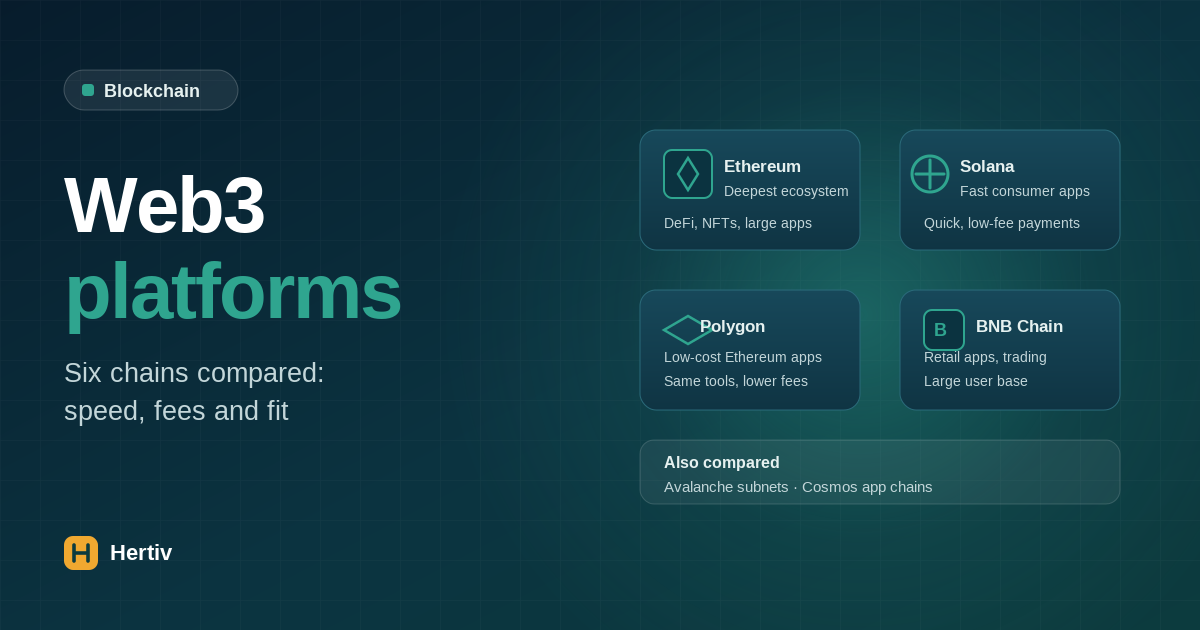
The Web3 platforms worth comparing are Ethereum, Solana, Polygon, BNB Chain, Avalanche and Cosmos. They differ on how fast transactions settle, what each transaction costs, how many developers build on them, and what kind of app each one suits best. The right pick follows the app you are building, not the platform with the loudest following.
Which Web3 platforms are worth comparing?
The Web3 platforms worth comparing are the ones with live apps, real users and tooling a team can actually build with. A platform with a large developer community and tested wallets is a safer place to start than a new chain with a small ecosystem, however good its design looks on paper.
Use this comparison to shortlist two platforms and build a small prototype on each before committing. Fees and speeds change, so see vendor site for current figures.
| Platform | Best for | How it works | Tooling |
|---|---|---|---|
| Ethereum | DeFi, NFTs, large apps | Smart contracts, large validator set | Widest tools and libraries |
| Solana | Fast consumer apps | High-throughput single chain | Strong wallets and SDKs |
| Polygon | Low-cost Ethereum apps | Scaling layers beside Ethereum | Ethereum tools, lower fees |
| BNB Chain | Retail apps, trading | Ethereum-compatible chain | Familiar tools, big user base |
| Avalanche | Custom chains, subnets | Subnets with own rules | Subnet tooling, EVM support |
| Cosmos | App-specific chains | Connected chains, shared tools | SDK for custom chains |
No platform is best in general. Ethereum has the deepest liquidity and the most audited code, while Solana and Polygon suit apps where low fees and fast confirmation matter more. The choice is a trade between reach, cost and control.
Ethereum: best for DeFi, NFTs and large apps
1. Ethereum: best for DeFi, NFTs and large apps
Ethereum is the oldest smart contract platform on this list and the one with the most apps, wallets, audits and developers. If your app needs to connect to lending pools, exchanges or NFT markets, Ethereum is where most of that activity already lives, which makes integrations easier.
The trade-off is cost and speed. Transactions on the main chain cost more and settle more slowly than on the newer chains, which is why many teams build on a scaling layer such as Polygon and settle on Ethereum. For high-value apps where security and reach matter most, that trade is usually worth it.
Pros:
- Deepest ecosystem: most apps, wallets and audited contracts
- Strong security record: long history and large validator set
- Best tooling: libraries, frameworks and testing tools
Cons:
- Higher fees: main-chain transactions cost more
- Slower confirmation: not built for instant consumer payments
- Scaling layers needed: most apps use a layer beside it
Solana: best for fast consumer apps
2. Solana: best for fast consumer apps
Solana is built for speed: transactions confirm quickly and fees are low, which suits consumer apps such as games, payments and trading where users will not wait or pay much per action. Its wallets and developer tools are mature, and its ecosystem has grown around that speed.
The trade-off is reliability history. Solana has had outages in the past, and teams building on it should plan for downtime in the same way they plan for any dependency. For a consumer app where a slow or costly transaction kills the experience, the speed is often worth that planning. How to build on Solana covers the practical steps.
Pros:
- Fast confirmation: transactions settle in seconds
- Low fees: cheap per-transaction costs for users
- Consumer focus: wallets and apps built for everyday use
Cons:
- Outage history: the network has stopped in the past
- Different tooling: not Ethereum-compatible by default
- Smaller DeFi base: less liquidity than Ethereum
Polygon: best for low-cost Ethereum apps
3. Polygon: best for low-cost Ethereum apps
Polygon provides scaling layers that sit beside Ethereum, so teams can use Ethereum's tools and security while paying far less per transaction. An app written for Ethereum can usually move to Polygon with small changes, which is why it is a common first step for teams that find main-chain fees too high.
The trade-off is that the scaling layers have their own security assumptions, and teams should read how each one settles back to Ethereum before trusting it with large value. For apps with many small transactions, such as games or loyalty programmes, the fee saving usually decides the choice. How to build on Polygon covers the steps.
Pros:
- Low fees: far cheaper per transaction than main-chain Ethereum
- Ethereum tools: same contracts, wallets and libraries
- Easy migration: small changes to move an Ethereum app
Cons:
- Own security model: scaling layers settle differently
- Several products: the range takes time to compare
- Less liquidity: smaller pools than Ethereum main chain
BNB Chain: best for retail apps and trading
4. BNB Chain: best for retail apps and trading
BNB Chain is an Ethereum-compatible chain with a large retail user base, built around fast blocks and low fees. It suits trading apps, games and consumer products where users already hold the native token and expect cheap, quick transactions.
The trade-off is centralisation. Fewer validators secure the chain than on Ethereum, and teams that need the strongest decentralisation should weigh that against the reach and the low fees. For a retail-facing app where the audience is already there, the reach often wins.
Pros:
- Large user base: many retail users already hold the token
- Low fees: cheap transactions for everyday use
- Ethereum-compatible: familiar contracts and tools
Cons:
- Fewer validators: more centralised than Ethereum
- Exchange-linked: closely tied to one exchange ecosystem
- Less DeFi depth: smaller pools than Ethereum
Avalanche: best for custom chains and subnets
5. Avalanche: best for custom chains and subnets
Avalanche lets teams launch their own subnets: chains with their own rules, validators and fees, connected to the wider network. That shape suits games, enterprise apps and regulated products that need their own settings while still talking to other chains.
The trade-off is complexity. Running a subnet means running infrastructure and making design decisions that a shared chain makes for you. Teams that only need one app on a shared chain usually find a simpler platform, while teams that need control over the chain itself find Avalanche's model fits.
Pros:
- Custom subnets: own rules, validators and fees
- Fast finality: transactions settle quickly
- EVM support: Ethereum contracts can run on it
Cons:
- More to run: a subnet needs its own validators
- Smaller ecosystem: fewer apps than the larger chains
- Learning curve: subnet design takes planning
Cosmos: best for app-specific chains
6. Cosmos: best for app-specific chains
Cosmos is a set of tools for building your own chain, plus a network that lets those chains talk to each other. It suits teams whose app needs its own chain: a trading app with custom matching, a game with its own economy, or a product where the chain's rules are part of the design.
The trade-off is that you are building and running a chain, not just an app. That takes more engineering, more security review and more operations than deploying a contract on a shared platform. For teams where the chain itself is the product, that work is the point; for everyone else, a shared chain is simpler.
Pros:
- Full control: your chain, your rules, your fees
- Connected chains: chains can pass assets and messages
- Proven SDK: many live chains are built with it
Cons:
- You run a chain: validators, upgrades and security are yours
- More engineering: a bigger build than a smart contract
- Smaller audience: each chain starts with few users
How to choose a Web3 platform
You choose a Web3 platform by matching it to the app, not by picking the chain with the most attention. Start with the users and the transactions, and let those decide.
- Name the transactions. How many per user per day, how much value each one carries, and how fast it must settle.
- Check where the users are. If they already hold a token and use a wallet on one chain, that chain has a head start.
- Check the tooling. Can your team write, test and audit contracts with tools it already knows?
- Test with a small prototype. Deploy the core contract on two shortlisted chains and measure fees and speed on real transactions.
- Plan the audit. Budget for an independent audit before launch, whatever the chain, because a bug in a deployed contract is hard to fix.
If you are building the product itself, a partner for blockchain development can help compare chains on your actual use case rather than on headline figures.
What are the common mistakes?
The most common mistakes when picking a Web3 platform are choosing on hype, ignoring fees, and skipping the audit.
- Choosing on hype. The chain with the most social media attention is not always the one with the users or the tooling your app needs.
- Ignoring transaction costs. A chain that is cheap for the team can still be expensive for users if every action costs a fee.
- Skipping the audit. An unaudited contract is a warning sign to users and exchanges, whatever the chain.
- Locking into one chain early. Design the app so the chain-specific parts are separate, in case you need to move.
- Forgetting wallets. If users cannot connect a wallet they trust, the chain choice does not matter.
These mistakes share one root: the platform was picked before the app was understood. A short prototype on real transactions prevents most of them.
Key takeaways
- Ethereum has the deepest ecosystem; the newer chains compete on speed and fees
- Match the chain to the transactions: value, volume and how fast they must settle
- Polygon and BNB Chain suit low-cost apps; Solana suits fast consumer apps
- Avalanche and Cosmos suit teams that need their own chain and its rules
- Prototype on two shortlisted chains before you commit, and budget for an audit
Frequently asked questions
Which Web3 platform has the most developers?
Ethereum has the largest developer community, the most libraries and the most audited contracts, which is why it is the default choice for DeFi and NFT apps. Solana and Polygon have large communities too, but they are smaller, and their tooling differs from Ethereum's.
Is Solana better than Ethereum?
Neither is better in general. Solana confirms transactions faster and charges less per transaction, which suits consumer apps. Ethereum has deeper liquidity, more audited code and more integrations, which suits high-value apps. Most teams pick by the app, not by the chain.
What is the cheapest Web3 platform to build on?
Fees change with network load, so check current figures on each chain before deciding. In general, Polygon, BNB Chain and Solana charge less per transaction than Ethereum's main chain. The cheapest chain for your app depends on how many transactions your users make and how much value each one carries.
Do I need my own chain to build a Web3 app?
No. Most Web3 apps are smart contracts on a shared chain such as Ethereum, Solana or Polygon. You only need your own chain, using Avalanche subnets or Cosmos, when the chain's rules are part of the product, such as a game economy or a regulated ledger.
Can I move my app from one Web3 platform to another?
Sometimes. Ethereum-compatible chains make the move easier, because the same contracts can run with small changes. Moving to a chain with a different model, such as Solana, usually means rewriting the contracts. Design the app so chain-specific parts are separate, which keeps the move possible.
How do I start building on a Web3 platform?
Pick one platform, write a small contract for your core action, test it on a test network, and have it audited before real value moves through it. A short prototype on a test network teaches you more about the platform than reading its documentation.


