Metaverse Use Cases: Where the Technology Actually Pays Off
Real metaverse use cases today are industrial digital twins, immersive training, remote collaboration and virtual events, plus tokenised ownership. Benefits hinge on data and workflow fit.
On this page
Short answer
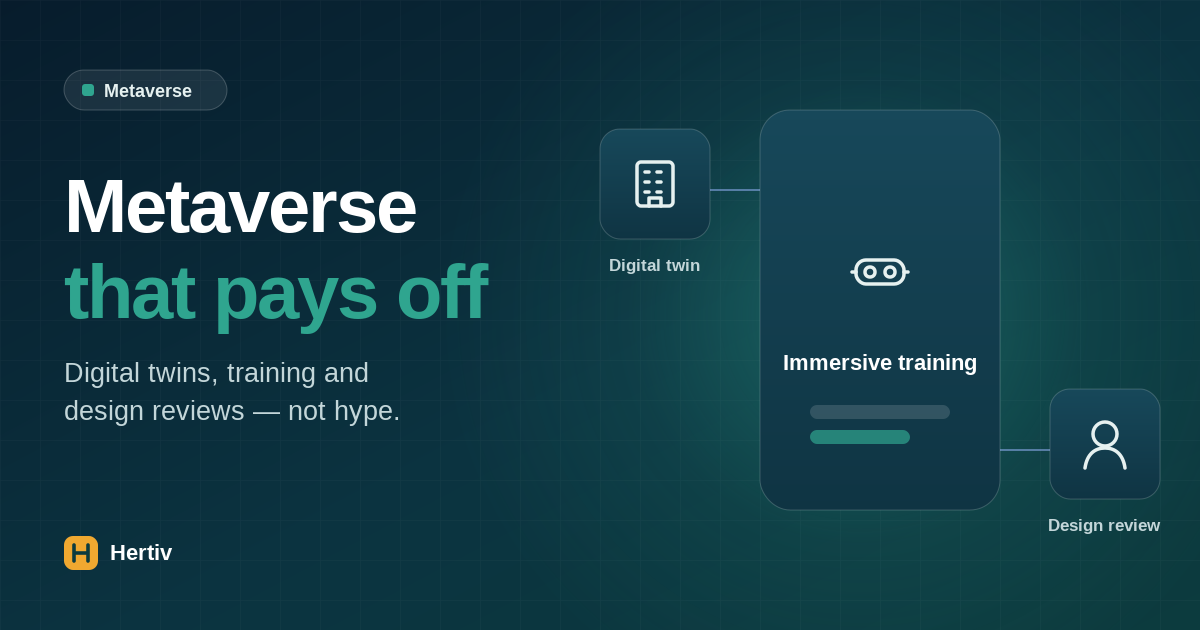
The most defensible metaverse use cases are industrial digital twins, immersive safety and equipment training, remote design reviews, virtual events and tokenised digital ownership. Benefits are faster training, fewer physical prototypes, better remote collaboration and new revenue from virtual goods, but only when the use case already has reliable 3D data and a clear workflow.
What is the metaverse, in practical terms?
The metaverse is a set of persistent, shared 3D environments that people access through browsers, headsets, phones or desktop apps, usually connected to real data and often to digital assets. It is not one product or one platform; it is a pattern for building spatial, multi-user software.
For a technical reader, the useful definition is narrower than the marketing one. A metaverse application combines four things: a 3D scene, real-time synchronisation between users, identity and permissions, and a data layer that ties the scene to something real (a factory floor, a product catalogue, a training record or a digital asset).
This is why most useful deployments look less like a social world and more like a specialised tool: a plant walkthrough, a product configurator, a training simulator or a virtual showroom. The business case usually comes from the data layer, not the graphics. If you cannot name the system of record behind the scene, the project is probably a prototype rather than a product.
A related pattern is tokenised assets inside these environments, covered in the AI and Web3 glossary.
Which metaverse use cases are worth building first?
The use cases that pay off first are the ones that reuse data you already have and replace an expensive physical activity. The table below compares common options.
| Use case | What it does | Typical data needed | Effort |
|---|---|---|---|
| Industrial digital twin | Live 3D view of a plant or asset | CAD, BIM, IoT sensor feeds | High |
| VR safety training | Simulates risky tasks | Procedure docs, 3D models | Medium |
| Remote design review | Teams inspect a 3D model together | CAD, PLM, meeting tools | Medium |
| Virtual showroom | Product exploration with configurators | Product catalogue, media | Medium |
| Hybrid events | 3D venue alongside a real event | Agenda, registrations, streams | Low to medium |
| Tokenised collectibles or access | Digital ownership or gated content | Wallet, contract, rights model | Medium |
| Onboarding and soft-skills VR | Role-play with avatars | Scripts, assessment criteria | Low to medium |
| Spatial data dashboards | 3D view of operational KPIs | BI data, floor plans | Medium |
A useful filter: score each row on whether the underlying data exists, whether a physical alternative is costly, and whether a workflow owner will adopt it. Rows that fail all three are usually demos.
Industrial digital twins and operations
Industrial digital twins are the most mature commercial use case because they connect to systems that already exist: CAD, BIM, historian data and IoT telemetry. The 3D layer becomes an interface to data engineers and operators already maintain.
In practice, a plant or facilities team uses a twin to walk a site remotely, see live sensor values on equipment, and review maintenance history in place. That reduces travel for inspections and shortens the time between an anomaly and a decision. It also gives non-technical stakeholders a shared view during incident reviews.
The hard parts are data quality and update discipline. A twin that drifts from the real asset loses trust quickly, so tie model updates to existing change management rather than a separate process. Start with one line, building or asset class, then extend.
Industrial deployments often sit alongside enterprise blockchain work for provenance and audit trails; see enterprise blockchain development for how those layers are typically separated.
Training, simulation and safety
Immersive training pays off where a mistake is expensive, dangerous or hard to rehearse in reality. Typical examples are heavy equipment operation, lockout procedures, emergency response and high-value maintenance tasks.
VR training works when it measures something: time to complete, steps skipped, error rates, or decisions taken under pressure. Without an assessment layer, it becomes an expensive video. Build the scoring rubric first, then the scene.
The strongest deployments blend formats. A short VR module for the risky step, a desktop or mobile walkthrough for refresher content, and an instructor dashboard for results. This keeps headset time limited and makes the content easier to update.
Costs vary widely by scope and content volume, so treat vendor quotes as ranges tied to the number of scenarios, not as fixed prices. A pilot with one scenario and clear metrics is the safest first step.
Collaboration, events and customer experiences
Remote design reviews and hybrid events are lower-risk entry points. They replace or extend an existing meeting or event and are easy to evaluate against a baseline.
For design reviews, the value is letting distributed teams and suppliers inspect the same 3D model with annotations and permissions. For events, a 3D venue adds reach and replay value but rarely replaces the in-person event; the practical model is a real event with a virtual extension for people who cannot travel.
Virtual showrooms and configurators work when the product is visual and customisable, such as furniture, equipment or property. They need clean product data and a fast loading experience on ordinary devices, not only headsets.
Teams exploring these experiences with AI assistants can start from the AI and blockchain use-case library.
Tokenised ownership and virtual economies
Tokenised ownership is the part of the metaverse story most tied to blockchain, and the part most often oversold. It makes sense when a digital asset needs verifiable ownership, transferability or access rights across platforms.
Realistic uses include gated content and memberships, collectible or access tokens for communities and events, and representation of physical assets such as property or equipment fractions. The token is only as good as the legal and operational model behind it. If ownership, transfer rules and settlement are unclear off-chain, the token adds risk without adding value.
A sound pattern is to keep the authoritative record in a conventional database and use the chain for proofs, settlement or cross-party transfer. That keeps compliance and support manageable while preserving the benefit.
For regulated assets, review the legal wrapper before writing contracts. Hertiv's blockchain consulting engagements usually start with that question rather than with a platform choice.
What benefits can you realistically expect?
The benefits are operational, not promotional. They show up as reduced travel, faster onboarding, fewer physical prototypes and better remote decision-making.
- Training: shorter time to competence and measurable error reduction, when assessment is built in.
- Operations: fewer site visits and faster incident review with a live twin.
- Design: fewer physical models and quicker sign-off across distributed teams.
- Customer experience: broader reach for events and configurable products.
- Digital ownership: new access or membership models, where rights are clear.
The benefits that rarely materialise are broad engagement metrics and vague brand uplift. Treat any claim without a baseline as unproven. Define the metric before the build, and compare against the current process, not against a demo.
Example (hypothetical): a manufacturer runs 20 site inspections a year, each involving two engineers and two travel days. Moving half of them to a twin removes 20 engineer-days of travel. Whether that justifies the build depends on loaded day rates and the cost of keeping the model current, so model both before committing.
How to prioritise and avoid common mistakes
Pick one use case, tie it to a workflow owner and a metric, and keep the first release small.
- List candidate use cases and the system of record behind each.
- Score each on data readiness, cost of the physical alternative and adoption likelihood.
- Choose one with a named business owner and a baseline metric.
- Build a narrow pilot on browser and mobile first, adding headsets only where they matter.
- Decide the scale or stop criteria before the pilot begins.
Common mistakes:
- Building a demo without a data owner or update process.
- Assuming headsets are required; most users will arrive on a laptop.
- Treating tokenisation as a feature rather than a legal and operational decision.
- Ignoring content maintenance costs after launch.
- Choosing a platform before defining permissions, identity and data flows.
For teams weighing build versus buy, a short discovery with a blockchain development company can clarify which layers need custom work.
Key takeaways
- Industrial digital twins are the strongest near-term use case because they reuse existing CAD and IoT data.
- VR training pays off where mistakes are expensive or physically risky, such as heavy equipment and plant operations.
- Virtual events and showrooms work best as a complement to a real event, not a replacement.
- Tokenised ownership adds real value only when property rights and settlement are clear off-chain.
- Start with one workflow and measurable outcome; broad metaverse strategies rarely survive contact with budgets.
Frequently asked questions
Is the metaverse still relevant for enterprises?
Yes, but mostly as specialised 3D software rather than a single shared world. Industrial twins, training simulators and virtual showrooms continue to see business use, while consumer social worlds have been more volatile. The value depends on data integration and workflow fit, not on the label.
Do metaverse use cases require VR headsets?
No. Most enterprise deployments run in a browser or on mobile and desktop, with headsets reserved for tasks where immersion matters, such as safety training or equipment operation. Designing for ordinary devices first widens adoption and reduces support overhead.
How does blockchain fit into metaverse projects?
Blockchain is useful for verifiable ownership, access rights, cross-party settlement and provenance of digital or tokenised physical assets. It is not needed for the 3D experience itself. Keep authoritative records in conventional systems unless multiple parties need a shared, auditable source of truth.
What data do I need for a digital twin?
You need an accurate 3D model, often from CAD or BIM, plus the operational data that makes it useful, such as sensor readings, maintenance records and asset identifiers. A clear update process matters as much as the initial model, because a twin that drifts from reality is quickly abandoned.
How long does a metaverse pilot take?
A narrow pilot with one scenario and a defined metric can often be delivered in a few weeks to a few months, depending on data readiness and content volume. Digital twins and multi-scenario training programmes take longer because they involve integration and content production.
What is the biggest risk in these projects?
Building an impressive scene without a workflow owner or a data process behind it. Pilots that skip the metric, the update cadence and the adoption plan tend to end as demonstrations. Agree the scale or stop criteria with the business owner before development begins.


