How the Web3 Metaverse Powers the Digital Economy
The Web3 metaverse lets people own digital items, sell them and get paid for their work without one company controlling the market.
On this page
Short answer
The Web3 metaverse is a set of online 3D spaces where ownership is recorded on a blockchain instead of in one company's database. That record lets people buy, sell and earn from digital goods, land and services, which is what turns a virtual world into a working digital economy.
What is the Web3 metaverse?
The Web3 metaverse is a set of shared 3D spaces where the things you own are recorded on a blockchain, not in a single company's database. Your avatar, your items, your land and your identity are held in your own wallet, so you can move them between spaces and sell them to other people.
That is the main difference from older virtual worlds. In a game or a social platform, the company owns the database, so it can delete your items, close your account or change the rules. In a Web3 space, the ownership record sits on a public chain, and the company that built the world cannot take your items away by editing its own server.
| Part | What it does | Who controls it |
|---|---|---|
| Wallet | Holds your identity and items | You |
| Blockchain | Records who owns what | The network |
| Smart contract | Runs sales, rents and royalties | The code on chain |
| Virtual space | Shows the world and its places | The builder |
| Token | Pays for goods and rewards | Anyone who holds it |
The economy part comes from trade. When items can be owned and sold by anyone, a market forms around them, and that market is what people mean by the digital economy. If you want the background, read what Web3 is first.
How does the Web3 metaverse power the digital economy?
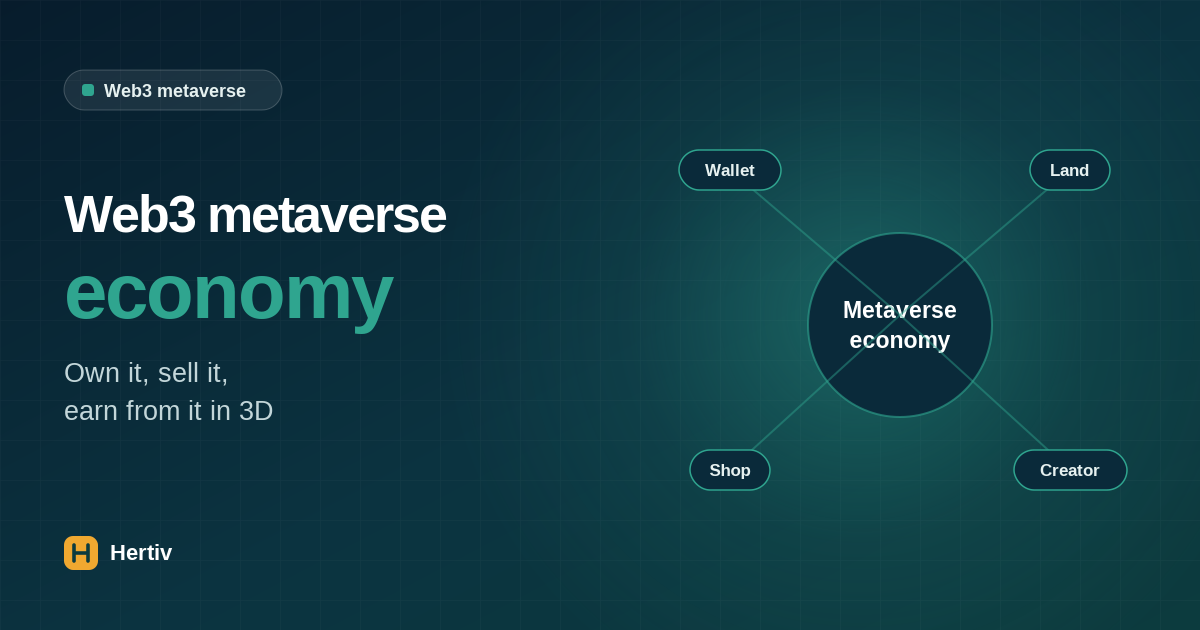
The Web3 metaverse powers the digital economy by making digital goods scarce, portable and tradable. A creator can sell a limited number of digital jackets, a shop can rent a virtual storefront, and a player can sell an item they earned to someone in another country, all without asking a single platform for permission.
Because the ownership record is public, buyers can check that an item is real before they pay. That check replaces the trust a buyer normally places in a big marketplace. A small seller can reach buyers anywhere, and the buyer does not have to trust the seller's word alone.
Payments move the same way. A token payment settles on chain in minutes, and the record is visible to both sides. That cuts out the payment steps that normally take days and charge fees at each step, which matters most for small sales and cross-border sales.
Who earns money in the Web3 metaverse?
Creators earn first. An artist, a designer or a musician can sell digital goods straight to buyers and keep a larger share, because there is no shop taking a cut of every sale. Many creators also earn a royalty each time their item is resold, which is written into the smart contract. See how the wider market works in metaverse use cases for business.
Builders earn next. People who design virtual shops, run events or build games inside the metaverse charge for their work, in tokens or in normal money. A good event space can earn rent from brands that want to meet customers there, and a popular game can earn from the items players trade.
Ordinary users earn too, in smaller amounts. Players sell items they earned, land owners rent out parcels, and guides get paid to show new users around. None of this replaces a salary on its own, but together it forms a market where time and skill can be turned into income.
What does ownership change for buyers and creators?
Ownership changes the balance of power. A buyer who owns a digital item can sell it, lend it or take it to another space, instead of renting access from one company. That makes the item worth more to the buyer, because it is not locked to a single app.
For creators, ownership changes how they get paid. In a normal store, the platform sets the price, takes its fee and controls who sees the work. In a Web3 space, the creator sets the terms in the smart contract, and the sale settles directly between buyer and creator, with the royalty following every resale.
It also changes what can be proven. A buyer can prove they own a ticket, a certificate or a limited item, and a brand can prove it made only a set number of copies. That proof is what makes digital scarcity real, and scarcity is what gives digital goods a price. The comparison with the older model is covered in Web3 vs the metaverse.
What are the risks and limits?
The biggest risk is that the market is thin. Many virtual items have few buyers, so a seller may wait weeks for a sale or find no buyer at all. Prices can swing fast, and an item that sells well one month may not sell the next.
Scams are common too. Fake copies of popular items, fake shops and links that steal wallet access all appear in these spaces. A buyer should check the contract address and the seller's history before paying, and never sign a transaction they do not understand.
The technology also has limits. Virtual worlds need fast connections and good hardware, and moving items between different worlds is still hard. A buyer should treat a Web3 purchase like any other purchase: spend only what they can afford to lose, and check the item before paying.
Example (hypothetical): a small fashion label sells digital jackets
Example (hypothetical): a small fashion label makes 200 digital jackets for avatars and sells each one for 25 tokens. It sells 120 in the first month, which brings in 3,000 tokens. Each resale pays the label a 5 percent royalty, so when 40 jackets change hands again at 30 tokens each, the label earns 60 tokens more.
The label also rents a small virtual shop for 200 tokens a month and runs two events there. At each event it sells 20 jackets at 25 tokens, adding 1,000 tokens over the two events. After rent, the label keeps most of what it earns, because there is no marketplace taking a large fee.
The risk is clear too. If the label makes 200 jackets and only 80 sell, it holds 120 unsold items and earns 2,000 tokens instead of 5,000. That is why the label starts with a small run, tests demand, and only makes more when the first batch sells.
What are the common mistakes?
The most common mistakes in the Web3 metaverse are buying without checking, building without an audience, and treating a speculative market like a safe investment.
- Buying a copy. Check the contract address and the creator's page before you pay, because fake copies are common.
- Building for no one. A virtual shop with no visitors earns nothing, so find the audience before you build the space.
- Spending too much. Prices swing fast, so only spend money you can afford to lose on digital items.
- Ignoring the wallet. If you lose your wallet keys, you lose your items, so keep your recovery phrase safe and offline.
- Trusting a promise. A project that promises high returns with no product is a warning sign, not an opportunity.
Key takeaways
- The Web3 metaverse records ownership on a blockchain, not in one company's database
- Digital goods become tradable when ownership is public and portable
- Creators earn from direct sales and royalties on every resale
- Buyers should check the contract and the seller before paying
- Thin markets and scams are the main risks, so start small
Frequently asked questions
Is the Web3 metaverse the same as the metaverse?
No. The metaverse is any shared virtual world, while the Web3 metaverse adds blockchain ownership, so items and identity are held in your wallet instead of a company's database. Many virtual worlds are not Web3 at all, and many Web3 spaces are small and simple.
Do I need cryptocurrency to use the Web3 metaverse?
In most spaces, yes, at least for buying items or paying fees, because payments settle in tokens. Some spaces let you look around for free, but buying, selling or renting normally needs a wallet with tokens. Check the fees before you sign any transaction.
Can I move my items between different metaverse worlds?
Sometimes. Items built on common standards can move between spaces that support them, but many worlds still use their own formats. Before you buy, check whether the item works in more than one place, because an item that only works in one world is worth less.
How do creators earn royalties in the Web3 metaverse?
The royalty is written into the smart contract that governs the item, so a share of each resale goes back to the creator automatically. The rate is set when the item is created, and it is visible on chain, so buyers can see it before they buy.
Is the Web3 metaverse a safe investment?
No, it is not safe in the way a bank deposit is safe. Prices swing fast, many items have few buyers, and scams are common. Treat purchases as spending on something you want to use, not as a way to earn money, and only spend what you can afford to lose.
What skills do I need to work in the Web3 metaverse economy?
The work is mostly the same as in any digital market: design, building 3D spaces, running events, writing and community work. The extra skill is understanding wallets, smart contracts and how on-chain payments work, so you can build and sell without depending on one platform.


