Metaverse Use Cases That Make Business Sense
Metaverse use cases that hold up commercially: digital twins, immersive training, virtual showrooms, events and tokenized assets, plus how to judge which fits your team.
On this page
Short answer
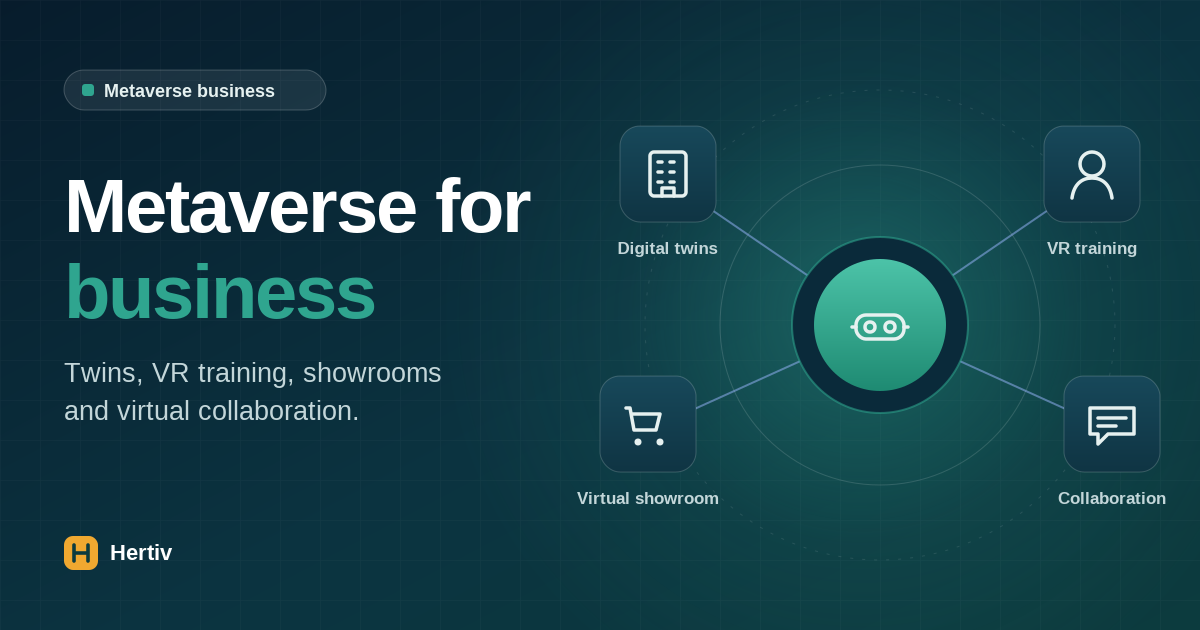
The metaverse is a set of connected 3D environments used for work, training, commerce and collaboration. The use cases that survive scrutiny are digital twins of physical sites, VR training, virtual showrooms, immersive events and tokenized ownership of in-world assets, each tied to a measurable business process.
What counts as a metaverse use case?
A metaverse use case is any business process that runs better inside a persistent, shared 3D environment than it does in a document, a video call or a physical site. The technology is a mix of real-time 3D engines, headsets or browsers, spatial data, and increasingly blockchain for identity and ownership.
The word itself is loose, so treat it as a container rather than a product. A useful filter is to ask what the 3D layer replaces: a site visit, a training room, a trade show stand, a product sample, or a spreadsheet of asset records. If nothing is replaced, the project is usually a demo with a maintenance bill.
The table below summarises the patterns that appear repeatedly in enterprise discussions. Effort is a rough indicator, not a budget.
| Use case | What it does | Typical data needed | Effort |
|---|---|---|---|
| Digital twin | Mirrors a site or asset in 3D with live status | CAD/BIM, sensor and IoT feeds | High |
| VR training | Simulates procedures in a safe space | Procedure manuals, 3D models | Medium |
| Virtual showroom | Lets buyers explore and configure products | Product models, pricing rules | Medium |
| Immersive events | Hosts conferences or launches in a shared space | Venue assets, access rules | Medium |
| Remote collaboration | Shared 3D review of designs or layouts | Design files, user roles | Medium |
| Tokenised assets | Records ownership of in-world or linked items | Wallet identity, contract logic | High |
| Spatial analytics | Tracks movement and attention in a space | Telemetry, consent records | Low |
The rest of this article takes the patterns that hold up commercially and explains where each one fits.
Digital twins of sites and assets
Digital twins are the strongest enterprise entry point because they attach to an existing operational budget. A plant, a data centre, a warehouse or a grid substation already has drawings, maintenance logs and sensor data; the twin gives teams a shared spatial view of all three.
The practical value shows up in three places. Operators can see status and alarms in context rather than in a table. Engineers can rehearse changes, such as a rack move or a line reconfiguration, before touching physical equipment. Planners can compare layouts and simulate flow without building anything.
Data is the hard part, not the graphics. You need a usable model of the asset, a mapping between model elements and real equipment identifiers, and a live feed from sensors or systems of record. Where equipment identifiers are inconsistent, the twin becomes a pretty picture that nobody trusts after the first month.
Twin work also pairs well with on-chain records when several organisations share an asset, because a permissioned ledger can hold a common, auditable history of readings and maintenance events. That pattern appears in energy and industrial settings more often than in retail.
VR training and simulation
VR training works when the real task is expensive, dangerous or hard to schedule. Typical fits are safety drills, machine maintenance, warehouse procedures, clinical workflows and equipment operation in places where you cannot pause production for practice.
The economics are simple to test. Compare the cost of the current method, including instructor time, travel, downtime and equipment wear, against the cost of building and maintaining a simulation. Where a single mistake carries high cost, or where real equipment is scarce, the simulation often clears the bar. Where the task is a short checklist, a video or an interactive web guide is cheaper and just as effective.
Two design choices decide whether training sticks. First, the simulation should score behaviour, not just completion, so managers can see who needs another session. Second, it should be updated whenever the procedure changes; stale training is worse than none because it teaches the wrong steps with confidence.
Example (hypothetical): a site runs 40 maintenance technicians through a two-day course twice a year, with one instructor and travel for half the group. If a simulation replaces one of those days and cuts travel, the saving is mostly instructor and travel time rather than headset cost. The arithmetic only works if the simulation is reused across cohorts and updated in-house.
Virtual showrooms and product configurators
Virtual showrooms suit products where buyers need to see configuration, scale or placement before committing: furniture, kitchens, industrial equipment, vehicles, property and fittings. The 3D layer earns its place when it answers a question a photo cannot, such as whether a unit fits a room or how two finishes look together.
Keep the scope tight. A showroom that mirrors an entire catalogue is expensive to maintain and rarely used beyond the launch. A configurator built around the twenty options that actually drive decisions is cheaper, faster to update and easier to measure through quote requests and conversion.
The connection to your existing stack matters more than the visuals. Pricing rules, stock, lead times and approval limits should come from the same systems the sales team already uses, so a configuration created in 3D becomes a real quote rather than a screenshot sent by email.
For property and equipment, the same models often support tokenised ownership or fractional investment later, which is discussed below.
Immersive events, collaboration and remote review
Immersive events and shared 3D review rooms work when distance or scale makes a physical meeting impractical. Design reviews of buildings, factory layouts and large equipment are the clearest case: several teams need to look at the same model, point at the same part and agree on a change.
The value is in decisions, not attendance. A session that ends with approved changes, flagged clashes and assigned owners is useful; one that ends with a recording nobody watches is not. Build the room around the review workflow: mark up a model, attach a comment, route it to the right owner, close it when resolved.
Large public events are a different business. They depend on audience, sponsorship and content, and the technical build is a fraction of the cost. Most mid-market firms are better served by private spaces for customers, partners or internal teams than by open virtual venues.
Access control, identity and data residency deserve early attention, especially for firms in regulated sectors. A shared 3D space is still a system holding user data, and it should meet the same standards as any other.
Tokenised assets and on-chain identity in virtual worlds
Blockchain enters metaverse work for three reasons: proving who owns something, letting ownership move between parties without a central administrator, and paying creators or rights holders automatically on resale. In-world items, land parcels, tickets, memberships and linked physical assets are the common cases.
The test is whether on-chain ownership solves a real problem. If a single company controls the whole environment and never expects third parties to trade assets, a normal database is simpler and cheaper. If assets are meant to move across environments, carry resale royalties, or represent a claim on something outside the platform, a token model starts to make sense.
Design choices matter more than the chain. You need a clear rule for what the token represents, where the metadata lives, who can mint, how disputes are handled, and what happens if the platform shuts down. Wallets also need to be usable by non-technical customers, which usually means custodial or account-abstraction patterns rather than asking buyers to manage seed phrases.
Tokenised real-world assets follow the same discipline: the legal claim is the product, and the token is a record of it. Teams exploring this area often start with a narrow pilot before committing to a platform.
How to prioritise a metaverse project
Prioritise by the process you are replacing, not by the technology you want to use. A short, disciplined sequence keeps the first project small enough to finish and honest enough to evaluate.
- Name the process and its current cost. Write down what happens today, who does it, how often, and what it costs in time, travel, downtime or errors. Without a baseline you cannot judge the result.
- Check whether 3D is required. If a checklist, video or ordinary dashboard solves it, stop there. The spatial layer should add something the alternatives cannot.
- Confirm the data exists. Identify the models, sensor feeds and system-of-record links you need, and the owner of each. Missing data is the most common reason these projects stall.
- Pick the smallest useful scope. One site, one product line, one training module. Ship it to real users and measure against the baseline.
- Decide on the platform and exit route. Choose hardware and software you can maintain, and document how content and data would be migrated if you changed direction.
If the project needs on-chain records, wallets or smart contracts, bring in blockchain engineering early rather than bolting it on at the end.
Common mistakes
Most failed metaverse projects fail for organisational reasons rather than technical ones. These patterns repeat across sectors.
- Building a showcase with no owner, budget line or success measure.
- Recreating a website in 3D instead of replacing a physical or costly activity.
- Ignoring the system of record, so the 3D view and the real data disagree.
- Assuming users have headsets; many enterprise cases work better in a browser.
- Treating tokens as a marketing feature without rules for ownership, resale and disputes.
- Skipping content updates, which leaves training or showrooms out of date within months.
- Underestimating identity, access control and data protection in shared spaces.
A useful habit is to write a one-page decision record before the build: the process being replaced, the baseline, the data sources, the owner and the kill criteria. It keeps the project honest when enthusiasm outruns evidence.
Key takeaways
- Prioritise use cases where a 3D or spatial model replaces an expensive physical activity, not where it duplicates a website.
- Digital twins of factories, buildings and networks are the most defensible enterprise entry point.
- VR training pays off where mistakes are costly or real equipment is scarce, such as safety and maintenance.
- Virtual showrooms and configurators work best when buyers already expect to customise a product.
- Tokenised in-world assets add real utility only when ownership, resale and royalties need to be enforced on-chain.
- Start with one process, one site or one product line, and set a baseline before building anything in 3D.
Frequently asked questions
Is the metaverse still relevant for businesses?
Yes, but the useful work has moved from public virtual worlds to targeted enterprise applications. Digital twins, VR training, virtual showrooms and shared design review are active areas because they attach to existing operational budgets and can be measured against a physical alternative.
Do metaverse projects always need blockchain?
No. Most enterprise cases run on ordinary databases and real-time 3D engines. Blockchain helps when ownership must be provable across parties, assets need to move between environments, or royalties and rights must be enforced automatically without a central administrator.
Do users need VR headsets?
Often not. Many business cases, including showrooms, configurators and shared model reviews, work in a browser or on a tablet. Headsets are most justified for training and simulation where immersion and hand tracking matter to the task.
How do you measure whether a metaverse use case worked?
Compare against a baseline recorded before the build: time to complete a task, training scores, travel and downtime avoided, quote conversion, or errors caught during design review. If no baseline was captured, the result becomes a matter of opinion.
What is the biggest risk in these projects?
Weak data and unclear ownership. A digital twin or configurator is only as good as the models and system links behind it, and a project without a business owner tends to lose funding before it reaches real users.
Where should a mid-market company start?
Start with one process that already has a measurable cost, such as training for a hazardous task or reviewing a site layout. Keep the scope to one site or product line, run it with real users, and decide on expansion after comparing results with the baseline.


