What Is the Metaverse, and How Does It Work?
The metaverse is a set of connected 3D virtual worlds where people work, learn and shop as avatars. Here is what it is, what it is not, and how it works.
On this page
Short answer
The metaverse is a network of connected three-dimensional virtual worlds where people meet, work, learn and shop as avatars. It is not one product or one company: it is a collection of platforms, devices and standards that let a digital identity move between virtual places.
What is the metaverse?
The metaverse is a shared, persistent set of 3D virtual worlds where people interact as avatars in real time. Unlike a video call or a website, it has space: you move through a place, stand next to other people, and pick things up, even though everything is digital.
Persistent means the world keeps going when you leave. A virtual shop, office or classroom stays where it was, and other people can visit it while you are away. That is what separates the metaverse from a single game session or a video meeting that ends when the call ends.
No single company owns the metaverse. It is a set of platforms, from game worlds to virtual offices, plus the devices and standards that connect them. Metaverse use cases and benefits shows where companies are already using it today.
What are the main parts of the metaverse?
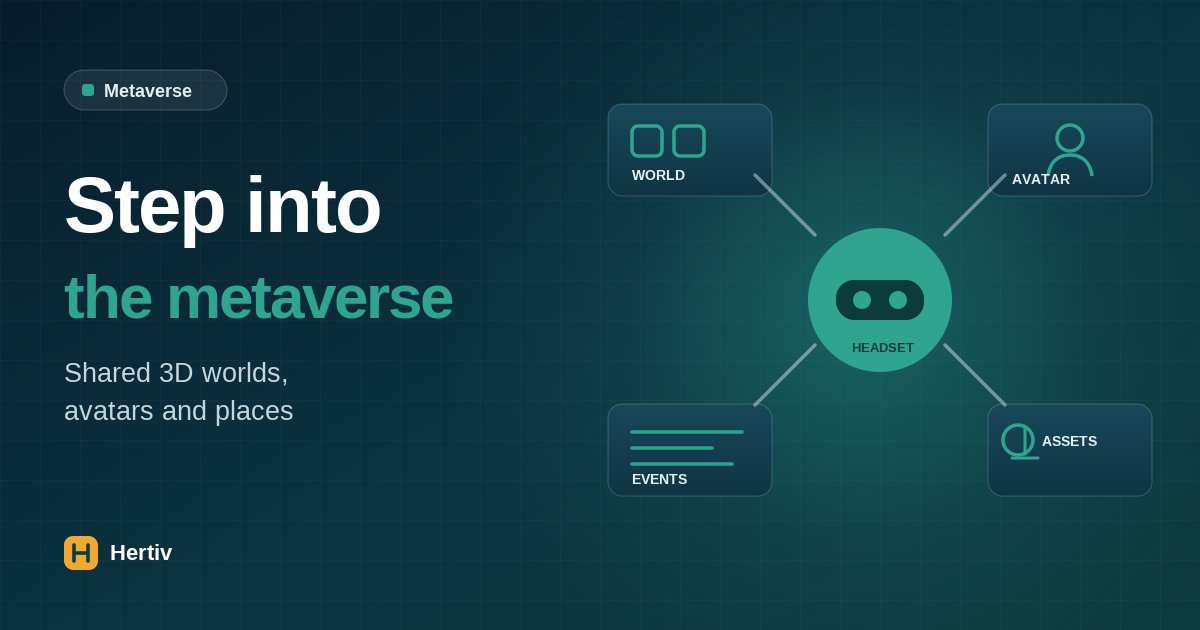
The metaverse is built from six layers, and each one can be built by different companies. The table shows what each layer does and what it looks like in practice.
| Layer | What it does | Example |
|---|---|---|
| Devices | Let people enter virtual worlds | VR headsets, phones, computers |
| Networks | Carry the 3D data fast enough | 5G, fibre broadband |
| Worlds | The places people visit | Virtual offices, shops, classrooms |
| Avatars and identity | Who you are in the world | Custom avatars, digital wallets |
| Assets and payments | Things you own and buy | Virtual clothes, tickets, tokens |
| Rules and standards | Let worlds connect to each other | Open file formats, shared logins |
The weakest layer today is the last one. Avatars, assets and identity mostly stay inside one platform, so moving from one world to another still means starting over. Open standards are the work that will decide whether the metaverse becomes one connected place or stays a set of separate worlds.
How do people use the metaverse today?
People use the metaverse today mostly for work, training, shopping and events, and the uses that work best are the ones where being in a shared space adds something a video call cannot.
- Training. Workers practise dangerous or rare tasks in a virtual copy of the real place, such as a factory floor or a hospital ward, without any risk.
- Meetings and collaboration. Teams meet as avatars around a 3D model, which helps when the work itself is spatial, such as designing a building.
- Retail. Shoppers visit a virtual store, try products on an avatar, and buy without travelling to a shop.
- Events. Concerts, conferences and product launches run in virtual venues that hold far more people than a physical hall.
- Education. Students visit places they cannot reach, such as a historical site or the inside of a machine.
Gaming is still the largest use, because games were 3D worlds long before the word metaverse became popular. The new uses borrow the same technology and apply it to work that used to need travel or physical space.
What technology makes the metaverse work?
The metaverse works through a mix of headsets, 3D engines, fast networks and identity systems, and each piece has to improve before the whole thing feels natural.
Headsets and glasses are the entry point. A VR headset puts you inside the world, while a phone or computer shows a flat view of it. Most people still enter through a screen, because headsets are expensive and tiring to wear for hours.
Game engines render the worlds in real time, and fast networks keep the movement of dozens of avatars in sync. Identity systems, often wallets, hold the avatar, the assets and the payment details, so the same person can be recognised across platforms. The building blocks of the metaverse explains each layer in more detail.
What are the limits and risks?
The metaverse is limited today by cost, comfort, privacy and the lack of shared standards, and each one is a real reason to wait before betting a business on it.
- Cost and comfort. Good headsets are expensive, and many people feel sick or tired after an hour inside one.
- Privacy. A virtual world records where you look, how you move and who you talk to, which is far more personal than a web page visit.
- Standards. Avatars and assets rarely move between platforms, so users are locked into one company's world.
- Safety. Harassment and fraud work in virtual worlds too, and moderation is harder when the abuse happens in real-time 3D.
- Access. A fast connection and a modern device are needed, which leaves out people and places without them.
These limits do not mean the metaverse is a dead end. They mean the useful applications today are narrow ones, such as training and design reviews, where the benefit is clear and the audience is small and known.
Example (hypothetical): a retailer tests a virtual store
Example (hypothetical): a furniture retailer builds a virtual store where shoppers walk through rooms as avatars, move a sofa, and change its colour. The build costs $60,000, and the store runs for three months alongside the retailer's website.
In the three months, 5,000 people visit the virtual store and 400 of them buy something, which is 8% of visitors. The average order is $120, so the store brings in $48,000 of sales. The website, by comparison, converts 2% of its visitors, so the virtual store converts four times better, though from a much smaller audience.
The retailer learns two things. First, shoppers who try furniture in 3D return it less often: 6% of virtual-store orders come back, against 14% of website orders. Second, most visitors arrive from the retailer's own email list, not from the metaverse itself. The retailer keeps the store, but treats it as a better product page, not as a new market.
What are the common mistakes?
The most common mistakes with the metaverse are building a world before knowing who will visit, ignoring comfort and privacy, and treating it as a replacement for a website rather than a different kind of experience.
- Building without an audience. A virtual world with no visitors is an expensive empty room. Find the audience first.
- Ignoring comfort. Long sessions in a headset make people ill. Design for short visits, or for screens as well as headsets.
- Forgetting privacy. Movement and gaze data are personal. Collect as little as possible and say so clearly.
- Copying the website. A virtual copy of a product page adds nothing. The value is in what only a 3D space can do, such as trying a product in place.
- Betting on one platform. Platforms change fast, and an asset that only works in one world can become worthless.
The metaverse overlaps with Web3 in identity and assets, and Web3 vs metaverse explains where the two ideas meet and where they differ.
Key takeaways
- The metaverse is a set of connected 3D worlds, not one product or one company
- It works today for training, design reviews, retail try-ons and events
- The weakest layer is standards: avatars and assets rarely move between worlds
- Cost, comfort and privacy are real limits, so the best uses are narrow and measured
- Start with one use only a shared 3D space can do, and compare it with the video call it replaces
Frequently asked questions
Is the metaverse the same as virtual reality?
No. Virtual reality is a device that puts you inside a 3D world. The metaverse is the set of connected worlds themselves, which you can enter through a headset, a phone or a computer. A headset is one way in, not the metaverse itself.
Do I need a VR headset to use the metaverse?
No. Most people enter through a phone or a computer, which shows a flat view of the 3D world. A headset gives a stronger sense of being there, but it is expensive and tiring to wear for long, so most business uses work fine on a screen.
Who owns the metaverse?
Nobody owns it as a whole. Different companies run different platforms, from game worlds to virtual offices, and the devices and standards come from many firms. That is why moving an avatar or an asset between platforms is still hard.
Is the metaverse the same as Web3?
They overlap but are not the same. The metaverse is about 3D virtual worlds. Web3 is about blockchains, wallets and user-owned data. Web3 tools, such as wallets and tokens, are often used for identity and assets inside the metaverse, but a metaverse world can exist without them.
What is the metaverse used for in business?
The most useful business uses today are training in virtual copies of real places, design reviews around 3D models, virtual stores where shoppers try products, and events in virtual venues. These work because being in a shared space adds something a video call cannot.
Will the metaverse replace websites?
No. A website is faster and easier for most tasks, such as reading, searching and buying something you already know. The metaverse adds value only where a shared 3D space helps, such as trying a product in place or practising a physical task.


