What Are the Building Blocks of the Metaverse?
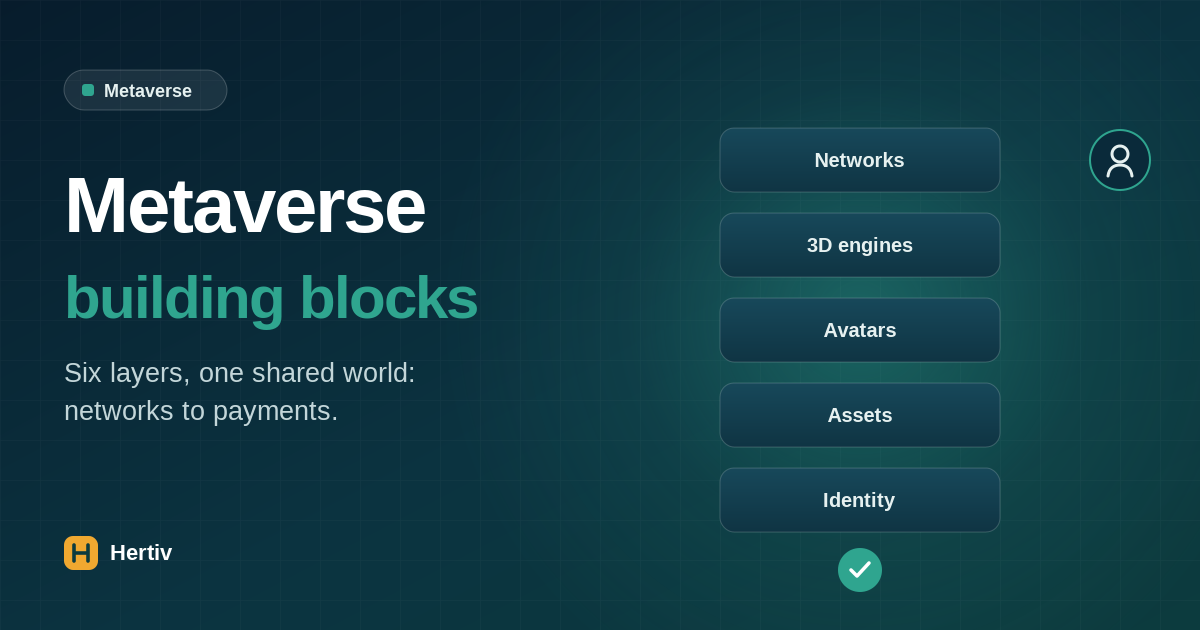
The metaverse rests on six building blocks: networks, 3D engines, avatars, digital assets, identity and payments. Each one must work before the world feels real.
On this page
Short answer
The building blocks of the metaverse are the six layers a shared 3D world needs to work: fast networks, 3D engines that draw the world, avatars that represent people, digital assets that can be owned, identity that travels between worlds, and payments that move value. If one layer is missing, the experience breaks.
What are the building blocks of the metaverse?
The metaverse is a set of connected 3D worlds where people meet, work and play through avatars. It is not one product or one company; it is a stack of layers, and each layer solves a different problem.
| Layer | What it does | What happens without it |
|---|---|---|
| Networks | Move data fast enough for live interaction | Avatars freeze and lag |
| 3D engines | Draw the world and its physics | Flat, empty spaces |
| Avatars | Represent each person in the world | No sense of presence |
| Digital assets | Items that can be owned and traded | Nothing to buy or keep |
| Identity | One account across worlds | New login everywhere |
| Payments | Move money for goods and services | No economy at all |
The layers depend on each other. A great 3D engine means little on a slow connection, and a rich economy means little if identity resets every time you change worlds.
How do networks and 3D engines carry the world?
Networks carry the world. A shared 3D space needs low delay, because an avatar that moves a second late feels broken. Fast broadband and 5G help, and servers placed near users cut the delay further. The world state, where everyone is and what they hold, must stay in sync across all devices.
3D engines draw the world and run its rules: gravity, collision, light and sound. Game engines do most of this work today, and they also handle the devices, from headsets to phones. A world that runs on a phone reaches far more people than one that needs an expensive headset.
The practical question is who your users are. A training world for engineers can demand a headset; a shopping world cannot, because most shoppers will open it on a phone.
What do avatars and identity do?
Avatars are how people appear and how others read them. A good avatar shows where a person looks, what they point at and how they move, which carries most of the social signal in a meeting. Simple avatars work fine for most uses; realistic faces matter less than responsive movement.
Identity is the harder layer. Today each world has its own account, so your name, friends and items do not follow you. The goal is an identity you own, carried between worlds, with the same friends and the same items. That needs shared standards, which are still being agreed.
For the business side of virtual worlds, metaverse use cases and benefits covers where companies already use them.
How do digital assets and payments work?
Digital assets are the items inside the world: land, clothing, tools, art and tickets. Tokens record who owns each item, so it can be bought, sold or carried to another world that accepts it. Without ownership, items are just pictures that any world can copy.
Payments move value for those items and for services inside the world, such as a concert ticket or a training session. Some worlds use normal card payments; others use tokens, which suit cross-border sales but add price swings and wallet friction. The choice depends on the audience: a consumer world needs card payments, while a crypto-native world can use tokens.
How ownership works in general is covered in how tokenization works, which explains what a token represents and how it moves between wallets.
Where is the metaverse actually used?
The metaverse is used today in a handful of places where being together in a space matters more than a video call. Training is one: engineers practise on virtual equipment that would be costly or dangerous to break. Retail is another: shoppers walk a virtual store and try products before buying.
Events and social spaces work too, because a crowd in a 3D space feels different from a chat window. Offices use virtual rooms for teams spread across countries, though many teams still prefer a call for routine work.
The pattern is clear: the metaverse helps where presence changes the outcome, such as training, shopping and events. It adds little where a page or a call already does the job.
Example (hypothetical): a retailer builds a virtual store
Example (hypothetical): a furniture retailer builds a virtual store where shoppers walk the rooms and place sofas in a model of their own living room. The store needs a 3D engine, avatars for shoppers and staff, and payments for orders placed inside the world.
The numbers are small at first. The build costs $90,000 and the store draws 2,000 visits a month. If 5% of visitors buy, that is 100 orders, and at $60 average margin each, the store earns $6,000 a month. It takes 15 months to cover the build, so the retailer treats it as a long-term channel, not a quick win.
For the wider web behind these worlds, what Web3 is explains the shared ledgers and wallets many metaverse projects build on.
What technology runs each layer?
Each layer of the metaverse runs on technology that already exists, put together in a new way. Networks run on broadband, 5G and content delivery networks that place data near users. 3D engines run on game engines that draw worlds and handle physics, sound and device input.
Avatars run on motion tracking and animation systems, from simple headset tracking to full-body capture. Digital assets run on tokens and shared ledgers that record ownership, while identity runs on wallets and account systems that can be carried between worlds. Payments run on card networks, app stores or token transfers, depending on the audience.
No single company owns this stack. The layers come from different vendors and open standards, which is why a world built on one engine can struggle to share assets with a world built on another. Standards for avatars and assets are the missing piece most teams wait for.
What are the common mistakes?
Most metaverse projects fail on the basics: the wrong device, no reason to return, or an economy nobody asked for.
- Building for headsets when the audience uses phones
- A world with nothing to do after the first visit
- Identity that resets every time a user changes worlds
- Token payments for an audience that wants cards
- Spending on realistic faces instead of responsive movement
- No plan for moderation when strangers share a space
Key takeaways
- The metaverse is a stack of six layers, not one product.
- Networks and 3D engines carry the world; without them, avatars freeze and spaces feel empty.
- Avatars carry social signal; identity should travel between worlds.
- Digital assets need ownership records, or they are just pictures.
- It helps where presence changes the outcome, such as training, shopping and events.
- Start with one room and one reason to return.
Frequently asked questions
What is the metaverse in simple terms?
It is a set of connected 3D worlds where people meet through avatars. It is not one app or one company, but a stack of layers: networks, 3D engines, avatars, digital assets, identity and payments.
Do I need a VR headset to use the metaverse?
No, not usually. Most metaverse worlds run on a phone or a computer as well as a headset. A headset adds a stronger sense of presence, but worlds that demand one reach far fewer people.
What is the difference between the metaverse and Web3?
Web3 is the layer of shared ledgers, wallets and tokens that some metaverse projects use for ownership and payments. The metaverse is the 3D world itself. A world can exist without Web3, and Web3 exists without any 3D world.
Can I own things in the metaverse?
Yes, in worlds that record ownership with tokens. Land, clothing and tickets can be bought, sold and sometimes carried to another world. In worlds without ownership records, items stay with the account and cannot be traded.
Is the metaverse only for games?
No. Games were first, but training, retail, events and remote work all use virtual worlds now. The common thread is that being together in a space changes the outcome compared with a video call.
Why do some metaverse projects fail?
Usually because the world has nothing to do after the first visit, the audience uses phones while the project needs headsets, or the economy is built before anyone wants the items. Start small, with one room and one reason to return.


