How Blockchain Voting Systems Work, Step by Step
A blockchain voting system records each vote as a signed entry on a shared ledger, so anyone can check the count while no one can change a vote after it is cast.
On this page
Short answer
A blockchain voting system is a voting system that records each ballot as a signed entry on a shared, tamper-evident ledger. Voters are checked against an eligibility list, each vote is encrypted or anonymised before it is recorded, and the final count can be checked by anyone with access to the ledger without revealing who voted for what.
What is a blockchain voting system?
A blockchain voting system is a voting system that records each ballot as a signed entry on a shared, tamper-evident ledger. Once a vote is written to the ledger it cannot be edited or deleted without the change being visible to everyone who holds a copy.
It is not the same as online voting in general. An ordinary online vote goes to a central server run by one organisation, and voters must trust that server to count honestly. A blockchain system spreads the record across many copies, so changing the result would mean changing every copy at once.
The idea is often compared with paper voting, and the trade-offs are laid out in the post on traditional vs blockchain voting, which weighs speed, cost and trust for each approach.
Most real systems use a permissioned ledger, where only approved nodes can write entries, rather than a public chain anyone can join. The ledger is shared among election officials, auditors and observers, which keeps the record open to inspection without opening it to the whole internet.
How does a vote travel from voter to final count?
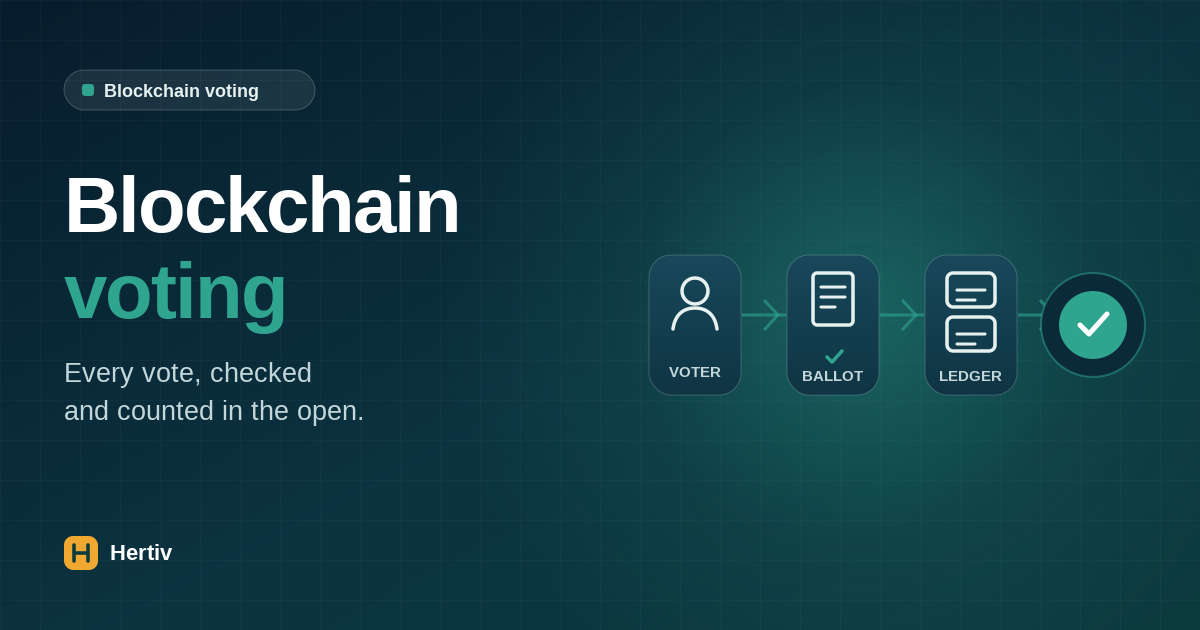
A vote in a blockchain voting system travels through six stages, from checking the voter to publishing the result. Each stage leaves a record, so the path of a ballot can be followed without revealing its contents.
- Registration. A voter is checked against the eligibility list and given a credential, such as a one-time code or a signed key, that proves they may vote once.
- Ballot issue. The voter receives a blank ballot for the election, tied to their credential but not to their identity in the counting stage.
- Vote casting. The voter marks the ballot on a device or at a terminal. The choice is encrypted or mixed with others before it leaves the device.
- Recording. The encrypted ballot is signed and written to the ledger as a transaction. The voter receives a receipt code they can use to check that their ballot is in the ledger.
- Tallying. When voting closes, the encrypted ballots are counted, either by a key shared among several officials or by a counting method that adds votes without opening individual ballots.
- Publication. The final count, the list of recorded ballots and the audit data are published, so anyone can repeat the count and confirm the result.
The receipt code is the voter's main protection. It proves a ballot was recorded, but it does not show how the person voted, so it cannot be used to sell or prove a vote.
How does the system check voters without revealing votes?
The system checks voters without revealing votes by separating identity from the ballot. The identity check happens at registration, the ballot is separated from the identity before counting, and the two are never joined again.
There are several ways to do this. A common one is to give each voter a signed token at registration, then strip the token from the ballot before it is recorded. Another is to mix ballots through several servers so the order is scrambled. A third is to encrypt each vote and count the encrypted values with a method that adds them without opening them.
| Method | How it separates identity and vote | Main risk |
|---|---|---|
| Token stripping | Token is checked, then removed before recording | A faulty step could keep the link |
| Mixing servers | Ballots are shuffled through several servers | Colluding servers could trace a ballot |
| Encrypted counting | Votes are added while still encrypted | Complex to build and audit |
| Separate lists | Who voted is listed apart from how they voted | Timing could link the two lists |
No method is free of trade-offs. The simpler methods are easier to audit but easier to attack, while the stronger methods need more expertise to build and to explain to voters. That tension is the main reason these systems move slowly from trials to real elections.
What are the parts of a blockchain voting system?
A blockchain voting system has five parts: the voter-facing app, the identity check, the ledger, the counting service and the audit tools. Each part has a clear job, and a failure in one part should not quietly change the result.
- Voter app. The screen or terminal where a voter marks a ballot. It must work on ordinary devices, show the choices clearly and confirm the vote was recorded.
- Identity check. The service that confirms a voter is eligible and has not already voted, without passing the voter's identity into the counting stage.
- Ledger. The shared record where signed, encrypted ballots are stored. It must be copied across several independent nodes so no single party can rewrite it.
- Counting service. The code that tallies the ballots and produces the result, run in a way that observers can repeat and verify.
- Audit tools. Public dashboards and verification tools that let any voter check their receipt code and let auditors repeat the count from the published data.
Smart contracts often sit between these parts, enforcing rules such as one vote per credential and a fixed closing time. The contracts themselves need an audit, since a bug in the counting code is a bug in the election. Teams building this kind of system usually start with smart contract development practices for tested, reviewed code.
What are the limits and risks of blockchain voting?
The limits and risks of blockchain voting are mostly about the parts around the ledger: voter devices, identity checks, key handling and the law. The ledger itself is the most reliable part of the system.
A voter's device can be compromised, showing one choice on screen while recording another. A lost or stolen credential can let someone vote as another person. A voter who loses their key may lose the ability to prove their ballot was recorded. None of these are solved by the ledger.
There are also practical limits. Counting encrypted ballots is slower than counting plain ones, and explaining the system to voters takes real effort. If voters do not understand the receipt check, the audit trail adds little trust.
The legal position is unsettled in most places. Election law usually names specific procedures, and a blockchain system must fit them or the law must change. The reasons governments are interested, and the trials run so far, are covered in the post on why governments are exploring blockchain voting.
Example (hypothetical): a members' association runs a vote
Example (hypothetical): a professional association with 3,000 members elects its board online. In past years it used email ballots, and each year a few members complained that their votes were not counted.
The association sets up a permissioned ledger run by five nodes: two at the association, one at its auditor, one at a university and one at a member firm. Each member receives a one-time code by post and votes through a web app. The app encrypts the choice, and the encrypted ballot is written to the ledger with the member's receipt code.
Of the 3,000 members, 2,100 vote. The count takes 20 minutes, and the result is published with the list of receipt codes. A member can check that their code is in the list, and the auditor repeats the count from the published data and matches the result exactly.
The total cost is higher than the old email ballot, and 40 members need help with their codes. The association keeps the system because the complaints about lost votes stop: every voter can now see that their ballot was recorded.
What are the common mistakes?
The most common mistakes in blockchain voting are treating the ledger as the whole system, ignoring the voter device, and skipping the audit that voters can actually use.
- Trusting the ledger alone. A tamper-evident record does not help if the vote was wrong before it reached the ledger. Check the device and the app as carefully as the chain.
- Weak identity checks. If credentials are easy to steal or share, one person can vote many times. The identity step deserves as much work as the counting step.
- No usable audit. A public ledger that nobody can read is theatre. Give voters a simple receipt check and auditors the tools to repeat the count.
- Skipping the paper fallback. When the system fails, there must be a defined way to vote and count by another method, agreed before election day.
- Overpromising. A blockchain system does not remove the need for trust. It moves trust from one central server to the people who run the nodes, the code and the identity checks.
Key takeaways
- Each vote is a signed entry on a shared ledger that cannot be quietly changed
- Identity is checked at registration, then separated from the ballot before counting
- The ledger is the reliable part; devices, keys and identity checks carry most of the risk
- Voters need a receipt code and auditors need tools to repeat the count
- A paper fallback and clear rules matter more than the choice of chain
Frequently asked questions
Is blockchain voting the same as online voting?
No. Online voting usually sends votes to one central server that voters must trust. A blockchain voting system records votes on a shared ledger held by several independent parties, so the record can be checked by anyone with a copy. The identity and device risks are similar in both cases.
Can a voter check that their vote was counted?
Yes, in a well-built system. The voter receives a receipt code when the ballot is recorded and can check that the code appears in the published list. The receipt does not show how they voted, so it cannot be used to prove a vote to someone else.
Why not use a public blockchain for voting?
Most voting systems use a permissioned ledger, where only approved nodes can write entries. A public chain would let anyone join, which adds cost and makes the rules harder to control. The ledger is shared among officials, auditors and observers instead.
What happens if a voter loses their voting credential?
It depends on the system's rules, which should be set before the election. Some systems let the voter request a new credential and cancel the old one; others treat a lost credential as a lost vote. The rule must be public and applied the same way to everyone.
Has blockchain voting been used in real elections?
It has been used in small trials and in votes for organisations, boards and some local polls. Large national elections have mostly stayed with paper or conventional electronic systems, because the legal rules and the scale of the risks are different.
Does blockchain voting remove the need for trust?
No. It moves trust from one central server to the people who run the nodes, write the counting code and check voter identity. A blockchain system makes the record harder to change quietly, but it still depends on honest operators and correct code.


