NFT Marketplace Development Challenges and How to Solve Them
Building an NFT marketplace means solving liquidity, security, fees and fraud before launch. Here are the main challenges and the practical fixes teams use.
On this page
Short answer
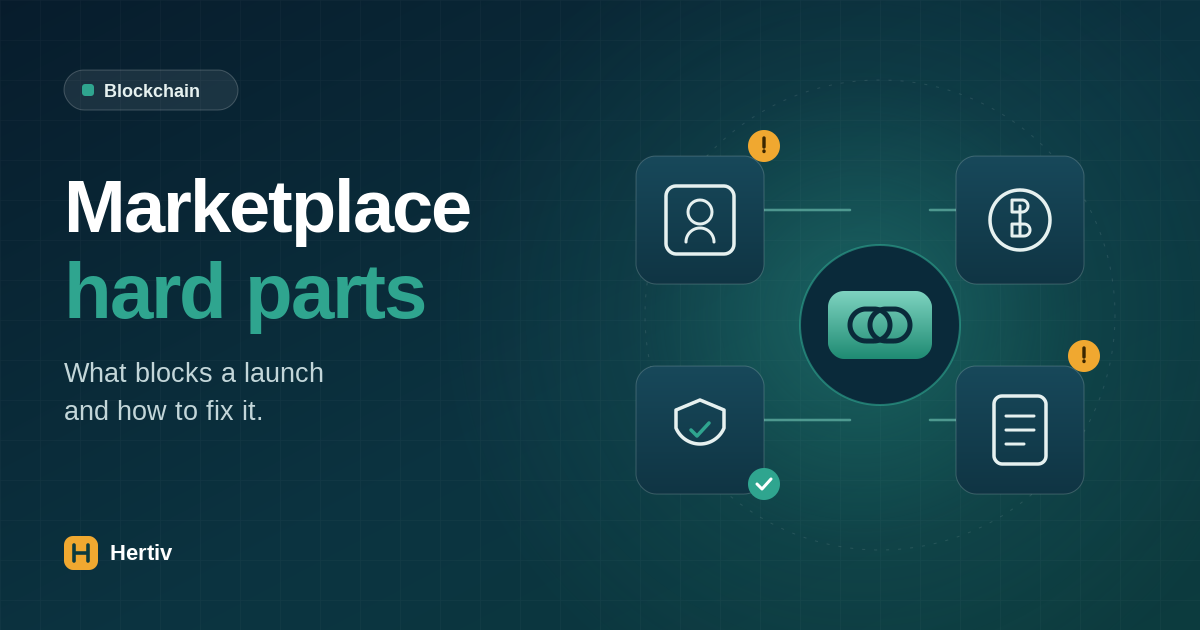
NFT marketplace development faces six main challenges: attracting buyers and sellers at launch, keeping smart contracts secure, holding gas fees down, stopping fake listings and fraud, handling legal and royalty rules, and building a wallet experience ordinary buyers can use. Each has a known fix, but teams that skip one usually pay for it after launch.
What makes building an NFT marketplace hard?
An NFT marketplace is a two-sided market, a smart contract system and a storefront at once. Buyers need items worth buying, sellers need buyers, and the contracts underneath must move money and tokens without mistakes. Each part is simple on its own; the hard part is making them all work together from day one.
The challenges below are the ones that sink most first versions. They are not exotic: they are liquidity, security, fees, fraud, legal rules and wallet experience. A team that plans for all six has a far better chance than one that only plans the storefront.
| Challenge | What goes wrong | The usual fix |
|---|---|---|
| Cold start | No buyers, no sellers | Launch with curated creators |
| Smart contract risk | Bugs drain funds | Audits and bug bounties |
| Gas fees | High costs kill small sales | Layer 2 and lazy minting |
| Fakes and fraud | Copied art, fake drops | Verification and takedowns |
| Legal and royalties | Unclear rules, unpaid creators | Clear terms, on-chain royalties |
| Wallet experience | Buyers give up at checkout | Simple onboarding, card payments |
This article takes each challenge in turn, with the fix teams actually use. For the build steps themselves, see how to develop an NFT marketplace step by step.
How do you solve the cold-start problem?
A marketplace with no listings attracts no buyers, and no sellers list where there are no buyers. The fix is to start narrow: invite a small group of creators with real audiences, and launch with their work only. Fifty committed creators beat five thousand empty listings.
Pick one niche, such as game items or digital art, and win it before adding more categories. A small, focused launch also makes support easier: the team can talk to every creator and fix problems fast, which is impossible with thousands of strangers.
Curated drops help too. A weekly drop gives buyers a reason to return and gives sellers a date to promote. Early sellers need attention: feature them, share their work and make sure their first sales happen fast.
Avoid paying for fake volume. Wash trading and free giveaways that nobody wants make the numbers look good for a week and destroy trust when buyers notice. Real demand grows slowly and lasts.
How do you keep the marketplace secure?
Smart contracts hold the money, so a bug in one can drain a marketplace in minutes. The fix is an audit by a firm that specialises in smart contracts, plus a bug bounty that pays researchers to find problems before attackers do.
Audits do not make a contract safe on their own. Keep the contracts simple, use tested libraries for standard parts such as token transfers, and test every change on a test network before it reaches real users.
Admin keys need care too. A single key that can pause trading or move funds is a target. Use multi-signature control, so several people must approve any change. For what the build costs, see how much an NFT marketplace costs to build.
How do you handle gas fees and scaling?
On a busy network, the fee to mint or buy a low-priced item can cost more than the item itself. That kills small sales and pushes casual buyers away. The fix is to move activity to a layer 2 network or a sidechain, where fees are a fraction of the main chain.
Lazy minting helps as well: the token is only created when a buyer pays for it, so sellers do not pay to list items that never sell. Batching several actions into one transaction cuts costs further.
Some teams also let buyers pay in ordinary money through a card, with the platform handling the crypto in the background, which removes one more barrier for new buyers. Pick the chain and the fee model before you build, not after.
Moving a live marketplace to another chain means moving listings, users and liquidity, which is far harder than choosing well at the start. Get the fee model right in the first version, even if it means a slower launch.
How do you deal with fakes, fraud and legal risk?
Anyone can copy an image and mint it as their own, so fake listings are the most common complaint on new marketplaces. The fix is verification: check that a creator is who they claim to be before their work is listed, and act fast on takedown requests from the real owner.
Royalties need clear rules. Creators expect a cut of resales, but royalty enforcement varies by chain and marketplace. State the royalty rate in plain terms and use on-chain royalties where the chain supports them, so creators are not surprised.
Legal risk is real and varies by country. Some items count as securities, some art counts as a regulated asset, and tax rules differ. Get legal advice before launch, not after the first complaint. For the wider picture, see NFT marketplace development trends worth building for.
Example (hypothetical): a first marketplace for game items
Example (hypothetical): a team launches a marketplace for game items with 50 creators, each listing 20 items, for 1,000 listings in total. In the first month, 8% of listings sell, which is 80 sales.
The average sale is $60, so monthly volume is 80 times $60, or $4,800. The marketplace takes a 2.5% fee, which is $120 in the first month. The team spends $400 on creator promotion and $150 on hosting, so the first month loses $430.
In month three, sales double to 160 a month, volume rises to $9,600 and fees reach $240, while costs stay near $550. The lesson is plain: a new marketplace needs a budget for the first few months, because fees do not cover costs until volume grows.
What are the common mistakes?
The most common NFT marketplace mistakes are launching with no creators, skipping the audit, ignoring fees, and trusting that the storefront alone will bring buyers.
- Launching with empty listings and hoping buyers arrive on their own.
- Skipping a smart contract audit to save money before launch.
- Ignoring gas fees until small sales cost more than the item.
- Listing unverified creators and learning about fakes from angry buyers.
- Promising royalties the chain or marketplace cannot enforce.
Plan for all six challenges before you write the first contract. A marketplace that solves liquidity, security, fees, fraud, legal rules and wallet experience has a real chance; one that solves only the storefront does not.
Key takeaways
- Start narrow: a few committed creators beat thousands of empty listings
- Audit smart contracts and use multi-signature control for admin keys
- Move to layer 2 and use lazy minting to keep fees down
- Verify creators and act fast on takedown requests
- Budget for the first months: fees rarely cover costs at launch
Frequently asked questions
What is the hardest part of building an NFT marketplace?
Attracting both sides at once. A marketplace with no listings draws no buyers, and no sellers list where there are no buyers. Starting narrow with a small group of creators and a single niche is the usual fix.
How much does it cost to build an NFT marketplace?
Costs depend on the chain, the features and whether you hire a team, so see the vendor site or a build quote for a firm number. A first version usually needs a smart contract audit, design, development and a launch budget for creators.
Do NFT marketplaces need a smart contract audit?
Yes. Smart contracts hold the money, and a bug can drain a marketplace in minutes. An audit by a specialist firm plus a bug bounty is the standard way to find problems before attackers do.
How do NFT marketplaces handle gas fees?
Most use a layer 2 network or sidechain, where fees are far lower than the main chain. Lazy minting also helps: the token is only created when a buyer pays, so sellers do not pay to list items that never sell.
How do marketplaces stop fake NFT listings?
By verifying creators before their work is listed and acting fast on takedown requests from the real owner. Some platforms also check new listings against known collections to catch copies early.
Do creators always get royalties on resales?
Not always. Royalty enforcement varies by chain and marketplace, and some buyers can avoid royalties on certain platforms. State the royalty rate in plain terms and use on-chain royalties where the chain supports them.