How to Develop an NFT Marketplace, Step by Step
An NFT marketplace needs wallets, contracts, listings and payments working together. These steps show how to plan, build and launch one.
On this page
Short answer
An NFT marketplace is a platform where people list, buy and sell unique blockchain tokens. To build one, define the items and sale model, choose a chain and token standard, write and audit the smart contracts, build the app with wallet login and checkout, index chain data for fast listings, and test the full trade flow on the test network before launch.
What is an NFT marketplace?
An NFT marketplace is a platform where people list, buy and sell non-fungible tokens, which are unique digital items recorded on a blockchain. Each token represents ownership of one item, such as digital art, a collectible, a game asset or a ticket, and the marketplace handles discovery, pricing, payment and transfer.
The platform sits between the blockchain and the user. Smart contracts hold the rules for minting, listing and sale, while the website or app provides search, profiles, wallets and order history. The blockchain records ownership; the marketplace makes it usable.
An NFT marketplace is different from a token exchange. Exchanges trade identical tokens, while a marketplace trades unique items, so it needs item pages, rarity data, creator profiles and auction or fixed-price sales rather than an order book alone.
What does an NFT marketplace include?
An NFT marketplace includes the features buyers and sellers need to complete a trade without manual help. The core set is small, and extra features can wait until the first version works.
| Feature | What it does | Needed in version one |
|---|---|---|
| Wallet login | Connects a wallet and proves ownership | Yes |
| Minting | Creates the token and its metadata | Yes |
| Listings | Fixed price or auction sales | Yes |
| Search and filters | Finds items by collection, price, trait | Yes |
| Payments and fees | Takes payment and splits fees | Yes |
| Creator profiles | Shows collections and history | Yes |
| Offers and bids | Lets buyers propose a price | Later |
| Royalties | Pays creators on resale | Later |
Keep version one small. A marketplace that lists, sells and settles reliably beats a large one that fails on the basics. See how much an NFT marketplace costs to build for the budget side of this decision.
Which blockchain and token standard should you choose?
The blockchain and token standard decide your fees, your audience and your tooling. Most general marketplaces start on Ethereum or a lower-fee chain such as Polygon, BNB Chain or Solana, depending on where their creators and buyers already are.
For token standards, ERC-721 fits unique one-of-one items, while ERC-1155 fits collections where many copies of one item exist, such as game assets or event tickets. On Solana, the Metaplex standard plays the same role. Pick the standard that matches the items you will sell, not the one with the most tutorials. For the minting side, see what NFT minting is.
Consider fees before you commit. A chain with high transaction fees makes low-price items uneconomic, because the fee can exceed the sale price. Test the full buy and sell flow on the test network and measure the real cost per trade.
Check wallet support as well. If buyers need a wallet they do not have, they will leave before they list or buy anything. The chain you choose should work with the wallets your audience already uses, and the test network should let your team try every step without spending real funds.
How to develop an NFT marketplace in 7 steps
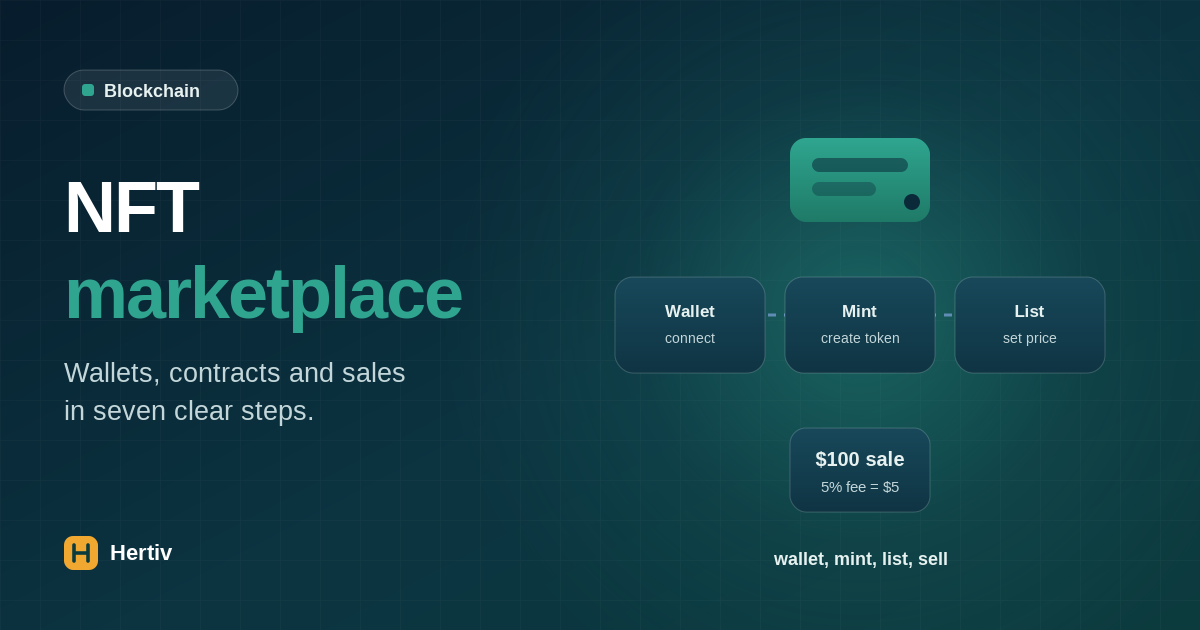
Developing an NFT marketplace follows a clear sequence: define the items and the sale model, write and audit the contracts, build the app, then test the full trade flow before launch.
- Define the items, the audience and the sale model: fixed price, auction or offers.
- Choose the chain and token standard, and confirm the fee per trade is viable.
- Design the data model: token metadata, collections, listings, orders and user profiles.
- Write the smart contracts for minting, listing, buying and cancelling, then get them audited.
- Build the app: wallet login, item pages, search, listings, checkout and order history.
- Index chain data so the app shows listings and sales without slow on-chain reads.
- Test the full flow on the test network, fix the failures, then launch with one collection.
Do not skip the audit. A contract bug can drain funds or lock items, and it cannot be patched the way a website bug can. For a chain-specific walkthrough, see how to launch an NFT marketplace on Cardano.
How much does it cost to build an NFT marketplace?
The cost of building an NFT marketplace depends on the chain, the features and whether you build from scratch or start from a ready platform. The bands below are indicative ranges for planning, not quotes.
| Scope | Indicative range | What it includes |
|---|---|---|
| First version | $80,000 - $200,000 | Wallet login, minting, listings, checkout |
| Full marketplace | $200,000 - $500,000 | Auctions, offers, royalties, admin tools |
| White label start | $25,000 - $70,000 | Rebranded ready platform, limited changes |
| Running costs | $4,000 - $12,000 a month | Hosting, indexing, support, monitoring |
The audit is a separate line item and should not be cut. A marketplace that skips the audit saves money once and risks far more later. If a ready platform fits your needs, see how a white label NFT marketplace works before building from scratch.
Budget for support and monitoring from the start. Failed sales, stuck transactions and wallet connection problems all need a human answer, and a marketplace with no support channel loses sellers after the first failed trade. Plan for at least one support person once the marketplace is live.
Example (hypothetical): a first version for digital art
Example (hypothetical): a small team builds a first-version marketplace for digital art. The build costs $110,000, and running costs are $5,000 a month, so the first year costs $110,000 + $60,000 = $170,000.
In the first year the marketplace lists 2,000 items. Of those, 400 sell at an average price of $100, giving $40,000 in sales volume. The platform takes a 5% fee, so fee income is $40,000 x 5% = $2,000. The marketplace also charges creators $10 per listing, and 2,000 listings bring $20,000.
Total first-year income is $2,000 + $20,000 = $22,000 against $170,000 of costs, so the marketplace does not pay for itself in year one. That is normal for a first version: the team should plan funding for at least two years and focus on growing listings and sales before expecting profit.
Common mistakes when building an NFT marketplace
Most NFT marketplace failures come from skipping the hard parts: contract security, indexing and the economics of fees. A marketplace that looks finished but cannot settle trades reliably will lose sellers fast.
- Skipping the smart contract audit to save time or money.
- Choosing a chain where the fee per trade exceeds the price of the items sold.
- Building too many features before the basic buy and sell flow works.
- Storing metadata in one place with no backup, so items break when it goes down.
- Ignoring royalties and fee rules until after launch, when they are hard to change.
- Launching with no creators or collections, so buyers arrive to an empty marketplace.
- No plan for support when a sale fails or a wallet cannot connect.
Key takeaways
- An NFT marketplace trades unique items, so it needs item pages and auctions, not just an order book.
- Version one needs wallet login, minting, listings, search, payments and creator profiles.
- ERC-721 fits one-of-one items; ERC-1155 fits collections with many copies.
- Smart contract audits are not optional: contract bugs cannot be patched like website bugs.
- Test the full buy and sell flow on the test network and measure the real fee per trade.
- Launch with one collection and one creator community, not an empty marketplace.
Frequently asked questions
What is the difference between an NFT marketplace and a crypto exchange?
A crypto exchange trades identical tokens, such as one bitcoin for another, using an order book. An NFT marketplace trades unique items, so each listing has its own page, price, traits and history. The two need different designs, even though both settle trades on a blockchain.
Which blockchain is best for an NFT marketplace?
It depends on where your creators and buyers already are and what the fee per trade is. Ethereum has the largest audience, while Polygon, BNB Chain and Solana offer lower fees. Test the full buy and sell flow on each candidate chain and measure the real cost before choosing.
Do I need a smart contract audit for an NFT marketplace?
Yes. The contracts hold the rules for minting, listing and payment, and a bug can drain funds or lock items. An audit by an independent reviewer is a standard step before launch, and it should be budgeted as a separate line item rather than cut to save money.
How long does it take to build an NFT marketplace?
A first version with wallet login, minting, listings and checkout usually takes three to six months with a small team. A full marketplace with auctions, offers, royalties and admin tools takes longer. The audit and test-network testing add weeks, and they should not be squeezed.
Can I build an NFT marketplace without coding?
A white label platform lets you launch a branded marketplace without writing contracts or building an app. You trade control for speed: the platform sets the features, the fees and the limits. If your marketplace needs custom sale rules or unusual items, building from scratch is the better path.
How do NFT marketplaces make money?
Most take a percentage fee on each sale, often around 2 to 5 percent, and some charge listing fees. The exact split depends on the platform and the chain. Fee income only covers costs once sales volume grows, so plan funding for at least two years before expecting profit.


