What Is NFT Minting, and How Does It Work?
NFT minting turns a digital file into a unique token on a blockchain, with a public record of who made it and who owns it. Here is how it works and what it costs.
On this page
Short answer
NFT minting is the process of creating a non-fungible token on a blockchain from a digital file, such as an image, a song or a ticket. The mint writes a unique token ID, a link to the file's metadata and the creator's address into a smart contract, so the token can be checked, transferred and sold without a central registry. The file itself usually stays off the chain.
What is NFT minting?
NFT minting is the process of creating a unique token on a blockchain that stands for a specific digital item. The token is non-fungible, which means it cannot be swapped one-for-one with another token the way one coin can be swapped for another.
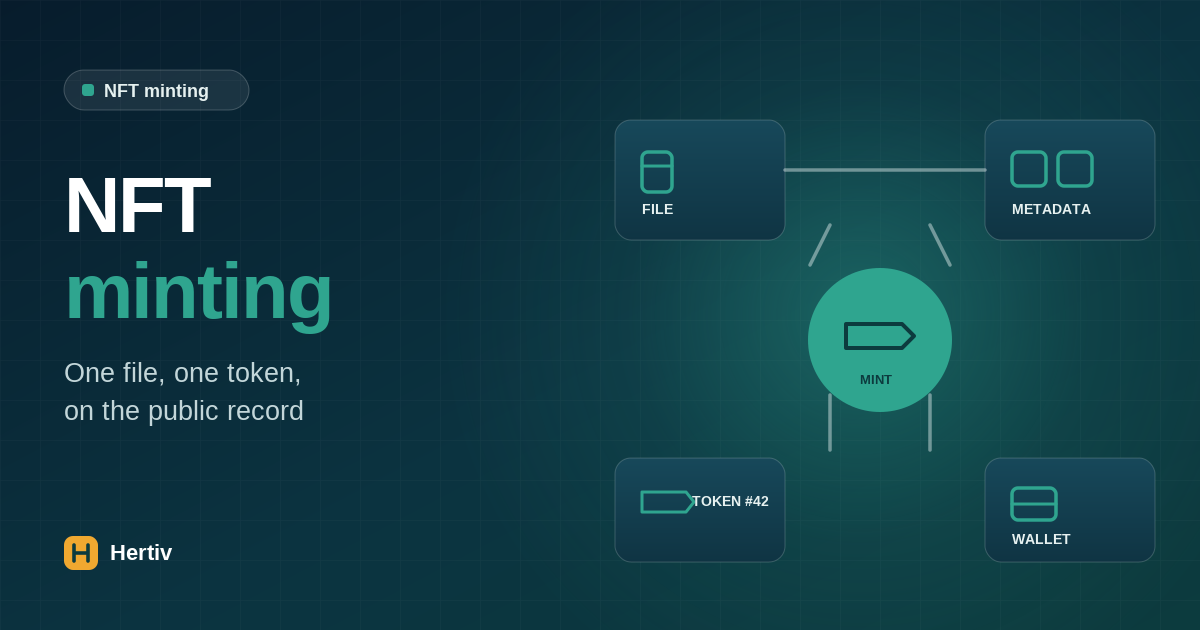
Minting does not put the file itself on the blockchain. It creates a token with a unique ID and a link to the file's metadata, which describes the item, its creator and its properties. Anyone can then check the chain to see that the token exists, who minted it and who owns it now.
What a mint records:
| Record | What it stores | Why it matters |
|---|---|---|
| Token ID | A number that is unique inside the collection | Tells this token apart from every other token |
| Metadata link | A link to the file and its description | Connects the token to the item it stands for |
| Creator address | The wallet that minted the token | Shows who first created the token |
| Royalty rule | The share the creator gets on resales | Lets creators earn from later sales |
The token lives in a smart contract, and the contract enforces the rules about transfers and royalties. That is the same idea behind how tokenization works for other kinds of assets.
How does NFT minting work?
NFT minting works by calling a mint function on a smart contract, which creates the token and assigns it to a wallet. The call is a blockchain transaction, so it is confirmed by the network and becomes part of the public record.
The usual sequence is:
- Choose a blockchain. Pick a chain your buyers already use, since a token on one chain does not move to another without a bridge.
- Set up a wallet. The wallet pays the minting fee and receives the token. Keep its recovery phrase somewhere safe and offline.
- Prepare the file and metadata. Upload the file to storage, then write the metadata: name, description, properties and the file link.
- Deploy or use a contract. Use an existing collection contract or deploy your own, then call its mint function with the metadata link.
- Confirm on the chain. Wait for the transaction to confirm, then check the token on a block explorer before you list it anywhere.
Most marketplaces run these steps for you behind a form, but the underlying action is the same: a contract call that creates the token. The contract is the part that needs care, which is why teams read what smart contract development involves before they build their own.
What does it cost to mint an NFT?
Minting costs vary because the main cost is the network fee for the transaction, and that fee changes with demand on the chain. On a busy chain the fee can be many times higher at peak hours than at quiet times, so timing matters.
There are three costs to plan for: the network fee for the mint transaction, any fee the marketplace charges for listing or selling, and the cost of storing the file and metadata. Storage on a distributed network is usually cheap, but it is still a real cost that needs a plan.
Lazy minting is a common way to cut the upfront cost. The token is only created on the chain when someone buys it, so the buyer pays the network fee instead of the creator. The trade-off is that the token does not exist until the sale, so it cannot be shown as minted before then.
Marketplace fees change, so check the fee page of the marketplace you plan to use and treat the figure as "see vendor site" rather than a fixed number. The same goes for any service that mints for you: confirm the fee before you start, not after.
What happens after an NFT is minted?
After an NFT is minted, the token exists in the owner's wallet and can be listed for sale, transferred to another wallet, or held. The owner controls the token, not the marketplace, so the token can move between marketplaces that support the same chain and standard.
Listing a token for sale does not move it: the token stays in the owner's wallet until a buyer pays, and the sale is then settled by the contract. Some marketplaces also let owners set a royalty, so the creator gets a share each time the token changes hands.
The metadata needs to stay available for as long as the token matters. If the file link breaks, the token still exists but the item it points to is gone. That is why teams store files on distributed storage rather than on a single server that can go offline.
Owners can also burn a token, which sends it to an address nobody controls. Burning is used to remove a token from circulation, for example when a limited edition is reduced or a faulty mint needs to be withdrawn.
Example (hypothetical): a photographer mints 100 prints
Example (hypothetical): a photographer mints 100 prints of one photograph as NFTs, each priced at $25. The mint fee on the chosen chain is $2 per token, so minting all 100 costs $200 in network fees.
In the first month, 40 prints sell. That brings in 40 x $25 = $1,000. After the $200 mint cost, the photographer keeps $800 before any marketplace fee is taken.
Later, five of those prints are resold at $60 each. The contract pays the photographer a 10% royalty on each resale, so 5 x $6 = $30 in royalties. The royalty is small next to the first sale, but it keeps paying on every resale without extra work from the photographer.
The arithmetic shows why the numbers matter more than the idea: at $2 a mint, the project works, but if the fee were $25 a mint, the $2,500 cost would wipe out the first month's sales. Checking the fee before minting is the step that protects the budget.
What are the common mistakes?
The most common NFT minting mistakes are choosing the wrong chain, storing metadata badly, and ignoring the costs and the rights that come with the token.
- Minting on a chain your buyers do not use. A token on an unfamiliar chain is hard to sell, however good the art is.
- Storing metadata on a single server. If the server goes down, the token points at nothing. Use distributed storage.
- Ignoring the gas fee. Minting at peak times can cost far more than expected. Check the fee before you confirm.
- Assuming the buyer owns the copyright. Buying a token usually buys the token, not the copyright. State the licence in writing.
- Losing the wallet keys. If the minting wallet is lost, the creator cannot prove they made the token or collect royalties.
- Minting before the contract is checked. A bug in a minting contract can let anyone mint extra tokens. Have the contract reviewed first.
How to mint your first NFT
Minting your first NFT is a small project, not a leap. Start with one token on a cheap chain, and treat the first mint as a test of the whole process.
- Pick the chain and marketplace. Choose a chain your buyers use and a marketplace that supports it, and read its fee page first.
- Set up a wallet and fund it. Create a wallet, back up the recovery phrase offline, and add enough funds for the mint fee.
- Prepare the file and metadata. Upload the file to distributed storage and write clear metadata with a name, description and properties.
- Mint one token. Mint a single token, confirm it on a block explorer, and check the metadata link opens.
- List it and review. List the token, check the listing shows the right file and price, and only then mint the rest of the collection.
For a larger collection or a custom contract, a team that builds on blockchain development can set up the minting contract and the metadata pipeline so the process repeats cleanly.
Key takeaways
- Minting creates a unique token with an ID, a metadata link and a creator address
- The file stays off the chain; the token is the on-chain record
- Network fees vary, and lazy minting moves the fee to the buyer
- Royalties pay creators on resales, but the licence terms need writing down
- Mint one token first and check it on a block explorer before minting a collection
Frequently asked questions
Do I own the copyright when I buy an NFT?
Usually not. Buying an NFT normally buys the token, not the copyright in the underlying work. The copyright stays with the creator unless the sale terms say otherwise in writing. Read the licence that comes with the token before you assume you can reproduce or sell the work.
Is minting the same as listing an NFT for sale?
No. Minting creates the token on the blockchain, while listing offers it for sale on a marketplace. You can mint a token and hold it without listing it, and you can list a token you already own. Some marketplaces combine both steps in one form, which is why they are easy to confuse.
What is lazy minting?
Lazy minting delays creating the token until someone buys it, so the buyer pays the network fee instead of the creator. The token does not exist on the chain before the sale, so it cannot be transferred or shown as minted until then. It is a useful way to test demand without paying mint fees upfront.
Can an NFT be minted on any blockchain?
No. A token is created on one chain, and it stays there unless a bridge moves it. Each chain has its own token standards, fees and wallets, so the chain you choose decides who can buy the token and what it costs to mint. Pick the chain your buyers already use.
What happens if the file linked to an NFT is deleted?
The token still exists, but the item it points to is gone, so the token loses most of its value. This is why metadata and files should live on distributed storage rather than a single server. Before buying a token, check that its metadata link opens and the file is stored somewhere durable.
Do I need a smart contract to mint an NFT?
Yes, in practice. The token is created by a smart contract, either one a marketplace provides or one you deploy yourself. Using a marketplace contract is simpler, while deploying your own gives control over royalties, supply and the minting rules. Either way, the contract should be reviewed before it mints anything.


