6 Alternatives to Blockchain Rollups Worth Comparing
Rollups are not the only way to scale a blockchain. Sidechains, validiums, state channels, plasma, app-chains and volitions trade security, cost and speed.
On this page
Short answer
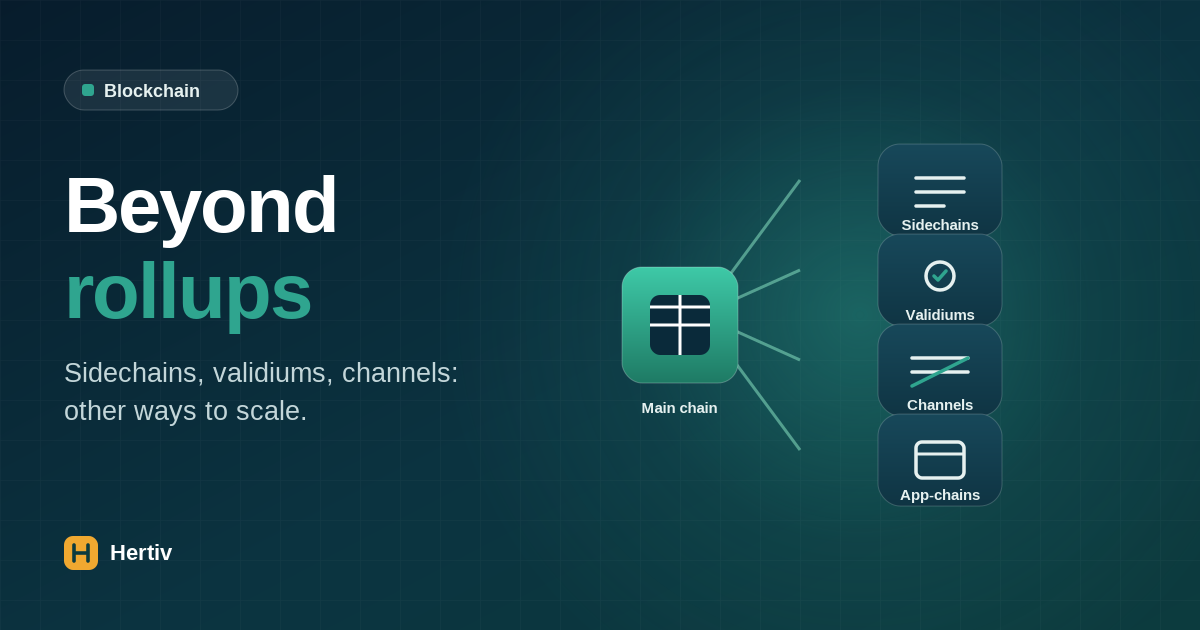
The main alternatives to blockchain rollups are sidechains, validiums, state channels, plasma chains, sovereign app-chains and volitions. Each moves work off the main chain in a different way: sidechains run their own validators, validiums keep data off-chain with validity proofs, state channels settle between two parties, and app-chains give one application its own chain.
What are the alternatives to rollups?
Rollups scale a blockchain by doing work off-chain and posting a proof or a summary back to the main chain. The alternatives below take different routes to the same goal: more transactions, lower fees and faster confirmation, without asking the main chain to process every step.
| Approach | Security basis | Data location | Best for |
|---|---|---|---|
| Sidechains | Own validators | On the sidechain | Games and apps that need speed |
| Validiums | Validity proofs | Off-chain | High-volume apps with low fees |
| State channels | Main chain settlement | Between participants | Repeated payments between two parties |
| Plasma | Main chain checkpoints | Off-chain | Payments and simple transfers |
| Sovereign app-chains | Own validator set | On the app-chain | One app that needs its own rules |
| Volitions | Validity proofs | User chooses on or off-chain | Apps mixing public and private data |
The table shows the key trade. Approaches that keep data on the main chain inherit more of its security, while approaches that move data off-chain can be cheaper and faster but ask users to trust something else. For a refresher on what rollups themselves do, see what a ZK rollup is.
Sidechains and validiums
1. Sidechains: best for speed-first apps
A sidechain is a separate blockchain that runs alongside a main chain and connects to it with a bridge. It has its own validators, its own block times and its own fees, so it can confirm transactions in seconds and charge far less than the main chain. Assets move between the two chains through the bridge, which locks them on one side and releases them on the other.
Sidechains suit games, social apps and other products where users make many small transactions and will not wait for main-chain confirmation. Polygon PoS and Ronin are well-known examples. The trade is security: a sidechain is only as safe as its own validator set, and a bridge failure can strand assets, so users accept weaker guarantees in exchange for speed.
- Pros: fast confirmations, low fees, full control over the chain rules
- Cons: weaker security than the main chain, bridge risk, separate validator set to trust
2. Validiums: best for high-volume, low-fee apps
A validium is like a ZK rollup, except the transaction data stays off-chain. Validity proofs still prove that every transaction was correct, so an operator cannot steal funds or invent a balance, but users must trust the data availability committee to keep the data and hand it over when asked. That trade removes the cost of posting data to the main chain, which is usually the largest cost of a rollup.
Validiums suit apps with very high volume and low value per transaction, such as games and trading platforms, where cheap fees matter more than full main-chain data availability. StarkEx and Immutable X are well-known examples. The risk is data: if the committee fails, users may not be able to prove what they own, even though the proofs show the balances are correct.
- Pros: very low fees, validity proofs stop invalid transactions, high throughput
- Cons: data held off-chain, users trust a committee, weaker guarantees than a rollup
State channels and plasma
3. State channels: best for repeated payments
A state channel lets two parties transact many times off-chain and settle only the final result on the main chain. The parties lock funds in a contract, exchange signed updates directly, and either party can close the channel and post the latest signed state. The main chain only sees the opening and the closing, so the payments in between are instant and nearly free.
Channels suit repeated payments between the same two parties, such as a user paying a service per use, or two businesses settling trades all day. The Lightning Network on Bitcoin and Raiden on Ethereum are the best-known examples.
The limit is scope: a channel only works between its participants, and funds locked in a channel cannot be used elsewhere until it closes. For a comparison with the optimistic approach, see what an optimistic rollup is.
- Pros: instant, nearly free payments, main-chain settlement, no new chain to trust
- Cons: only between channel participants, funds locked while open, needs both sides online
4. Plasma: best for simple, high-volume transfers
Plasma is a framework for child chains that report checkpoints to the main chain. The child chain processes transactions quickly and cheaply, and it posts a summary of its state to the main chain at intervals. If the child chain misbehaves, users can withdraw their funds to the main chain by proving what they own, using the posted checkpoints as evidence.
Plasma was one of the earliest scaling ideas for Ethereum, and Plasma Cash refined it by giving each deposit its own token, which made withdrawals simpler to prove. It suits simple transfers and payments, where the state is easy to prove. It suits complex smart contracts poorly, because proving a contract state from a checkpoint is hard, which is why rollups largely replaced plasma for general apps.
- Pros: cheap transfers, main-chain checkpoints, users can exit with proof
- Cons: poor fit for complex contracts, slow exits, little live use today
Sovereign app-chains and volitions
5. Sovereign app-chains: best for one app with its own rules
A sovereign app-chain is a blockchain built for a single application, with its own validators, fees and governance. The app does not share block space with anyone else, so it never competes for throughput and can set rules that fit its own users, such as its own fee token or its own upgrade process.
App-chains suit products that have outgrown a shared chain: a large game, a trading venue or a chain of its own, built with a framework such as the Cosmos SDK or as an Avalanche subnet. The cost is responsibility: the team must attract validators, secure the chain and run the infrastructure, instead of inheriting those things from a main chain. For how rollup projects compare with each other, see blockchain rollup solutions.
- Pros: dedicated throughput, custom rules and fees, no competition for block space
- Cons: team must secure the chain, higher running costs, weaker network effects
6. Volitions: best for mixing public and private data
A volition lets each user choose, per transaction, whether the data goes on-chain like a rollup or off-chain like a validium. The same chain therefore serves two kinds of user at once: those who want full main-chain data availability, and those who want the lower fees of off-chain data. Validity proofs cover both, so the correctness guarantee stays the same either way.
Volitions suit apps where some users need strong guarantees and others need cheap fees, such as a trading platform where large traders want on-chain data and casual users do not. StarkWare introduced the idea, and it appears in systems that let users pick their data availability per account. The cost is complexity: the system must handle two data modes, and users must understand which one they chose.
- Pros: user chooses data availability, validity proofs for both modes, flexible fees
- Cons: more complex to build and explain, off-chain users still trust a committee
How to choose between the alternatives
Choose by what your users need most: security, cost, speed or control. The steps below turn that into a short decision.
- List what the app actually does. Payments between two parties point to channels; many small transactions point to sidechains or validiums; one app with special rules points to an app-chain.
- Decide how much security you can give up. If users hold large balances, keep data on the main chain. If the amounts are small and speed matters, off-chain data is a fair trade.
- Check the exit. For every option, ask how a user gets funds out if the operator stops. A good answer is a proof the main chain accepts, not a support ticket.
- Count the running costs. Validators, data committees and bridges all need people and servers. A cheap fee for users can mean a large bill for the team.
- Test with real users first. Run a small pilot on the leading option and measure fees, confirmation times and failed transactions before committing to it.
Most teams end up combining approaches: a rollup for the core product and a sidechain or channel for the high-volume part. For the direct comparison between the two rollup types, see ZK rollups vs optimistic rollups.
What are the common mistakes?
The most common mistakes when choosing a rollup alternative are chasing the lowest fee, ignoring the exit path, and treating every option as interchangeable.
- Choosing by fee alone. The cheapest option is often the one with the weakest security. Match the security to the value at stake, not to the fee.
- Ignoring the bridge. Sidechains and plasma depend on bridges, and bridges have failed more often than the chains they connect. Check who runs the bridge and how it is secured.
- Forgetting the exit. If users cannot leave with their funds when the operator stops, the system is a trap, not a scaling solution. Test the exit before launch.
- Mixing up validiums and rollups. They share validity proofs, but only rollups keep data on the main chain. Calling a validium a rollup hides the data trust assumption.
- Building an app-chain too early. Running your own chain is a large job. Start on a shared chain and move only when the traffic and the rules demand it.
Key takeaways
- Sidechains trade main-chain security for speed and low fees
- Validiums keep data off-chain but prove every transaction with validity proofs
- State channels are the cheapest way to handle repeated payments between two parties
- Plasma suits simple transfers but fits complex contracts poorly
- An app-chain is worth it only when one app needs its own rules and throughput
Frequently asked questions
What is the difference between a sidechain and a rollup?
A sidechain runs its own validators and only connects to the main chain through a bridge, so its security comes from its own validator set. A rollup posts its data or proofs to the main chain, so its security comes from the main chain itself. Sidechains are usually faster and cheaper, while rollups are usually safer.
Is a validium as safe as a rollup?
No. Both use validity proofs, so neither can process an invalid transaction. The difference is data: a rollup keeps transaction data on the main chain, where anyone can check it, while a validium keeps data off-chain with a committee. If the committee fails, validium users may not be able to prove what they own.
When do state channels make sense?
State channels make sense when the same two parties transact many times, such as a user paying a service per use or two businesses settling trades all day. They make little sense for one-off payments, because opening and closing the channel costs more than the payments inside it save.
Is plasma still used today?
Plasma sees little live use today, because rollups handle general smart contracts better and sidechains handle simple transfers more simply. The idea still matters: it was the first widely discussed framework for child chains with main-chain checkpoints, and later designs borrowed from it.
What is a sovereign app-chain?
A sovereign app-chain is a blockchain built for one application, with its own validators, fees and governance. It gives the app dedicated throughput and custom rules, but the team must secure and run the chain itself instead of inheriting security from a main chain.
What is a volition?
A volition is a chain where each user chooses per transaction whether data goes on-chain like a rollup or off-chain like a validium. Validity proofs cover both modes, so the correctness guarantee is the same, but the data availability guarantee depends on the choice each user makes.


