What Is a ZK Rollup, and How Does It Scale Ethereum?
A ZK rollup bundles many transactions off chain, proves them with a short cryptographic proof, and posts that proof to Ethereum. Learn how it works and when it fits.
On this page
Short answer
A ZK rollup is a scaling method that processes transactions off the main chain and posts a short cryptographic proof to Ethereum showing they were done correctly. The main chain checks the proof instead of re-running every transaction, so many transactions settle for the cost of one proof.
What is a ZK rollup?
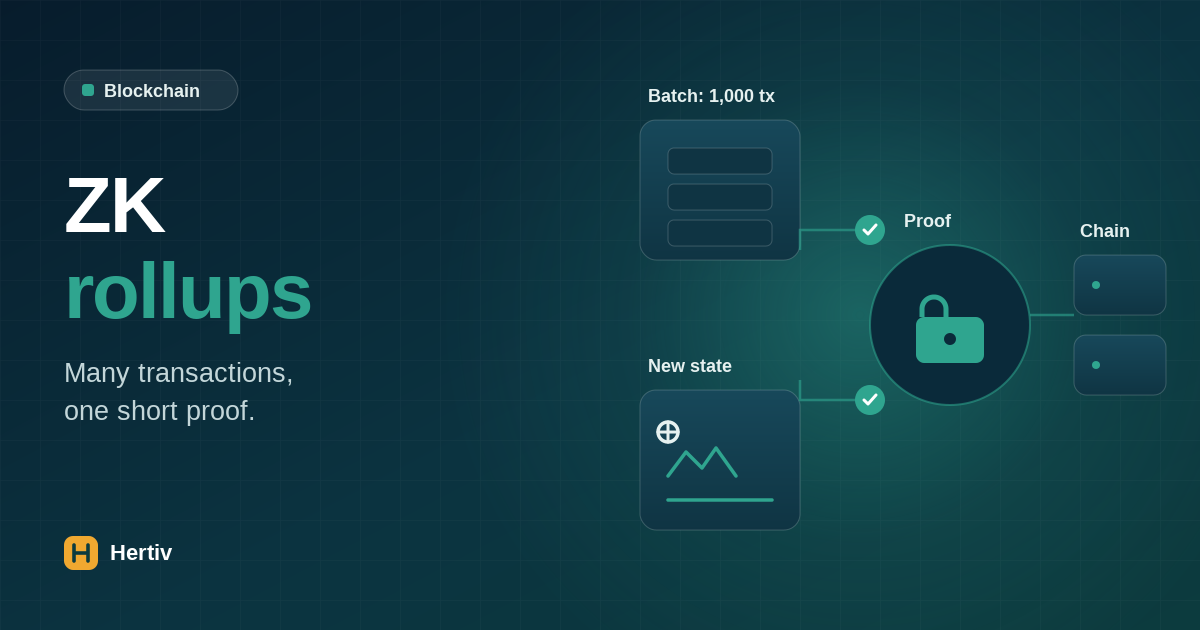
A ZK rollup is a layer 2 scaling method that moves transaction processing off Ethereum while keeping its security. Transactions happen on the rollup, and a short cryptographic proof is posted to Ethereum showing that the new state is correct.
The name comes from zero-knowledge proofs: a way to prove a statement is true without revealing all the details behind it. In a rollup, the proof shows that a batch of transactions was executed correctly, without Ethereum having to re-run each one.
The rollup keeps its own record of accounts and balances, and it posts two things to the main chain: the compressed transaction data and the proof. Ethereum checks the proof, and if it passes, the new state is accepted as final.
That split is the point. The main chain does the verification work once per batch instead of once per transaction, so a batch of thousands of transactions costs roughly the same to verify as a batch of ten.
How does a ZK proof keep the rollup honest?
A ZK proof keeps the rollup honest because the main chain will not accept a new state without a valid proof. The rollup operator cannot invent balances or skip a transaction, because the proof would fail and the state would be rejected.
The proof is built from the batch itself. A prover takes the old state, the transactions and the new state, and produces a short proof that the transition followed the rules. The proof is small even when the batch is large, which is why verification stays cheap.
There are two common proof systems, often called SNARKs and STARKs. Both do the same job, and they differ in proof size, proving time and the setup they need. A team choosing a rollup does not usually need to pick between them directly; the rollup they use has already made that choice.
One practical limit is proving time. Building a proof takes real computation, so a rollup has to balance batch size against how fast it can produce proofs. That is why some rollups settle in minutes rather than seconds.
ZK rollups vs optimistic rollups
ZK rollups and optimistic rollups solve the same problem in opposite ways. A ZK rollup proves correctness up front; an optimistic rollup assumes correctness and lets anyone challenge it later.
| Aspect | ZK rollup | Optimistic rollup |
|---|---|---|
| How correctness is shown | Proof posted with the batch | Assumed, with a challenge window |
| Time to final settlement | Minutes, once the proof is ready | Days, while challenges are possible |
| Withdrawing to the main chain | Fast, after proof verification | Slow, must wait out the window |
| Cost to run | Higher proving cost | Lower proving cost |
| General computation | Harder to support fully | Easier to support fully |
| Best for | Payments, simple transfers | Complex applications |
The trade-off is speed of finality against flexibility. ZK rollups settle faster but have historically supported a narrower range of applications. Optimistic rollups support more kinds of programs but make users wait for finality.
That gap is narrowing as proving systems improve. Teams that need fast withdrawals usually pick a ZK rollup; teams that need a program that behaves exactly like the main chain often start with an optimistic one.
How does a transaction move through a ZK rollup?
A transaction moves through a ZK rollup in five steps, from the user's wallet to final settlement on Ethereum.
- Submit. The user signs a transaction and sends it to the rollup, usually through a wallet or an application.
- Order. The rollup sequencer orders the transaction with others into a batch and updates the rollup state.
- Prove. A prover builds a zero-knowledge proof that the batch was executed correctly against the old state.
- Post. The rollup posts the compressed batch data and the proof to Ethereum.
- Verify. Ethereum checks the proof. If it passes, the new state is final and the transaction is settled.
From the user's side, the transaction feels confirmed once the rollup includes it in a batch. Full finality arrives when the proof is verified on the main chain, which is usually a matter of minutes.
If you are planning a product on a rollup, blockchain development teams usually start by mapping which of these steps the application touches, because fees and timing differ at each one.
Example (hypothetical): settling a batch of payments
Example (hypothetical): a small payments app processes 1,000 transfers a day. On the main chain, each transfer costs $2 in fees, so the day costs 1,000 times $2, which is $2,000.
The app moves to a ZK rollup. The rollup batches the 1,000 transfers and posts one proof. The total cost of posting the batch and the proof is $50 for the day.
That is $50 divided by 1,000 transfers, which is $0.05 per transfer. The saving is $2,000 minus $50, which is $1,950 a day, or about $58,500 over a 30-day month.
The numbers are invented to show the arithmetic, not a real fee quote. The point is that the saving comes from sharing one proof across many transactions, and it grows with batch size. A rollup with ten transactions a day saves far less than one with a thousand.
When is a ZK rollup the right choice?
A ZK rollup is the right choice when you need fast finality, cheap transfers and main-chain security together. Payments, trading and any flow where users withdraw often are the natural fits.
It is also a good fit when the application logic is simple enough for the rollup to prove. Transfers, swaps and straightforward state changes are well supported. Programs that need unusual computation may fit an optimistic rollup better, at least for now.
Consider the proving cost too. A rollup that settles small batches pays more per transaction, because the proof cost is shared across fewer of them. High-volume applications get the best economics, which is why the first ZK rollups focused on payments and exchanges.
For teams deciding between scaling options, the guide to what will define blockchain in the years ahead covers how rollups fit the wider scaling picture.
What are the common mistakes?
The common mistakes with ZK rollups are treating them as a cheaper copy of the main chain, ignoring proving time, and assuming every application fits.
- Assuming instant finality. A transaction is included quickly, but it is only final once the proof is verified on the main chain.
- Ignoring batch economics. A rollup with few transactions pays more per transaction, because the proof cost is shared across a small batch.
- Picking a rollup for one feature. Check the wallets, bridges and tooling your users already use before choosing.
- Skipping the bridge risk. Moving assets between the rollup and the main chain goes through a bridge, which needs its own review.
- Forgetting data availability. If the batch data is not posted where anyone can read it, users cannot prove what happened.
Teams building a token or payment flow on a rollup usually start from the token side first; how to create a cryptocurrency covers the supply and audit steps that still apply.
Key takeaways
- A ZK rollup proves a batch of transactions correct with one short proof.
- Ethereum verifies the proof instead of re-running every transaction.
- ZK rollups settle in minutes; optimistic rollups wait out a challenge window.
- The saving grows with batch size, so volume matters.
- Check the proof system, the bridge and data availability before moving value.
Frequently asked questions
What does ZK stand for in a ZK rollup?
ZK stands for zero-knowledge. A zero-knowledge proof shows that a batch of transactions was executed correctly without revealing every detail of how. Ethereum checks the proof and accepts the new state if it passes.
Is a ZK rollup as secure as Ethereum?
It inherits Ethereum security for settlement, because the proof is verified on the main chain. The rollup itself adds risks around its sequencer, its bridge and data availability, which is why those parts need review.
How fast do ZK rollup transactions settle?
Inclusion is usually quick, within seconds or minutes. Full finality arrives once the proof is built and verified on the main chain, which is typically a matter of minutes rather than the days an optimistic rollup needs.
Do ZK rollups work for any application?
Not yet for every kind. Simple transfers and swaps work well, while programs that need unusual computation may fit an optimistic rollup better. Proving systems are improving, so the range of supported applications keeps growing.
What is the difference between a ZK rollup and a sidechain?
A sidechain runs its own consensus and security, separate from Ethereum. A ZK rollup posts proofs to Ethereum and inherits its security for settlement, which is a stronger guarantee for users moving real value.
Why are ZK rollups cheaper than the main chain?
Because many transactions share one proof. The main chain verifies the proof once per batch instead of running each transaction, so the cost per transaction falls as the batch grows.


