What Is an Optimistic Rollup, and How Does It Work?
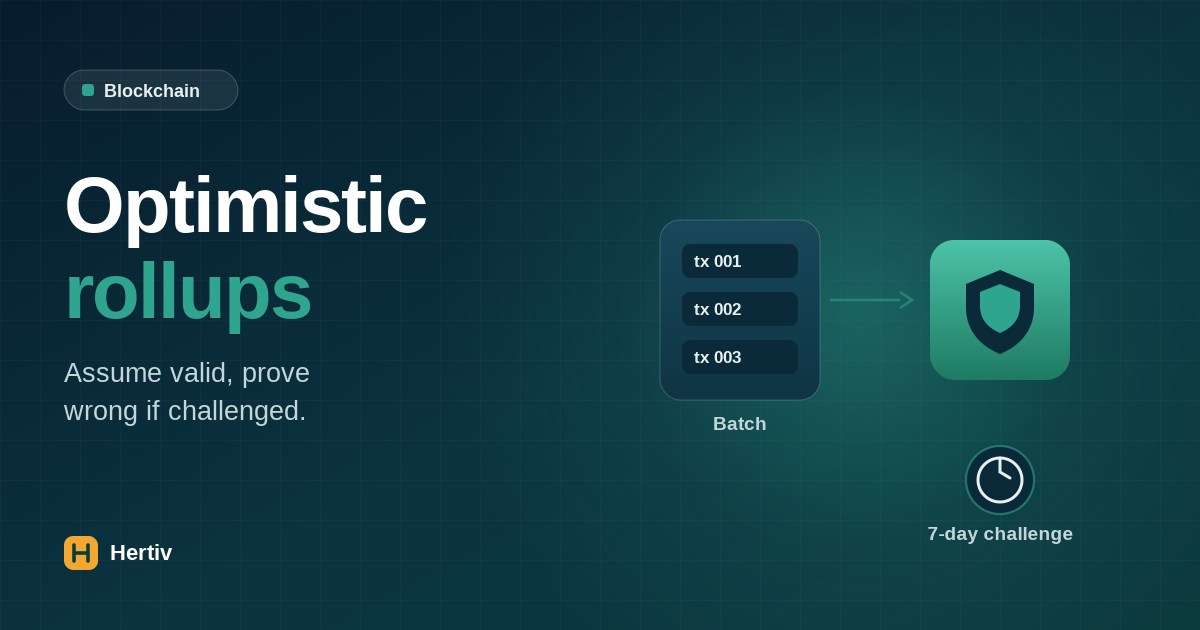
An optimistic rollup bundles transactions off-chain and assumes they are valid unless challenged. Fees fall sharply, but withdrawals wait out a challenge period.
On this page
Short answer
An optimistic rollup is a layer 2 method that executes transactions off Ethereum, posts a compressed batch to the main chain, and assumes the batch is valid unless someone proves otherwise during a challenge period. It cuts fees sharply, at the cost of waiting days for withdrawals to finalise.
What is an optimistic rollup?
An optimistic rollup is a layer 2 scaling method for Ethereum that bundles many transactions off the main chain, posts a compressed summary back to Ethereum, and assumes the transactions are valid unless someone proves otherwise. The name comes from that assumption: the network is optimistic that batches are correct.
The idea is simple. Ethereum is secure but slow and costly for every transaction, because each one must be processed by the whole network. A rollup moves the execution elsewhere: a sequencer orders transactions, executes them off-chain, and posts only the resulting state and the transaction data to Ethereum. Anyone can check the batch, and if it is wrong, they can challenge it.
Optimistic rollups are one of two main rollup designs. The other is the ZK rollup, which proves each batch is valid with cryptography instead of waiting for challenges. The optimistic design is simpler to build, which is why the earliest widely used rollups took this approach.
How does an optimistic rollup work?
An optimistic rollup works by separating execution from settlement. Execution happens off-chain on the rollup, while Ethereum holds the data and acts as the final judge when a dispute arises.
| Step | What happens | Where |
|---|---|---|
| Submit | Users send transactions to the rollup | Rollup sequencer |
| Execute | Transactions run and state updates | Off-chain |
| Post | Compressed batch data goes to Ethereum | Ethereum main chain |
| Wait | Challenge period runs for checks | Ethereum |
| Finalise | Batch is accepted as final | Ethereum |
The sequencer is the component that orders transactions and builds batches. Some rollups run a single sequencer, others plan to decentralise it. Whoever runs it, the security does not depend on trusting the sequencer, because the posted data lets anyone verify or challenge the result.
What is the challenge period?
The challenge period is a waiting window, usually around seven days, during which anyone can dispute a batch by submitting a fraud proof. If the proof shows the batch was wrong, the batch is rejected and the party that posted it can lose a bond they staked.
This waiting window is the main trade-off of the optimistic design. Transactions on the rollup itself confirm quickly, so users experience fast confirmations. But moving assets back to Ethereum requires waiting out the challenge period, because the withdrawal is only final once nobody has disputed the batch.
In practice, most users do not wait. Liquidity providers offer fast exits: they give you funds on Ethereum immediately and take the rollup funds plus a small fee once the period ends. The waiting window still matters for the design, because it is what makes fraud unprofitable.
How do optimistic rollups differ from ZK rollups?
Optimistic rollups and ZK rollups differ in how they prove a batch is correct. Optimistic rollups assume correctness and wait for challenges. ZK rollups prove correctness up front with a cryptographic proof, so there is no waiting window.
The optimistic approach is simpler to build and easier to keep compatible with Ethereum's virtual machine, which is why the first large rollups used it. The ZK approach needs complex proving machinery, but it settles faster and does not depend on watchers to catch fraud.
For most apps, the practical difference is the withdrawal time and the development cost. If fast exits matter, a ZK rollup fits better. If EVM compatibility and mature tooling matter more, an optimistic rollup is the easier choice. ZK rollups vs optimistic rollups compares the two designs in detail.
What a ZK rollup is explains the other side.
What are optimistic rollups used for?
Optimistic rollups are used for the same apps that run on Ethereum, at lower fees: decentralised exchanges, lending, payments, games and social apps. Any app where users transact often and fees on the main chain would be too high is a candidate.
They suit apps that already run on Ethereum, because contracts usually deploy with little change. A DeFi protocol can move to an optimistic rollup and keep its code, its tooling and most of its user experience, while its users pay a fraction of the main-chain fee.
They are a weaker fit where instant finality on Ethereum is required, such as a settlement that must be irreversible within minutes. In that case the challenge period is a real constraint, and a ZK rollup or the main chain itself may fit better.
Example (hypothetical): a payments app batches transfers
Example (hypothetical): a payments app processes 1,000 small transfers a day. On the Ethereum main chain, each transfer costs about $2 in fees, so 1,000 transfers cost $2,000 a day. The app's users will not pay that for small payments, so the product cannot work at main-chain prices.
The team moves the transfers to an optimistic rollup. Each transfer now costs about $0.05 in rollup fees, so 1,000 transfers cost $50 a day. The app posts one compressed batch to Ethereum, and the batch is final after the challenge period.
The saving is $1,950 a day, or about $58,500 over a 30-day month. The trade-off is that withdrawals back to Ethereum wait out the challenge period, so the team offers instant exits through a liquidity provider for users who need funds on the main chain quickly.
What are the common mistakes?
The most common mistakes with optimistic rollups are forgetting the challenge period, assuming the sequencer is the security, and skipping the bridge test.
- Forgetting the challenge period. Withdrawals take days to finalise. Design the product around that, or offer fast exits.
- Trusting the sequencer. Security comes from the posted data and fraud proofs, not from whoever orders transactions. Check that the data is actually on Ethereum.
- Skipping the bridge test. Moving assets in and out is part of the product. Test it with small amounts before launch.
- Assuming identical behaviour. Most contracts work unchanged, but gas behaviour and timing can differ. Test your actual contract.
- No plan for downtime. If the sequencer stops, users should still be able to exit. Check the escape path exists.
How to decide whether an optimistic rollup fits your app
You decide whether an optimistic rollup fits by checking your fee sensitivity, your withdrawal needs and your team's comfort with the design.
- Measure the fee problem. If main-chain fees are a real barrier for your users, a rollup is worth considering. If not, stay on the main chain.
- Check withdrawal needs. If users must exit to Ethereum quickly, plan fast exits or look at a ZK rollup instead.
- Test your contract. Deploy it on a test network and run your main flows before committing.
- Test the bridge. Move assets in and out with small amounts and confirm the experience is acceptable.
- Check the escape path. Make sure users can withdraw even if the sequencer is down.
A short test on a test network answers most of these questions in a day. If you are weighing the options, layer 3 blockchain solutions show where the ecosystem is heading next.
Ethereum development covers the build side.
Key takeaways
- Optimistic rollups assume batches are valid and rely on fraud proofs to catch errors
- The challenge period, usually around seven days, is the main trade-off
- Transactions confirm fast on the rollup; only withdrawals back to Ethereum wait
- Security comes from data posted on Ethereum, not from trusting the sequencer
- Test your contract and the bridge on a test network before committing
Frequently asked questions
What is an optimistic rollup?
It is a layer 2 scaling method that runs transactions off Ethereum and posts a compressed batch to the main chain. Batches are assumed valid unless someone submits a fraud proof during the challenge period.
Why is it called optimistic?
Because the network is optimistic that batches are correct. Instead of proving every batch up front, it waits for someone to challenge a bad one, which is simpler to build than proving validity cryptographically.
How long is the challenge period?
Usually around seven days. Transactions on the rollup confirm quickly, but moving assets back to Ethereum only becomes final after the period ends, unless a liquidity provider offers a fast exit.
What is a fraud proof?
A fraud proof is evidence submitted to Ethereum showing that a batch was executed incorrectly. If the proof checks out, the batch is rejected and the party that posted it can lose a staked bond.
How is an optimistic rollup different from a ZK rollup?
An optimistic rollup assumes correctness and waits for challenges, while a ZK rollup proves each batch valid with cryptography. ZK rollups settle faster, but optimistic rollups are simpler and easier to keep compatible with Ethereum.
Can I use an optimistic rollup with my existing contract?
In most cases, yes. Optimistic rollups are designed for EVM compatibility, so Solidity contracts usually deploy with little change. Test your actual contract on a test network first, since gas behaviour and timing can differ.


