ZK Rollups vs Optimistic Rollups: Key Differences
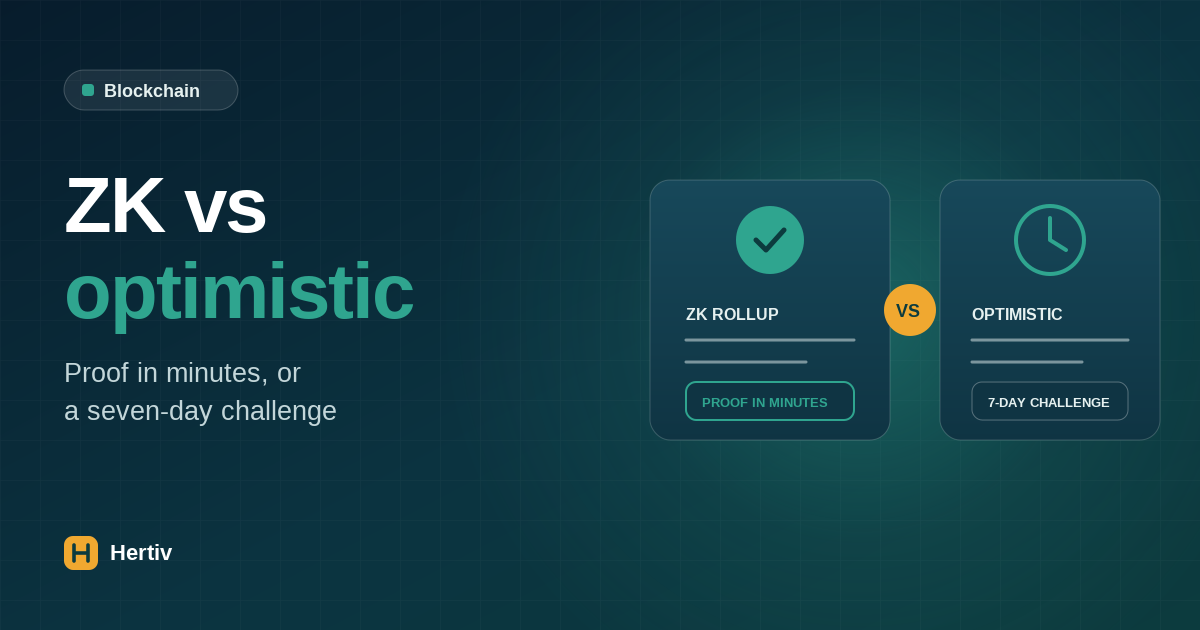
ZK rollups prove each batch correct, so settlement takes minutes. Optimistic rollups assume batches are correct and wait about seven days for challenges.
On this page
Short answer
A ZK rollup runs transactions off the main chain and posts a validity proof that shows the batch is correct, so it settles in minutes. An optimistic rollup posts results and assumes they are correct, waiting about seven days for anyone to challenge them with a fraud proof.
What is a ZK rollup?
A ZK rollup is a layer 2 scaling method that runs transactions off the main chain and posts a short cryptographic proof, called a validity proof, back to it. The proof shows that every transaction in the batch was correct, so the main chain can accept the batch without re-running each transaction.
The letters ZK stand for zero knowledge. The proof lets the main chain verify the result without seeing every detail of every transaction. In practice, that means a ZK rollup can pack thousands of transactions into one proof and settle them on the main chain for a fraction of the cost of running them there directly.
ZK rollups are used for payments, trading and games, where users want fast confirmation and low fees. The trade-off is that generating the proof takes real computing work, and building a ZK rollup is harder than building other scaling methods. The ZK rollup explainer covers how the proof works in more detail.
What is an optimistic rollup?
An optimistic rollup is a layer 2 scaling method that runs transactions off the main chain and posts the results back, assuming they are correct unless someone proves otherwise. The name comes from that assumption: the rollup is optimistic that the transactions are valid.
Instead of a proof, an optimistic rollup relies on a challenge period, usually about seven days. During that time, anyone can submit a fraud proof showing that a transaction was wrong. If the challenge succeeds, the bad batch is removed and the challenger is rewarded. If nobody challenges, the batch is treated as final.
Optimistic rollups are easier to build than ZK rollups, because they reuse the same execution model as the main chain. That is why many early layer 2 networks chose this design. The cost is the waiting period: moving funds back to the main chain takes about a week, unless a third party bridges the gap for a fee.
How do ZK rollups and optimistic rollups compare?
ZK rollups and optimistic rollups solve the same problem, high fees and slow confirmation on the main chain, but they prove correctness in opposite ways.
| Point | ZK rollup | Optimistic rollup |
|---|---|---|
| How it proves correctness | Validity proof posted with the batch | Fraud proof only if someone challenges |
| Time to finality | Minutes, once the proof is verified | About seven days, the challenge period |
| Cost per transaction | Low, but proof generation costs money | Very low, with cheaper computation |
| Moving funds back | Fast, after the proof is checked | Slow, unless a bridge is used |
| Building difficulty | Hard, needs proof circuits and tooling | Easier, reuses main-chain execution |
| Best for | Payments, trading, fast withdrawals | General apps, early launches |
The table shows the real trade-off: ZK rollups are faster to settle and safer to withdraw from, while optimistic rollups are simpler to build and cheaper to run. Neither is better in every case, and the right choice depends on what the app needs most.
How does finality differ between the two?
Finality differs because the two designs answer the question "is this batch correct?" at different times.
In a ZK rollup, the answer comes with the batch. The validity proof is checked by the main chain as soon as it arrives, so the batch is final within minutes. A user who deposits funds can withdraw them quickly, because the main chain already knows the batch is correct.
In an optimistic rollup, the answer comes after the challenge period. The batch is posted and treated as correct, but it is not final until about seven days pass without a successful challenge. A user who wants to move funds back to the main chain must wait, or pay a bridge service to take the wait and the risk instead.
That wait matters most for apps where users move money in and out often, such as trading and payments. It matters less for apps where users stay on the rollup, such as games, where most activity never touches the main chain at all. The main ZK rollup projects show how fast settlement works in live networks.
What about security and cost?
Security and cost pull in different directions for the two designs, and teams should weigh both before choosing.
On security, ZK rollups have the stronger guarantee. A bad batch cannot pass, because the proof would fail and the main chain would reject it. The risk sits in the proof code itself: a bug in the circuit or the verifier could let a bad proof through, so audits matter a great deal.
Optimistic rollups have a different risk. The design is sound only if someone is watching and ready to challenge a bad batch. If nobody checks, a bad batch could pass unchallenged. In practice, large networks have watchers and rewards for challengers, but a small or new rollup may have fewer eyes on it.
On cost, optimistic rollups are usually cheaper to run day to day, because they do not pay for proof generation. ZK rollups pay that cost, but the gap has narrowed as proof tools improved. For users, the fee difference is often small, and the withdrawal wait is usually the bigger factor.
When should a team choose each one?
A team should choose a ZK rollup when fast withdrawals and strong finality matter most, and an optimistic rollup when speed of launch and low running cost matter most.
Choose a ZK rollup for payments, trading and any app where users move funds back to the main chain often. The fast settlement is worth the extra build effort, and users notice the difference when they withdraw. Choose an optimistic rollup for a general app, a first launch, or a team that wants to reuse existing main-chain tools without learning proof engineering.
There is also a middle path. Some teams launch on an optimistic rollup, learn what their users need, and move to a ZK rollup later when the volume justifies it. That is a reasonable plan, but moving users and funds between rollups takes work, so the team should treat it as a real migration, not a weekend job. The ZK rollup use cases post shows where fast settlement pays off in practice.
Example (hypothetical): a payments app on each rollup
Example (hypothetical): a payments app processes 10,000 transfers a month. On the main chain, each transfer costs $2.00 in fees, so the month costs 10,000 times $2.00, which is $20,000.
On a ZK rollup, each transfer costs about $0.05, so the month costs 10,000 times $0.05, which is $500. Withdrawals settle in minutes, because the validity proof is checked when the batch arrives. On an optimistic rollup, each transfer costs about $0.03, so the month costs 10,000 times $0.03, which is $300, but withdrawals wait about seven days for the challenge period to end.
The app saves $19,500 a month on the ZK rollup and $19,700 on the optimistic rollup, so the fee difference is small. The deciding factor is the wait: the app's users withdraw often, so the team picks the ZK rollup and accepts the higher build cost. If users rarely withdrew, the optimistic rollup would win on simplicity and cost.
What are the common mistakes?
The most common mistakes when choosing between ZK and optimistic rollups are picking on fees alone, ignoring the withdrawal wait, and assuming the two are interchangeable.
- Choosing on fees alone. The fee gap between the two is usually small. Finality and withdrawal time matter more for most apps.
- Ignoring the seven-day wait. Users who need their funds back fast will not accept a week-long wait, and bridges that skip it charge a fee.
- Assuming the code is the same. A ZK rollup needs proof circuits and different tooling. A team that plans for an optimistic rollup cannot switch without new work.
- Skipping the audit. Both designs move real value. The proof code and the bridge should be reviewed before launch.
- Forgetting the watchers. An optimistic rollup is only as safe as the people watching it. A new rollup with few watchers is a weaker bet.
Key takeaways
- ZK rollups prove correctness up front with a validity proof; optimistic rollups assume correctness and rely on challenges
- ZK rollups settle in minutes, while optimistic rollups take about seven days to reach finality
- Optimistic rollups are simpler and cheaper to build; ZK rollups are harder but settle faster
- Withdrawal speed is usually the deciding factor, not the small fee difference
- Both designs need audits, and optimistic rollups also need watchers ready to challenge bad batches
Frequently asked questions
What is the main difference between ZK and optimistic rollups?
The main difference is how they prove a batch of transactions is correct. A ZK rollup posts a validity proof that the main chain checks at once, so the batch settles in minutes. An optimistic rollup posts the results and assumes they are correct, then waits about seven days for anyone to submit a fraud proof.
Which rollup is cheaper to use?
Optimistic rollups are usually slightly cheaper per transaction, because they do not pay for proof generation. ZK rollups pay that cost, but the gap has narrowed as proof tools improved. For most users the fee difference is small, and the withdrawal wait matters more than a few cents per transaction.
Why do optimistic rollup withdrawals take seven days?
The seven days are the challenge period. During that time, anyone can submit a fraud proof showing that a batch was wrong. Only after the period passes without a successful challenge is the batch treated as final. Bridge services can skip the wait by taking the risk themselves, for a fee.
Are ZK rollups more secure than optimistic rollups?
ZK rollups have a stronger guarantee, because a bad batch cannot pass when the proof check fails. Optimistic rollups are safe only if someone is watching and ready to challenge a bad batch. Both designs still need audits, since a bug in the proof code or the bridge can cause real losses.
Can a team switch from one rollup type to the other?
Yes, but it is a real migration, not a quick switch. A ZK rollup needs proof circuits and different tooling, while an optimistic rollup reuses main-chain execution. Moving users, funds and contracts takes planning, testing and a clear communication plan for users.
Which rollup should a new app choose?
Choose a ZK rollup if your users move funds back to the main chain often, such as in payments or trading. Choose an optimistic rollup if you want the fastest launch and lowest running cost, and your users mostly stay on the rollup. Start from what your users do, not from which design is newer.


