ZK Rollup Projects Worth Knowing, and What Each One Does
Six ZK rollup projects lead the field, each with a different trade between compatibility, speed and design. Compare them and pick by what your app already uses.
On this page
Short answer
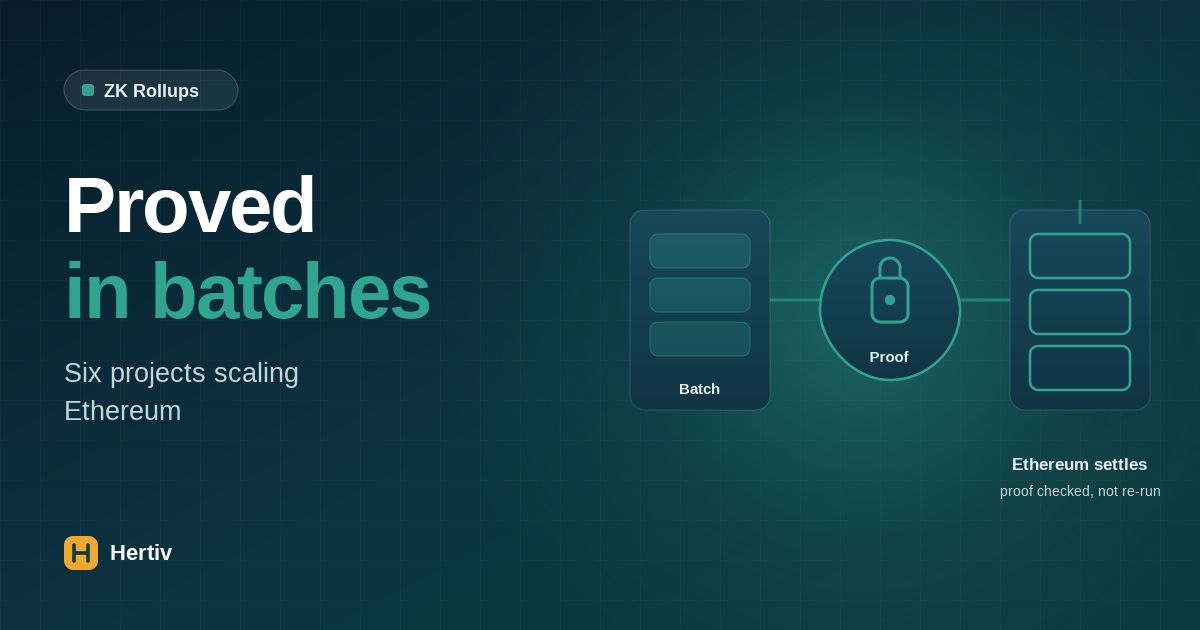
ZK rollups are systems that run transactions off the main Ethereum chain, bundle them together, and prove the bundle is correct with a cryptographic proof. The six projects below lead the field, each with a different trade between compatibility, speed and design, and the right pick depends on what your app already uses.
Which ZK rollup projects should you know?
ZK rollups are systems that run transactions off the main Ethereum chain, bundle them together, and prove the bundle is correct with a cryptographic proof. The main chain then checks the proof instead of re-running every transaction, which is how the rollup scales. The table below maps the six projects that matter most today.
| Project | What it is | Best for |
|---|---|---|
| zkSync Era | ZK rollup built for general apps | Teams that want Ethereum compatibility |
| Starknet | ZK rollup with its own language, Cairo | Teams building new kinds of apps |
| Polygon zkEVM | ZK rollup from the Polygon team | Teams already on Polygon |
| Scroll | ZK rollup aiming for full compatibility | Teams moving existing apps unchanged |
| Linea | ZK rollup from Consensys | Teams that want MetaMask and Infura links |
| Taiko | ZK rollup built to match Ethereum exactly | Teams that want the closest match to Ethereum |
None of these is a ranking. Each one makes a different trade between compatibility, speed and design, and the right pick depends on what your app already uses and what it needs to do. For the mechanics behind them, see what a ZK rollup is.
1. zkSync Era: best for teams that want Ethereum compatibility
zkSync Era is a ZK rollup built for general applications, with the aim of letting developers write contracts much as they would on Ethereum itself. It supports the common tooling and languages that Ethereum teams already know, so a team can move an app without rewriting it from scratch.
Its design puts compatibility first: the rollup runs the same kind of contracts, and users pay fees in the same currency they already hold. That makes it a natural first look for a team that wants lower fees and faster confirmations without changing how it builds.
Pros:
- Familiar tools: Ethereum tooling and languages carry over
- General purpose: built for ordinary apps, not one niche
- Active ecosystem: wallets, bridges and apps already live on it
Cons:
- Not a perfect copy: some Ethereum features behave differently, so test before moving
- Newer codebase: the prover and sequencer are still maturing
- Bridge risk: moving funds between chains always carries its own risk
2. Starknet: best for teams building new kinds of apps
Starknet is a ZK rollup that takes a different path: instead of copying Ethereum exactly, it uses its own language, Cairo, and its own way of writing contracts. The trade is more work to learn, in exchange for more freedom in what an app can do.
That freedom suits teams building something new rather than moving an existing app. Games, complex financial products and apps that need heavy computation on-chain are the cases where Starknet's design earns its keep.
Pros:
- Designed for scale: built from the start for high-throughput apps
- New possibilities: Cairo allows logic that is hard to express elsewhere
- Strong research roots: the team behind it has worked on the maths for years
Cons:
- New language to learn: Cairo is not Solidity, so the team must learn it
- Smaller tooling set: fewer ready-made tools than the Ethereum-compatible rollups
- Moving an existing app costs more: a rewrite, not a copy
3. Polygon zkEVM: best for teams already on Polygon
Polygon zkEVM is a ZK rollup from the Polygon team, built to run Ethereum contracts with as little change as possible. A team that already builds on Polygon can move to the rollup while keeping its tools, its wallets and its habits.
Its strength is the ecosystem around it. Polygon has spent years building wallets, bridges and developer tools, and the zkEVM inherits that work. For a team that already knows Polygon, the rollup is a shorter step than starting somewhere new.
Pros:
- Polygon ecosystem: wallets, bridges and tools already exist
- Ethereum-compatible contracts: most contracts move with small changes
- Known team: Polygon has shipped chains and tools for years
Cons:
- Still maturing: the prover and the network are newer than the Polygon sidechain
- Fees vary: costs depend on load, so check them at your volume
- One vendor's roadmap: the direction is set mainly by one team
4. Scroll: best for teams moving existing apps unchanged
Scroll is a ZK rollup that aims for the closest possible match to Ethereum, so that an existing app can move without changing its code. The idea is simple: if the rollup behaves like Ethereum, the team does not need to learn anything new.
That aim suits teams with a working app on Ethereum that has grown expensive to run. Moving it to Scroll keeps the code, the tests and the tooling, and the main work is the migration itself: bridging assets, testing the app on the rollup, and watching it in production.
Pros:
- Minimal changes: existing contracts move with little or no rewrite
- Familiar workflow: the same tools and tests keep working
- Clear purpose: one goal, done well, instead of many features
Cons:
- Younger ecosystem: fewer apps and tools live on it than on older rollups
- Compatibility takes time: matching Ethereum exactly is hard, and edge cases remain
- Sequencer centralisation: early rollups often run one sequencer, which is a trust point
5. Linea: best for teams that want MetaMask and Infura links
Linea is a ZK rollup from Consensys, the team behind MetaMask and Infura. Its strength is the link to those tools: a team that already builds with MetaMask and Infura can reach Linea through the same stack it already uses.
That link matters for user experience. A wallet that already works, a provider that already serves the app, and a rollup that accepts the same contracts make the move shorter than it looks on paper.
Pros:
- MetaMask and Infura links: the tools most Ethereum users already have
- Ethereum-compatible: contracts move with small changes
- Backed by a known team: Consensys has built Ethereum tooling for years
Cons:
- Newer network: the ecosystem is smaller than the older rollups
- Fees depend on load: check the cost at your volume before committing
- One team's direction: the roadmap is set mainly by Consensys
6. Taiko: best for teams that want the closest match to Ethereum
Taiko is a ZK rollup built to match Ethereum as closely as possible, even at the cost of speed. It reuses Ethereum's own rules for ordering and execution, so a contract that works on Ethereum should work on Taiko in the same way.
That choice suits teams that value correctness over novelty. If the app is a financial product or a contract that must behave exactly as it does on Ethereum, the closest match is worth more than the fastest rollup.
Pros:
- Closest to Ethereum: the same rules, the same behaviour
- No new language: Solidity contracts move as they are
- Decentralised aim: the design plans for many provers, not one
Cons:
- Slower by design: matching Ethereum exactly costs speed
- Newer ecosystem: fewer apps and tools than the older rollups
- Still early: the network is younger, so expect change
How to choose a ZK rollup project
You choose a ZK rollup project by matching it to the app you already have, not by counting features.
- Start from your contracts. If your app is written in Solidity and you want it to move unchanged, shortlist the Ethereum-compatible rollups. If you are building something new, Starknet is worth a look.
- Check the tooling. Can your team keep its wallet, its provider and its tests? A rollup that fits your stack is worth more than a faster one that does not.
- Test a real migration. Move one contract, run your tests against it, and bridge a small amount first. A demo migration hides the rough edges.
- Check the fees at your volume. Fees depend on load and on how your app uses the chain. Work out the monthly cost at your volume, not at the volume in a blog post.
- Check the trust points. Who runs the sequencer, who can upgrade the contracts, and what happens if they stop? Write the answers down before you commit.
For teams weighing the wider chain decision, Ethereum development covers how teams choose between chains.
The Polygon side of the same question is covered in Polygon development.
What are the common mistakes?
The most common mistakes are picking the fastest rollup by default, skipping the migration test, and ignoring the trust points.
- Choosing on speed alone. A rollup that is fast but does not run your contracts is not useful. Compatibility and tooling matter more than headline speed.
- Skipping the migration test. Moving a contract without testing it on the rollup hides differences in behaviour until they affect real users.
- Ignoring the sequencer. Early rollups often run one sequencer. If it stops, the rollup stops, so know who runs it and what the fallback is.
- Forgetting the bridge. Moving funds between chains is a separate risk from the rollup itself. Use a bridge you have checked, and move small amounts first.
- Treating a rollup as Ethereum. A rollup is not Ethereum. Fees, finality and failure modes differ, and your app should handle those differences.
Each mistake has the same root: the team chose on a headline instead of on a test. A short migration test on real contracts answers most of the questions that matter.
Key takeaways
- ZK rollups scale Ethereum by proving bundles of transactions instead of re-running them
- zkSync Era, Polygon zkEVM, Scroll, Linea and Taiko aim for Ethereum compatibility
- Starknet trades compatibility for new kinds of apps in its own language, Cairo
- Pick by your contracts and tooling, not by headline speed
- Test a real migration and check fees and trust points before committing
Frequently asked questions
What is a ZK rollup?
A ZK rollup is a system that runs transactions off the main Ethereum chain, bundles them together, and proves the bundle is correct with a cryptographic proof. The main chain checks the proof instead of re-running every transaction, which is how the rollup scales.
Which ZK rollup is best?
There is no single best option. Teams moving existing Solidity apps should shortlist zkSync Era, Polygon zkEVM, Scroll, Linea or Taiko, while teams building something new may prefer Starknet. Test a real migration on your own contracts before deciding.
Do I need to rewrite my contracts to use a ZK rollup?
Usually not, if you pick an Ethereum-compatible rollup. Most Solidity contracts move with small changes or none at all. Starknet is the exception: it uses its own language, Cairo, so moving an existing app there means a rewrite.
Are ZK rollups cheaper than Ethereum?
Usually, because many transactions share one proof and one main-chain check. The exact cost depends on load and on how your app uses the chain, so work out the monthly cost at your volume rather than trusting a headline figure.
What is the risk of using a ZK rollup?
The main risks are the bridge that moves funds between chains, the sequencer that orders transactions, and the upgrade keys that can change the rollup's contracts. Check who runs each one and what happens if they stop, before you commit.
What is the difference between a ZK rollup and an optimistic rollup?
A ZK rollup proves each bundle is correct with a cryptographic proof, so the main chain can accept it at once. An optimistic rollup assumes bundles are correct and waits for a challenge period, so withdrawals take longer. The ZK path is faster to settle; the optimistic path is simpler to build.


