ZK Rollup Use Cases: Where They Work in Practice
ZK rollups move most work off the main chain and post a short proof back, cutting fees and confirmation time. Here are the use cases where that trade-off pays off.
On this page
Short answer
ZK rollups are useful where many small actions must be recorded and verified cheaply, such as payments, trading, games and identity, because they batch transactions off chain and post a single validity proof to the main chain for final settlement.
What is a ZK rollup use case?
A ZK rollup use case is a situation where a blockchain application moves most of its work off the main chain and posts a short cryptographic proof back to it, so users get lower fees and faster confirmation without giving up the security of the main chain. The rollup batches many transactions together, computes a validity proof, and the main chain only has to check that proof.
This pattern fits any application where many small actions need to be recorded and verified, but the main chain is too slow or too costly for each one. Payments, trading, games and identity checks all share that shape: lots of activity, each item small, and a clear need to prove that nothing was faked.
ZK rollups are not a good fit for every job. They work best where the rules of the application can be written as a circuit the prover can check, and where the data needed to rebuild the state stays available. When the logic is too open-ended or the data is private by design, other scaling designs may fit better.
| Use case | Why it fits | Watch out |
|---|---|---|
| Payments | Many small transfers, shared proof cost | Withdrawal time to the main chain |
| Trading | Frequent orders, low fees per trade | Thinner liquidity at the start |
| Games and NFTs | Frequent item actions, provable ownership | Only pays off with heavy item economies |
| Identity | Proofs without revealing private data | Needs extra design for privacy |
You can read the basics first in what a ZK rollup is before comparing the use cases below.
How does a ZK rollup actually work?
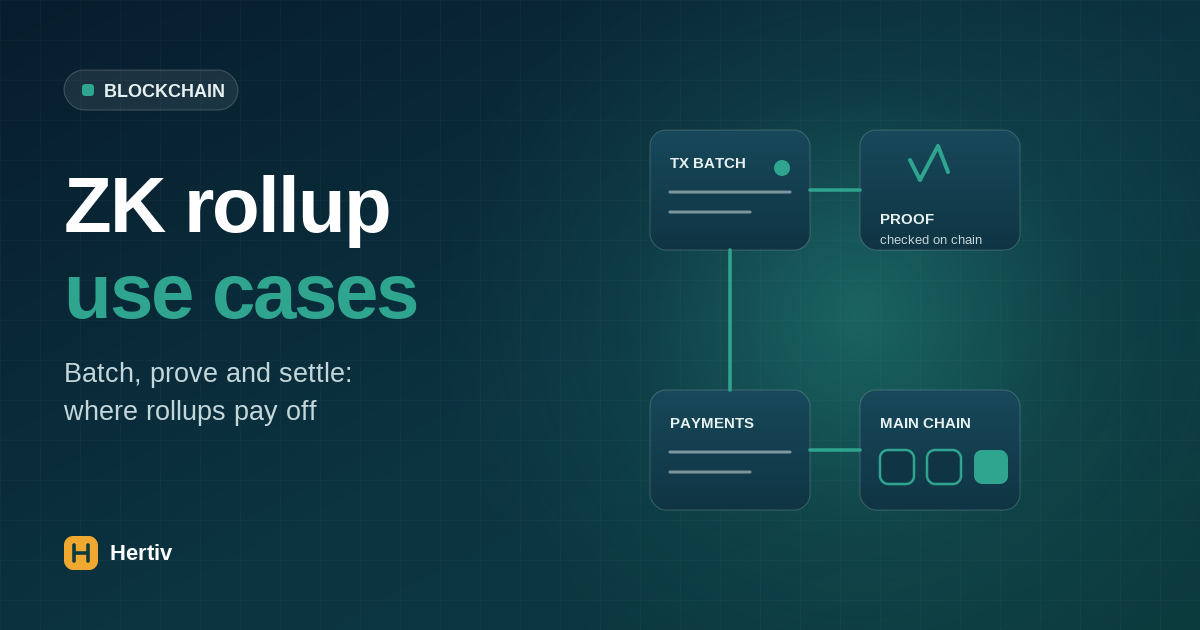
A ZK rollup works by running transactions on a separate layer, grouping them into a batch, and generating a validity proof that the batch followed the rules. The batch and the proof are posted to the main chain, which verifies the proof instead of re-running every transaction.
The key pieces are the sequencer, which orders transactions; the prover, which builds the proof; and the smart contract on the main chain, which checks the proof and updates the state root. Because the proof is checked on chain, a dishonest batch cannot be accepted even if the operator is untrusted.
Users withdraw funds by proving ownership against the latest state root, so the main chain remains the place where value is finally settled. This is why teams compare rollups with the projects already live, as in the main ZK rollup projects, before choosing one for a product.
Where do ZK rollups help payments?
ZK rollups help payments where many small transfers need to settle quickly and cheaply, such as remittances, payroll for distributed teams, and micropayments inside apps. A single batch can carry hundreds of transfers, so the cost of the main-chain proof is shared across all of them.
For a payments product, the important numbers are confirmation time, fee per transfer and how quickly a user can withdraw to the main chain. A rollup that confirms in seconds but takes hours to withdraw may suit everyday spending and suit a wallet less well for large settlements, so the team has to match the design to the flow of money.
Stablecoins are a common pairing here, because the value stays steady while the rollup keeps the transfer cost low. The combination is already used for cross-border payouts where card rails are slow or costly, and it is one of the clearest places where the technology pays for itself.
What about trading and DeFi?
ZK rollups help trading and DeFi where orders, swaps and liquidations happen far more often than the main chain can handle. A decentralised exchange on a rollup can match orders quickly and post only the net result on chain, which keeps fees low even when the market is busy.
The trade-off is liquidity. A rollup exchange starts with a smaller pool of funds than a main-chain exchange, so large orders may move the price more. Teams handle this by bridging liquidity in stages, by sharing liquidity across rollups, or by starting with pairs that already have deep markets.
Privacy is a second benefit in some designs. A rollup can hide the details of individual trades while still proving that the batch is valid, which matters for funds and market makers that do not want their positions visible. This is a niche use today, but it is one of the reasons trading teams keep watching the field.
How are ZK rollups used in games and NFTs?
ZK rollups are used in games and NFTs where players make many small actions, such as minting an item, trading it, or recording a result, and each action must be owned and checkable. Putting every move on the main chain would cost too much and take too long, so the game runs on a rollup and only the proof goes on chain.
For a game, the rollup also changes the design. Items can be minted in large batches, seasonal events can run without fee spikes, and players can trade without waiting for main-chain confirmation. The game keeps the main chain as the place where ownership is finally recorded, which is what makes the items portable between games and marketplaces.
Not every game needs this. A game with a few large transactions, or one where ownership does not matter, gains little from a rollup. The fit is strongest for games with heavy item economies and frequent trades, where the cost of each on-chain action would otherwise eat the value of the item itself.
Example (hypothetical): a payments app on a ZK rollup
Example (hypothetical): a small payments app lets freelancers receive pay from clients abroad. On the main chain, each payment costs about $4 in fees and takes a minute to confirm, so a $50 payment loses 8% to fees and the team cannot offer instant payouts.
The team moves the app to a ZK rollup. Payments are batched, and the proof is posted to the main chain every few minutes. The fee per payment falls to about $0.05, and confirmation takes a few seconds. A $50 payment now loses 0.1% to fees, and the team can offer same-day payouts.
The team keeps the main chain as the settlement layer. Withdrawals to the main chain take longer than rollup transfers, so the team tells users that large withdrawals may take up to an hour, while everyday payments stay instant. The arithmetic is simple: 1,000 payments a month at $4 is $4,000 in fees, while at $0.05 it is $50, a saving of $3,950 a month that the team passes on as lower fees.
What are the common mistakes?
The most common ZK rollup mistakes are choosing the technology before the use case, ignoring withdrawal time, and assuming every rollup offers the same security.
- Picking a rollup for the name, not the fit. A rollup built for general smart contracts may be the wrong choice for a payments-only app, and the reverse is also true.
- Forgetting withdrawal time. Some designs need hours before funds can move back to the main chain, which breaks products that promise instant settlement.
- Assuming privacy is included. Most rollups are transparent by default. Privacy needs extra design, not just the word zero-knowledge.
- Ignoring data availability. If the data behind a batch is not available, users cannot rebuild the state or exit safely.
- Skipping the cost model. Proof generation has a real cost, and it changes with batch size, so teams should test with real volumes before launch.
How do you choose a ZK rollup use case?
You choose a ZK rollup use case by checking three things: the volume of small actions, the need for main-chain security, and whether the rules can be proved.
- Count the actions. If the product records dozens of small actions per user per day, a rollup can cut costs sharply. A handful of large actions gains little.
- Check the security need. If users must be able to verify the result on the main chain, a validity proof is the right tool. If trust in one operator is acceptable, a simpler design may do.
- Test the withdrawal path. Move funds in and out with real amounts before promising instant settlement to users.
- Price the proof. Measure proof generation cost at the expected batch size, not at the size in a demo.
- Plan the exit. Make sure users can leave with their funds even if the rollup operator stops working.
For teams building on this stack, blockchain development support can help with the choice between a general rollup, an app-specific rollup and staying on the main chain.
Key takeaways
- ZK rollups cut fees by batching many small actions and proving them once on chain
- Payments, trading, games and NFTs fit best because each action is small and frequent
- Withdrawal time and proof cost are the two limits teams most often overlook
- Privacy is not automatic: most rollups are transparent unless extra design is added
- Choose by action volume, security need and a tested exit path, not by the rollup name
Frequently asked questions
What is a ZK rollup in simple terms?
A ZK rollup is a layer-2 design that runs transactions off the main chain, groups them into a batch and posts a short validity proof to the main chain. The main chain checks the proof instead of re-running every transaction, which keeps fees low while keeping main-chain security.
Are ZK rollups safe?
They are as safe as the proof system and the data availability behind them. The main chain rejects any batch whose proof does not check out, so a dishonest operator cannot steal funds by posting a false batch. Users still need a working exit path if the operator stops.
What is the difference between a ZK rollup and an optimistic rollup?
A ZK rollup posts a validity proof that is checked at once, so withdrawals are fast. An optimistic rollup assumes batches are valid and waits for a challenge period, usually days, before funds can be withdrawn. The ZK design is faster to settle but harder to build.
Do ZK rollups work for private transactions?
Not by default. Most ZK rollups are transparent: anyone can see the transactions in a batch. Privacy needs extra design, such as shielded pools or private inputs, and that design brings its own costs and audit needs.
Can a ZK rollup run any smart contract?
Some can run general smart contracts, while others are built for one job such as payments or trading. General-purpose rollups are more flexible but slower to prove, so teams should match the rollup type to the application before building.
How much do ZK rollups cost to use?
Fees vary by rollup, batch size and main-chain congestion, so there is no single figure. As a rule, a rollup transfer costs far less than a main-chain transfer, and teams should measure the fee at their own expected volume rather than trusting a demo number.


