Layer 3 Blockchain Solutions Worth Knowing
Layer 3 chains give one app its own block space on top of a layer 2. Compare six live solutions, from game chains to app-specific ZK chains, and pick the right one.
On this page
Short answer
Layer 3 blockchain solutions are dedicated chains that settle on a layer 2, giving one app its own fees, rules and throughput instead of sharing a busy network. The live options range from game chains like Xai to frameworks like Arbitrum Orbit and zkSync Hyperchains.
Which layer 3 blockchain solutions are worth knowing?
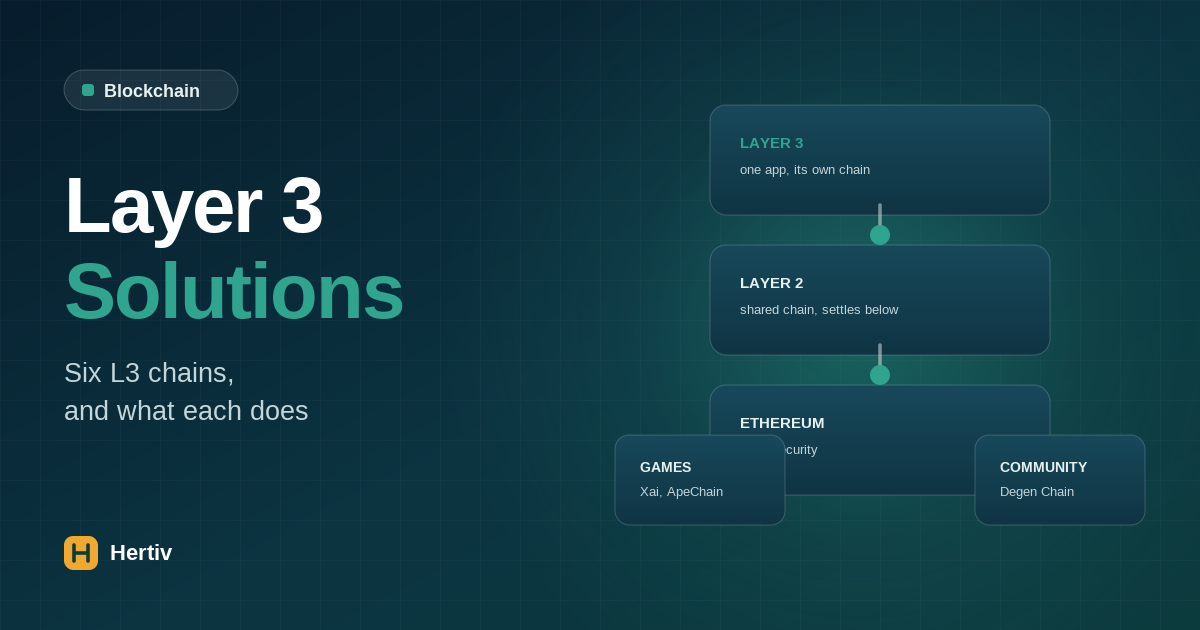
Layer 3 solutions are application-specific chains that settle on a layer 2, which in turn settles on Ethereum. They exist because a busy general-purpose chain is a poor fit for one app that needs its own fees, rules and throughput. A layer 3 gives that app its own space while still borrowing security from the layers below it.
Use this comparison to shortlist. Every entry below is a live network or framework that teams are building on now.
| Solution | Built on | Main use | Best for |
|---|---|---|---|
| Degen Chain | Base via Arbitrum Orbit | Tipping and social apps | Community tokens |
| Xai | Arbitrum Orbit | Web3 games | Game studios |
| ApeChain | Arbitrum Orbit | ApeCoin apps and games | NFT communities |
| Arbitrum Orbit | Ethereum via Arbitrum | Custom layer 3 chains | Teams that want their own chain |
| zkSync Hyperchains | zkSync Era | App-specific chains | Teams that need ZK proofs |
| Orbs | Ethereum | Extra execution for apps | DeFi and trading apps |
Pick from the problem, not the brand. A chain built for games will not help a payments app, and a general framework will not help a team that only needs one feature.
<h3>1. Degen Chain: best for community tipping and social apps</h3>
Degen Chain is a layer 3 built for the Degen community, where the DEGEN token started as a tipping token on a social network. It runs on Base through Arbitrum Orbit, so transactions settle cheaply and quickly enough for tipping, small payments and social apps that would be too costly on a main chain.
The chain shows what layer 3 is for: a community with one clear use case gets its own block space instead of competing with every other app on a shared chain. Fees stay low because the chain serves a narrow set of transactions.
Pros
- Very low fees for small, frequent transactions
- Built around an existing community with real users
- Settles through Base and Ethereum, so it keeps a link to larger networks
Cons
- Narrow focus: it is built for one community, not general apps
- Depends on Base and Arbitrum Orbit working well
- Smaller developer ecosystem than a large layer 2
<h3>2. Xai: best for Web3 games</h3>
Xai is a layer 3 built for games, running on Arbitrum Orbit. It is designed so that players can trade in-game items and move assets without paying high fees or waiting long for confirmation. Game studios use it to give players real ownership of items while keeping the game itself fast.
The chain handles the parts of a game that need a ledger, such as item ownership and trades, while the game logic runs off chain. That split is the usual pattern for Web3 games: the chain stores what must be owned and traded, and the game server runs the rest.
Pros
- Built for games, with low fees and fast confirmation
- Supports item trading and ownership out of the box
- Backed by Arbitrum technology, which many teams already know
Cons
- Focused on games, so it fits few other use cases
- Game economies still need careful design to avoid inflation
- Depends on the Arbitrum Orbit stack
<h3>3. ApeChain: best for ApeCoin apps and NFT communities</h3>
ApeChain is a layer 3 built for the ApeCoin community and its apps, including games and NFT projects. It also runs on Arbitrum Orbit, and it uses ApeCoin as its gas token, so the community token pays for transactions on the chain.
The idea is the same as Degen Chain: a community with its own token and its own apps gets its own chain. Developers building for that community can count on low fees and on users who already hold the token. The chain also supports the kind of apps NFT communities build, such as games, marketplaces and membership tools.
Pros
- Gas paid in ApeCoin, which fits the community it serves
- Low fees for games and NFT apps
- Clear audience: builders targeting the ApeCoin community
Cons
- Useful mainly inside one community
- Newer than the larger layer 2 networks, so tooling is still growing
- Token price swings change the real cost of gas
<h3>4. Arbitrum Orbit: best for teams that want their own chain</h3>
Arbitrum Orbit is not one chain but a framework for launching your own layer 3. Teams use it to spin up a dedicated chain on top of Arbitrum, choosing their own gas token, governance rules and throughput. It is the stack behind Degen Chain, Xai and ApeChain.
Orbit matters because most layer 3 projects do not build a chain from scratch. They take the Orbit stack, set the parameters that fit their app, and launch. That is why so many layer 3 names share the same base: they are different chains built from the same toolkit.
Pros
- Full control over gas token, fees and chain rules
- Well-tested stack used by several live chains
- Settles through Arbitrum to Ethereum for security
Cons
- You run a chain, not just an app, so operations are heavier
- Needs a team that can maintain infrastructure
- Interoperability with other chains needs extra work
<h3>5. zkSync Hyperchains: best for app chains with ZK proofs</h3>
zkSync Hyperchains are app-specific chains built on the zkSync stack, using zero-knowledge proofs to settle on Ethereum. The proof-based design is the main difference from the Orbit chains above: instead of posting transaction data and waiting for a challenge window, a Hyperchain posts a proof that its transactions are valid.
That design suits teams that want fast finality and strong privacy options. A Hyperchain can also share liquidity and messaging with other chains in the zkSync ecosystem, which helps apps that need to talk to each other. The trade-off is complexity: zero-knowledge tooling is harder to work with than a standard rollup stack.
Pros
- Fast finality through zero-knowledge proofs
- Can share liquidity with other zkSync chains
- Strong option when privacy matters
Cons
- Harder to build on than a standard optimistic stack
- Smaller set of live Hyperchains to learn from
- Proof generation adds its own costs
For the proof model itself, see what is a ZK rollup.
The projects using this design are listed in top ZK rollup projects.
<h3>6. Orbs: best for DeFi apps that need extra execution</h3>
Orbs is a layer 3 execution layer that sits alongside a main chain and runs the extra logic that a smart contract cannot handle well on its own. Decentralised exchanges and trading apps use it for things like limit orders, stop-loss orders and decentralised backends that need to run on a schedule.
Orbs does not try to be a general chain. It is a decentralised set of nodes that executes specific jobs for apps on Ethereum and other networks, and it returns the results on chain. That makes it useful for DeFi teams that need off-chain computation with on-chain verification, rather than a whole new chain.
Pros
- Adds execution power without moving the app to a new chain
- Suits trading features like limit and stop orders
- Works with several base chains, not just one
Cons
- Not a general-purpose chain for any app
- Requires integration work per feature
- Smaller ecosystem than the big rollup stacks
How to choose a layer 3 solution
Choose a layer 3 by the app you are building, not by which chain is talked about most. The right choice follows from your users, your transactions and your team's skills.
- Name the one job the chain must do. Games need fast, cheap item trades. DeFi needs reliable execution. A community token needs low-fee tipping. Write the job down before comparing chains.
- Check what settles underneath. Most layer 3 chains settle through a layer 2 to Ethereum. Make sure you are comfortable with that base layer and its fees.
- Test with real transactions. Send the transactions your app will send, at the volume you expect, and measure fees and confirmation time. Marketing claims will not tell you this.
- Count the operating cost. A dedicated chain means monitoring, upgrades and incident response. A framework like Orbit or a Hyperchain still needs someone watching it.
- Check the tooling your team knows. If your developers already work with Arbitrum or zkSync tools, the matching layer 3 will be faster to build on than an unfamiliar stack.
If the app does not need its own chain, a layer 2 is usually enough. A layer 3 is for apps whose traffic or rules justify separate block space. The guide to smart contract development covers the build steps once the chain choice is made.
What are the common mistakes?
Teams make the same mistakes with layer 3 chains as with any new infrastructure: they pick the chain first and the use case second.
- Launching a chain for one small app. If your app sends a few hundred transactions a day, a shared chain is cheaper and simpler than running your own.
- Ignoring the base layer. A layer 3 is only as reliable as the layer 2 and layer 1 below it. Check their fees, outages and upgrade plans too.
- Assuming low fees last forever. Fees depend on demand and on the token used for gas. A chain that is cheap while quiet can get expensive as it fills up.
- Skipping the bridge risk. Moving assets between layers uses bridges, which are a known point of failure. Plan for bridge limits and downtime.
- Building without users. A chain with no users is an expensive empty room. Prove the app has demand on a shared chain first, then move it to its own layer 3.
Key takeaways
- Layer 3 chains sit on a layer 2, which settles on Ethereum, giving one app its own block space
- Game and community chains like Xai, Degen Chain and ApeChain serve one audience with low fees
- Arbitrum Orbit and zkSync Hyperchains are frameworks for launching your own layer 3
- Orbs adds execution power to existing chains instead of being a chain itself
- Ship on a layer 2 first; move to a layer 3 only when fees or throughput force the move
Frequently asked questions
What is a layer 3 blockchain?
A layer 3 is an application-specific chain that settles on a layer 2, which in turn settles on a main chain like Ethereum. It gives one app or community its own block space, fees and rules, while still borrowing security from the layers below it.
How is a layer 3 different from a layer 2?
A layer 2 is a shared chain that serves many apps and settles on Ethereum. A layer 3 is narrower: it serves one app, community or use case and settles on a layer 2. The layer 3 trades generality for dedicated throughput and custom rules.
Do I need a layer 3 for my app?
Usually not at first. Most apps run fine on a layer 2, which is cheaper and simpler to operate. A layer 3 makes sense when your app sends enough transactions that shared-chain fees hurt, or when it needs rules a shared chain cannot offer.
Are layer 3 chains secure?
A layer 3 inherits security from the layers below it, but it adds its own risks: its bridge, its sequencer and its operators. Check how the chain settles, who runs it, and what happens if a bridge or sequencer goes down before you commit.
What does it cost to run a layer 3 chain?
Costs vary widely and change with demand, so check the chain's own fee page rather than trusting a quoted figure. Budget for the chain's gas, the base layer fees underneath it, and the team time to monitor and upgrade the infrastructure.
Which layer 3 is best for games?
Chains built for games, such as Xai, are the usual starting point because they are tuned for fast, cheap item trades. ApeChain fits games aimed at the ApeCoin community. Test your game's actual transactions on each candidate before choosing.


