Top 10 Blockchain Rollups to Compare Before You Build
Rollups move work off the main chain so apps run faster and cheaper, but they differ in proof type, speed and ecosystem. Compare ten of them before you choose.
On this page
Short answer
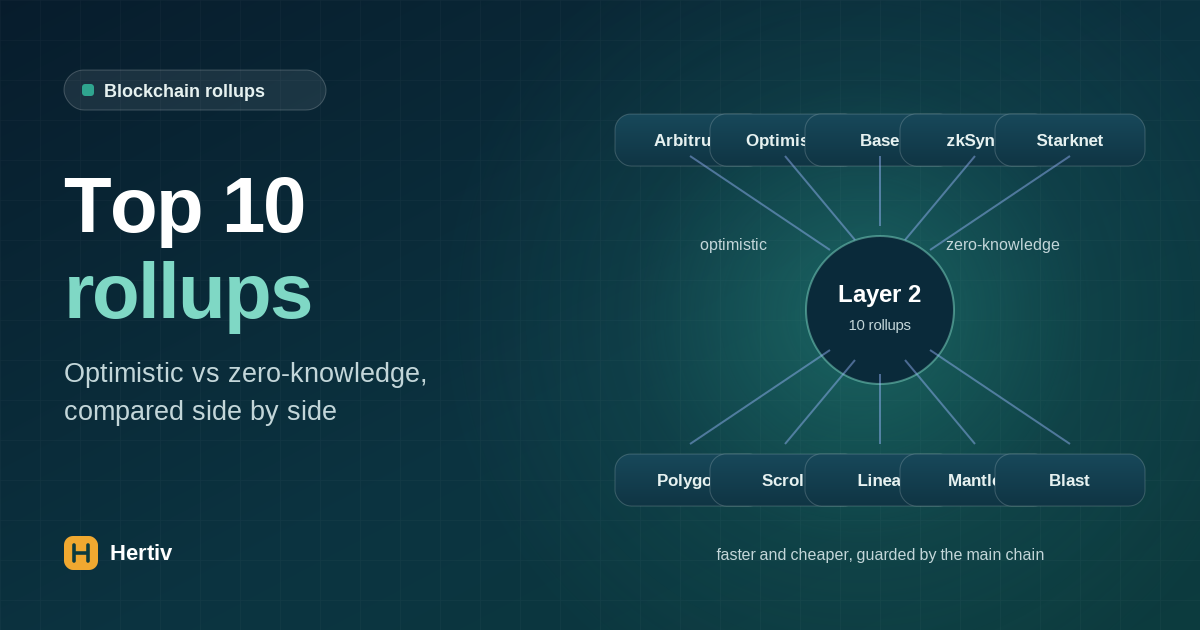
The ten blockchain rollups most teams compare are Arbitrum One, Optimism, Base, zkSync Era, Starknet, Polygon zkEVM, Scroll, Linea, Mantle and Blast. Optimistic rollups assume transactions are valid and check them only when challenged, while zero-knowledge rollups prove each batch with cryptography. The right choice depends on your app's need for speed, cost, tooling and the ecosystem your users already use.
What are blockchain rollups?
A rollup is a chain that runs on top of a main chain, usually Ethereum, and posts its results back to it. It does the heavy work off the main chain, so apps run faster and cost less to use, while the main chain still guards the final record.
The ten rollups below cover the main choices a team faces. Use the table to compare them at a glance, then read the two that fit your app. Every rollup has a short list of strengths and risks. If you need help scoping a rollup build, blockchain development services cover the chain choice as part of the plan.
| Rollup | Proof type | Best for | Notes |
|---|---|---|---|
| Arbitrum One | Optimistic | Large DeFi apps | Largest DeFi ecosystem |
| Optimism | Optimistic | Simple tooling | Close to Ethereum tools |
| Base | Optimistic | Reaching new users | Built by Coinbase |
| zkSync Era | Zero-knowledge | Fast finality | Proof-based security |
| Starknet | Zero-knowledge | High-throughput apps | Uses the Cairo language |
| Polygon zkEVM | Zero-knowledge | Ethereum-compatible apps | Runs Ethereum code easily |
| Scroll | Zero-knowledge | Faithful Ethereum copy | Matches Ethereum closely |
| Linea | Zero-knowledge | ConsenSys tool users | Works with MetaMask |
| Mantle | Optimistic | Modular design | Grants for early apps |
| Blast | Optimistic | Native yield | Yield on deposits by default |
Arbitrum One and Optimism
1. Arbitrum One: best for large DeFi apps
Arbitrum One is an optimistic rollup with a large DeFi ecosystem and broad tooling support. Teams building trading, lending or yield products find the contracts, wallets and analytics they need already in place.
Its size is its strength: more users, more liquidity and more examples to learn from. The trade-off is that withdrawals back to the main chain take about a week under the optimistic model, unless a faster bridge is used. Many of the largest DeFi apps run here; a look at popular DeFi use cases shows what those apps do.
Pros
- Largest DeFi ecosystem among rollups
- Broad tooling and wallet support
- Well-tested contracts and bridges
Cons
- Main-chain withdrawals take about a week
- Fees rise when the network is busy
- Large ecosystem means more competition for users
2. Optimism: best for teams that value simple tooling
Optimism is an optimistic rollup built to stay close to Ethereum's own tools, so code written for Ethereum usually runs with small changes. Teams that want a short move from the main chain find the switch easy.
Optimism also runs a shared network of chains, sometimes called a superchain, where chains share security and tooling. The same one-week withdrawal wait applies, as with other optimistic rollups.
Pros
- Close to Ethereum tooling
- Short move for existing Ethereum apps
- Shared network of related chains
Cons
- Withdrawals take about a week
- Fewer native apps than the largest rollup
- Shared standards are still forming
Base and zkSync Era
3. Base: best for reaching new users
Base is an optimistic rollup built by Coinbase, and it draws users from the exchange's large customer base. Apps that need new users rather than only crypto-native ones find a ready audience there.
Base keeps fees low and tools close to Ethereum, which makes it a friendly place to launch a first app. Its link to a large exchange is a strength for reach, but teams should still plan for users who arrive from other wallets.
Pros
- Large audience from a major exchange
- Low fees and familiar tools
- Friendly place for a first launch
Cons
- Newer than the largest rollups
- Audience is still growing
- Central link to one company
4. zkSync Era: best for teams that want fast finality
zkSync Era is a zero-knowledge rollup, which means each batch of transactions carries a cryptographic proof that it is correct. Finality arrives faster than on optimistic rollups, because no one-week challenge wait is needed.
The proof system is strong, but it is also complex, and some tools built for Ethereum need extra work to run there. Teams with the skill to handle that trade-off get speed and low fees in return.
Pros
- Fast finality with no challenge wait
- Low fees for users
- Strong proof-based security
Cons
- Some Ethereum tools need extra work
- Proof system is complex
- Smaller ecosystem than the largest rollups
Starknet and Polygon zkEVM
5. Starknet: best for high-throughput apps
Starknet is a zero-knowledge rollup built for apps that need many transactions at low cost, such as games and large trading systems. Its proof system handles heavy loads well, and its own language, Cairo, is built for that kind of work.
Cairo is the trade-off: it is a new language, so teams must learn it or hire for it. Teams that accept that cost get a chain built for scale from the start.
Pros
- Built for high transaction counts
- Strong proof-based security
- Active developer community
Cons
- Cairo is a new language to learn
- Smaller app ecosystem
- Tooling is still maturing
6. Polygon zkEVM: best for Ethereum-compatible apps
Polygon zkEVM is a zero-knowledge rollup that aims to run Ethereum code with as few changes as possible. Teams with an existing Ethereum app can move it across and keep most of their tools.
Its strength is familiarity: the same wallets, tools and code patterns work. Its trade-off is that it is newer than the largest rollups, so its app ecosystem is still growing.
Pros
- Runs Ethereum code with few changes
- Familiar wallets and tools
- Fast finality from proofs
Cons
- Newer than the largest rollups
- App ecosystem still growing
- Proof system adds complexity
Scroll and Linea
7. Scroll: best for teams that want a faithful Ethereum copy
Scroll is a zero-knowledge rollup built to match Ethereum as closely as possible, byte for byte where it can. Developers can move code across with very few changes, and the behaviour they know from Ethereum stays the same.
Scroll suits teams that value that faithfulness over a larger ecosystem. Its app base is still young, so teams may need to build more of their own integrations.
Pros
- Very close to Ethereum behaviour
- Easy move for existing code
- Fast finality from proofs
Cons
- Young app ecosystem
- Fewer ready-made integrations
- Newer than the largest rollups
8. Linea: best for teams using ConsenSys tools
Linea is a zero-knowledge rollup from ConsenSys, the team behind MetaMask and other widely used Ethereum tools. It fits well with those tools, and it draws users from the MetaMask audience.
Linea suits teams already using ConsenSys products, because the wallets, developer tools and support line up. Its ecosystem is still growing, so teams should check that the apps they need are already there.
Pros
- Works well with MetaMask and ConsenSys tools
- Familiar for Ethereum developers
- Fast finality from proofs
Cons
- Ecosystem still growing
- Newer than the largest rollups
- Depends on one vendor's toolset
Mantle and Blast
9. Mantle: best for teams that want a modular design
Mantle is an optimistic rollup with a modular design: it separates the parts of the chain, such as data storage and execution, so each part can be improved on its own. Teams that care about that design find it easy to reason about.
Mantle also holds a large treasury that funds grants and growth, which can help early apps. Its ecosystem is smaller than the largest rollups, so teams should check that their users and tools are there.
Pros
- Modular design, easy to follow
- Grants and funding for early apps
- Low fees for users
Cons
- Smaller ecosystem than the largest
- Newer than the largest rollups
- Modular design is still proving itself
10. Blast: best for teams that want native yield
Blast is an optimistic rollup that pays yield on deposits by default, using staking and treasury yields behind the scenes. Users earn on funds that would otherwise sit idle, which can attract deposits quickly.
The yield is the draw and the risk: it depends on outside systems, and teams should understand where it comes from before they build on it. Blast suits teams that want that yield as a feature, not as a surprise.
Pros
- Yield on deposits by default
- Fast growth in deposits
- Low fees for users
Cons
- Yield depends on outside systems
- Newer than the largest rollups
- Model is still proving itself
How to choose a rollup
Start with your users, not with the rollup. If your users already hold assets on one rollup, building there is worth more than a small fee saving elsewhere. A chain your users already use beats a chain they have to learn.
- List where your users already hold funds.
- Shortlist the rollups that serve those users.
- Check that the tools and contracts you need already run there.
- Compare finality and withdrawal time for your use case.
- Test with a small launch before you commit.
Run the test on the real app, not on a demo. A small launch with real users shows the fee, the speed and the tooling gaps that a table cannot show.
What are the common mistakes?
The most common mistake is choosing by fee alone. A rollup with the lowest fee can still be the wrong choice if your users are elsewhere, or if the tools you need do not run there. Fees matter, but they are one factor among several.
The second mistake is ignoring withdrawal time. Optimistic rollups need about a week for a withdrawal back to the main chain, and a product that promises instant withdrawals must use a bridge or a liquidity provider to get them. Plan for that from the start.
The third mistake is building for a rollup that may not last. New rollups appear often, and some fade. Check that the rollup you pick has working apps, real users and a team that ships updates. A guide to smart contract basics helps you judge the code side of any rollup you shortlist.
Key takeaways
- Rollups move work off the main chain while it still guards the record
- Optimistic rollups assume validity; zero-knowledge rollups prove each batch
- Arbitrum One has the largest DeFi ecosystem; Base reaches the most new users
- Start with where your users already hold funds
- Fees are one factor; tooling, finality and users matter as much
Frequently asked questions
What is a blockchain rollup?
A rollup is a chain that runs on top of a main chain, usually Ethereum, and posts its results back to it. It does the heavy work off the main chain, so apps run faster and cost less, while the main chain still guards the final record.
What is the difference between optimistic and zero-knowledge rollups?
Optimistic rollups assume transactions are valid and check them only when someone challenges them, which means withdrawals take about a week. Zero-knowledge rollups prove each batch with cryptography, so finality arrives faster.
Which rollup is best for DeFi?
Arbitrum One has the largest DeFi ecosystem, with the most contracts, wallets and analytics in place. Optimism and Base are also strong for DeFi, but the best choice depends on where your users already hold funds.
Which rollup is cheapest to use?
Fees change with network load, so no rollup is always cheapest. Zero-knowledge rollups often cost less per transaction, but the honest test is the fee your users pay on a real transaction, not a figure from a marketing page.
How long do withdrawals take from a rollup?
Optimistic rollups need about a week for a withdrawal back to the main chain, because that is the challenge window. Zero-knowledge rollups settle faster. Bridges and liquidity providers can offer faster exits, but they add cost and risk.
Should I build on a new rollup?
Only if it serves users you already have, or if its tools clearly fit your app. New rollups can fade, so check that it has working apps, real users and a team that ships updates before you commit to it.


