AI-Powered Marketing Automation: How It Works
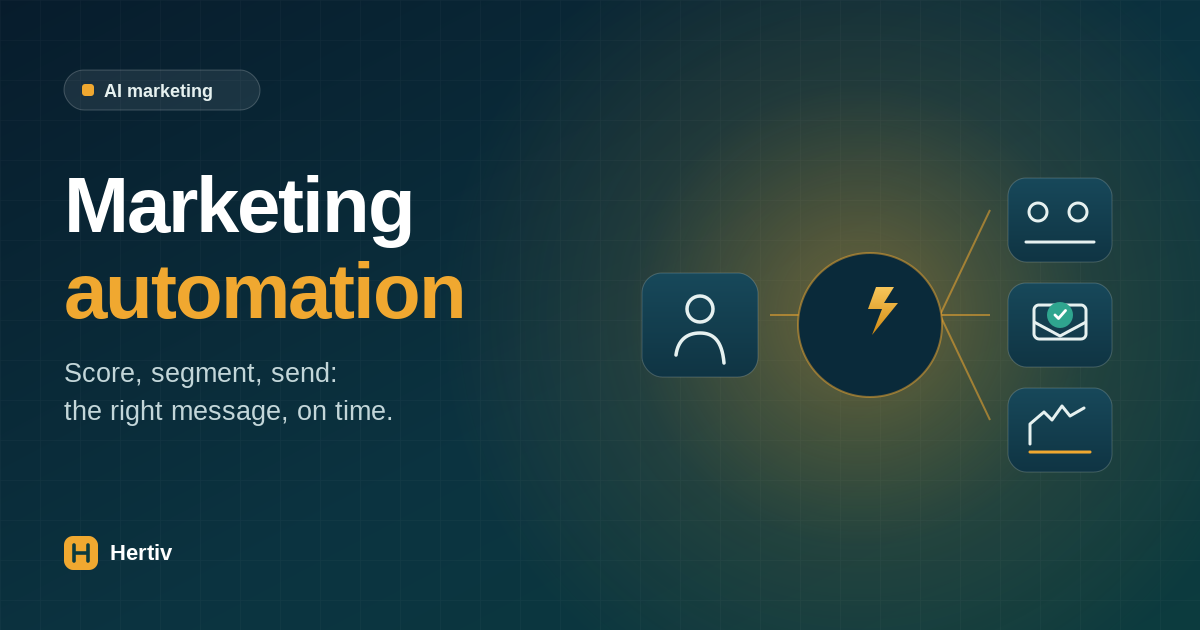
AI-powered marketing automation scores leads, segments audiences and sends the right message at the right time. Here is how it works and where to start.
On this page
Short answer
AI-powered marketing automation is software that uses machine learning to run repetitive marketing work: scoring leads, segmenting audiences, choosing send times and drafting follow-ups. It reads behaviour from your CRM and website, then triggers the next step for each person automatically. The marketer still sets the goals, the messages and the rules; the AI handles the timing and the targeting at a scale no team can do by hand.
What is AI-powered marketing automation?
AI-powered marketing automation is software that uses machine learning to decide who should get which marketing message, and when. Traditional automation follows fixed rules, such as sending an email three days after a signup. AI automation adds judgement: it scores each lead, predicts which channel and time will work best, and changes the message based on what the person has actually done.
Four jobs cover most of what the AI does:
| AI job | What it does | Example |
|---|---|---|
| Lead scoring | Ranks contacts by likely interest | Hot leads go to sales first |
| Segmentation | Groups contacts by behaviour | Buyers, browsers and dormant users |
| Journey orchestration | Picks the next step per person | Demo invite after a pricing view |
| Send-time optimisation | Chooses when each person opens mail | Morning sends for one group, evenings for another |
The difference from plain automation is that the system learns from results. A fixed rule sends the same welcome series to everyone; an AI system notices that one group converts after two emails while another needs five, and adjusts the flow. The marketer still writes the messages and sets the goal, but the timing and targeting are decided per person.
How does AI decide who gets what?
AI decides who gets what by scoring each contact against what similar contacts did before. The model looks at behaviour signals, such as pages visited, emails opened, trial actions taken and time since the last visit, and compares them with the patterns of contacts who became customers. A contact whose pattern matches past buyers gets a higher score and a faster, more direct next step.
Segmentation works the same way, but in groups. Instead of a marketer drawing up fixed segments by hand, the model finds clusters in the data: people who read pricing pages and compare plans, people who only read blog posts, people who signed up months ago and went quiet. Each cluster gets a different journey, because each one needs a different nudge.
The scores are only as good as the data behind them. A CRM full of stale contacts and missing fields will produce confident-looking scores that are wrong, so teams clean the list before they trust the model. The first job is usually data hygiene, not model tuning, and it is the step most teams skip.
Good tools show why a contact scored high, such as the three actions that pushed the score up. That explanation matters, because a sales team will not trust a score it cannot understand. If a tool only gives a number with no reason, ask the vendor how the score is built before you buy.
What can it automate across the customer journey?
AI marketing automation can run most of the journey that follows a first visit: the welcome series, the nurture emails, the trial prompts, the win-back messages and the upsell offers. Each step is triggered by behaviour, so a person who watches a demo gets a different next email from one who only read a blog post.
Welcome and onboarding flows are the usual starting point. A new signup gets a short series that explains the product, points to the first useful action and answers the common early questions. The AI picks the order and timing per person, and stops the series as soon as the person takes the key action, so nobody gets emails about a step they already finished.
Nurture and win-back flows come next. A lead who goes quiet for a month gets a different message from a lead who is active every week, and the model decides which message has the best chance of a reply. For existing customers, the same logic powers upsell and renewal reminders, timed to usage rather than to a fixed calendar date.
What it cannot do is replace the message itself. The AI can pick the time, the channel and the audience, but the words still need a human who knows the product and the customer. Teams that let a model write every email without review end up with copy that sounds the same as every other automated email in the inbox.
What data does it need to work well?
AI marketing automation needs three kinds of data to work well: who the contact is, what they have done, and what they have agreed to. Identity comes from the CRM, behaviour comes from the website and product, and consent comes from the signup form and the privacy settings. Without any one of the three, the system either targets badly or breaks the rules.
Behaviour data is the most valuable and the most neglected. Page views, email opens, trial actions and support tickets together show intent far better than a job title or company size. The teams that get the best results log these events in one place with a contact id on every event, so the model can see the full story instead of fragments.
Consent and privacy rules shape what is allowed. Marketing emails need a lawful basis and an easy opt-out, so check your privacy rules before connecting a new data source. If you are planning the build, the best marketing automation tools compared shows which platforms handle consent and data well.
Data quality matters more than data volume. A list of 2,000 contacts with clean emails, real job roles and tracked behaviour beats a list of 100,000 bought contacts with no history. Clean the list, remove the bounces and the people who never open anything, and the model's scores will improve without any change to the model itself.
How do you set up AI-powered marketing automation?
You set up AI-powered marketing automation by starting with one journey, one data source and one measure, then adding more once the first flow works. A single working welcome flow teaches you more than five planned flows that never ship.
- Pick one journey. The welcome series for new signups is the usual first choice, because the trigger is clear and the result is easy to measure.
- Connect the data. Link the CRM and the website tracking so the tool can see who each contact is and what they did.
- Clean the list. Remove bounces, duplicates and contacts who have not engaged in a year, so the model learns from real people.
- Write the messages. Draft the emails for each step, with a human voice and a clear next action in each one.
- Turn on scoring and timing. Let the AI decide the order and send time per person, and watch the first results for two weeks.
- Measure and adjust. Compare open, click and conversion rates against the old fixed flow, then change one thing at a time.
Each step needs an owner and a date, or the setup drifts. The most common failure is buying the tool and never finishing the data connection, so the AI has nothing to learn from. If the setup stalls, shrink the scope to one flow rather than pausing the whole project. For the content side of the messages, generative AI in marketing covers how drafting tools fit into the workflow.
Example (hypothetical): a small ecommerce team
Example (hypothetical): a small ecommerce team has 8,000 subscribers and sends one newsletter a week to everyone. Its open rate is 18 percent and its click rate is 2 percent, so about 160 people click through each week. The team adds AI automation: the list is split by behaviour, and each group gets a different send time and a different subject line.
After a month, the open rate is 24 percent and the click rate is 3 percent. That is 8,000 x 0.03 = 240 clicks a week, up from 160, a gain of 80 clicks a week with the same list and the same products. The team also adds a win-back flow for the 1,200 subscribers who have not opened anything in three months, and 96 of them open the first win-back email.
The team spends about four hours a week on the automation, mostly writing and checking the messages, against six hours a week on the old manual newsletter. The gain came from sending the right message at the right time, not from sending more email. The list did not grow; the same people simply heard from the team when they were ready to listen.
What are the common mistakes?
The most common mistakes in AI-powered marketing automation are automating before the data is ready, trusting the score without checking it, and sending more email instead of better email.
- Automating a dirty list. A model trained on stale contacts and missing fields will score the wrong people highly.
- Trusting the score blindly. If nobody checks why a contact scored high, bad scores reach sales and damage trust in the whole system.
- More email, not better email. Automation that doubles the volume without improving relevance just trains people to ignore you.
- No human review of the copy. AI-drafted messages can sound generic or make claims the product does not support.
- Measuring opens, not revenue. An open rate that rises while sales stay flat means the automation is entertaining, not selling.
- Skipping the opt-out. Every automated flow needs a clear unsubscribe, or complaints and spam reports will follow.
Marketing automation is a force multiplier for a team that already knows its customers. For the wider picture, AI agents for marketing teams covers the agent side of the same work.
Key takeaways
- AI marketing automation scores leads and picks timing per person, instead of fixed rules
- The model learns from behaviour in the CRM and on the website, so clean data matters more than volume
- Welcome, nurture, win-back and upsell flows are the usual starting points
- The AI picks time, channel and audience; a human still writes the message
- Start with one journey, measure it for a month, then add the next
- Measure conversions and revenue, not opens alone
Frequently asked questions
What is the difference between marketing automation and AI marketing automation?
Plain marketing automation follows fixed rules, such as sending an email three days after signup. AI marketing automation adds scoring and prediction, so the timing, the audience and the next step are chosen per person from their behaviour.
Do small teams need AI marketing automation?
Not always. A team with a few hundred contacts and one weekly newsletter can manage with simple rules. AI automation pays off once the list is large enough that personal follow-up is impossible and behaviour data is flowing.
What data does AI marketing automation need?
It needs identity from the CRM, behaviour from the website and product, and consent from the signup form. Without clean behaviour data the model has nothing to learn from, so data hygiene usually comes before model tuning.
Can AI write my marketing emails?
It can draft them, but the drafts need human review before they go out. AI copy can sound generic or make claims the product does not support, so keep a person in charge of the words and the promises.
How do you measure AI marketing automation?
Compare the automated flow against the old fixed flow on open, click and conversion rates, and on revenue per contact. Opens alone are not enough; the test is whether more people take the action you want.
Is AI marketing automation allowed under privacy rules?
It is, as long as you have a lawful basis for the emails, a clear notice about tracking, and an easy opt-out in every message. Check your privacy rules before connecting a new data source, and keep the data inside approved systems.