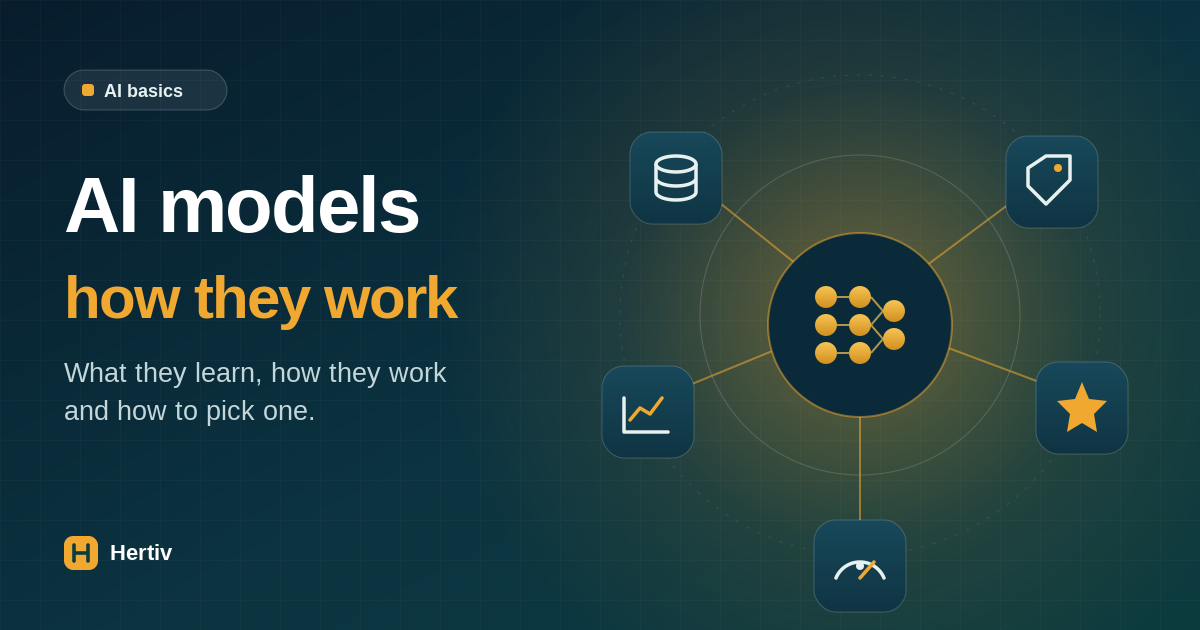
AI Models: What They Are and How They Work
An AI model is software that learns patterns from data and makes predictions. Learn the main types, how training works, and how to match a model to your task.
On this page
Short answer
An AI model is a piece of software that learns patterns from examples and uses them to make predictions or generate content. You train it on data, such as past sales or labelled images, and it builds rules from that data instead of following rules a person wrote by hand. The same idea powers spam filters, product recommendations, chatbots and image generators, with different model types for each job.
What is an AI model?
An AI model is software that learns patterns from data and then uses those patterns to make predictions or generate new content. Instead of a programmer writing out every rule, the model is shown many examples and works out the rules itself.
A spam filter is a simple example. It is shown thousands of emails labelled as spam or not spam, and it learns which words and patterns mark a message as spam. A new email is then scored against those patterns. The same idea, scaled up, powers recommendations, chatbots and image tools.
The main families of models are listed below. Most products use more than one, and the choice depends on the data you have and the job you need done.
| Family | Learns from | Typical use |
|---|---|---|
| Classifiers | Labelled examples | Spam, fraud, sorting tickets |
| Clustering | Unlabelled data | Customer groups, anomaly spotting |
| Deep learning | Large datasets | Images, speech, complex patterns |
| Foundation models | Huge mixed data | Chat, drafting, code, search |
| Reinforcement learning | Trial and reward | Games, routing, control systems |
What makes a model an AI model, rather than ordinary software, is that its behaviour comes from the data it was trained on. Change the data and you change the model, which is why data quality matters more than model choice in most projects.
What are the main types of AI models?
Classifiers are the workhorses. They take an input and assign it a label: spam or not spam, fraud or clean, churn or stay. They need labelled examples, and they are the easiest type to test, because you can count how often the label is right.
Clustering models work without labels. They group similar items together, which is useful for finding customer segments or spotting unusual transactions that do not match any known group. The output needs a person to interpret it, since the model does not name the groups itself.
Deep learning models use layered networks and large datasets to handle images, speech and text. They are powerful but hungry: they need more data, more computing and more testing than simpler models. Foundation models are the largest deep learning models, trained on huge mixed data and then adapted to many jobs, from chat to code. Generative models are one kind of foundation model; see generative AI models for how they produce text and images.
How does an AI model learn from data?
A model learns by adjusting its internal settings until its predictions match the examples it was shown. Training starts with a dataset: inputs paired with the right answers, such as emails labelled spam or not spam. The model guesses, measures how wrong it was, and nudges its settings to do better next time.
That loop runs thousands or millions of times. The data is split so the model is tested on examples it has never seen, which shows whether it learned a real pattern or just memorised the training set. A model that only works on its training data is useless in production.
Training is the most technical part of building a model, and it has its own costs and methods. For the full picture, see what AI model training is and how it works, which covers data needs, training types and how teams know training worked.
What can an AI model do well, and where does it fail?
Models are good at pattern work: sorting, scoring, ranking and summarising at a scale no team can match. A model can read ten thousand support tickets in minutes, score every loan application the same way, and keep working overnight without getting tired or bored.
They fail in predictable ways. A model only knows what its training data showed it, so it struggles with new situations, rare cases and data that has changed since training. It can also repeat biases in the data, such as scoring one group of customers differently for reasons nobody intended.
The practical answer is to keep a person in the loop where mistakes cost money. Let the model sort and draft, and let a person decide on the cases that matter, the cases the model is unsure about, and anything the model has never seen before.
How do you match a model to your task?
Match the model to the job, not the other way round. Start with the decision you need, then pick the simplest model type that can make it, and only move to a bigger model when the simple one fails.
- Define the output. Write down exactly what the model should return: a label, a score, a summary or a draft.
- Check your data. Count your labelled examples. A few hundred labelled cases suit a classifier; a foundation model suits jobs with little labelled data.
- Start simple. A basic classifier or a rule-based baseline is cheap to test and often good enough.
- Test on unseen data. Measure accuracy on examples the model never saw, and check the mistakes it makes.
- Plan the handoff. Decide which outputs go straight through and which need a human review, before you ship.
Choosing between named models is a separate step once the type is settled. See how to select the right AI model for the factors to compare before you commit.
Example (hypothetical): a shop sorts 500 support tickets
Example (hypothetical): an online shop receives 500 support tickets a week. Sorting each one by hand takes about 2 minutes, which is 500 times 2 minutes, or 1,000 minutes, about 16 hours and 40 minutes of staff time every week.
The shop trains a classifier on past tickets labelled by topic: delivery, returns, payment and product questions. The model sorts 450 tickets on its own and flags 50 it is unsure about. A staff member checks those 50 at 2 minutes each, which is 100 minutes, or about 1 hour and 40 minutes.
The team saves about 15 hours a week. The model does not answer tickets; it only routes them, and the uncertain ones still reach a person, which is why the shop trusts it.
What are the common mistakes?
Most AI model projects fail on data and expectations, not on the model itself. The mistakes below are the ones teams repeat most often.
- Picking the biggest model before testing a simple one
- Training on data that does not match real inputs
- Testing only on training data, so the model looks better than it is
- Shipping without a plan for the cases the model gets wrong
- Expecting the model to handle situations it was never trained on
- Ignoring bias in the data until customers complain
Key takeaways
- An AI model learns patterns from examples instead of following rules written by hand.
- Classifiers, clustering, deep learning and foundation models fit different jobs and data.
- Training works by guessing, measuring the error and adjusting, tested on unseen data.
- Models are strong at pattern work at scale and weak at new situations and rare cases.
- Start with the simplest model that can do the job and keep a person on the uncertain cases.
Frequently asked questions
What is the difference between AI and an AI model?
AI is the broad field of building software that performs tasks needing human-like judgement. An AI model is the specific trained piece of software inside that system: the part that learned patterns from data and makes predictions. A chatbot is an AI product; the language model inside it is the AI model.
Do I need a lot of data to use an AI model?
It depends on the type. A classifier needs labelled examples, often hundreds to start, while a foundation model can work with little labelled data because it was already trained on huge amounts of text. If you have almost no data, start with a foundation model or collect labelled examples first.
What is the difference between a classifier and a foundation model?
A classifier is trained for one narrow job, such as sorting tickets, and it returns a label. A foundation model is trained on huge mixed data and can be adapted to many jobs, such as chat, drafting and search. Classifiers are cheaper and easier to test; foundation models are more flexible.
How do you know if an AI model is working?
Test it on examples it has never seen and count how often it is right, using the same measures you would use for a person doing the job. Track the mistakes it makes, especially on the cases that cost money, and re-test whenever the data changes.
Can an AI model keep learning after it ships?
Some can, but most production models are retrained on a schedule instead of learning live, because live learning can pick up bad patterns from new data. Teams usually collect new examples, retrain in a controlled way, test the new version and then replace the old one.
Why do AI models make mistakes?
Models make mistakes when the data is thin, biased or out of date, or when they meet a situation unlike anything in training. They also fail on edge cases that are rare in the data. That is why the uncertain cases should go to a person instead of being decided by the model alone.