What Is AI Model Training, and How Does It Work?
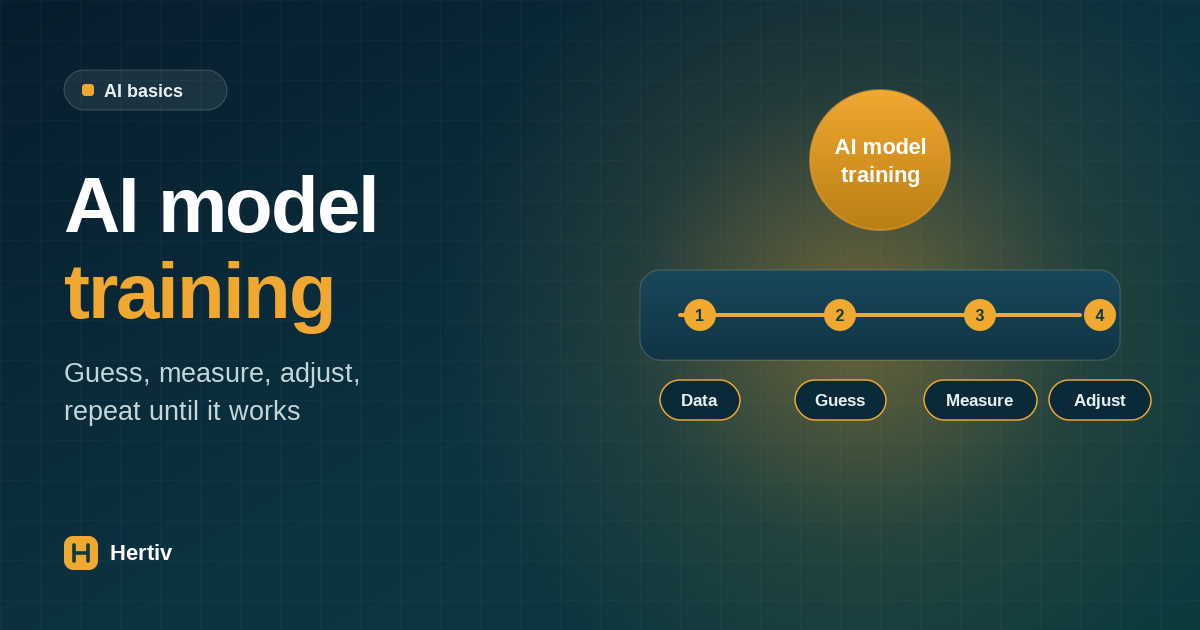
AI model training is how a model learns from data: it makes guesses, measures its errors, and adjusts until the guesses improve.
On this page
Short answer
AI model training is the process of teaching a model to make useful predictions by showing it examples and letting it adjust itself. The model starts by guessing, measures how wrong each guess is, and changes its internal settings a little at a time. After many rounds, the guesses get better.
What is AI model training?
AI model training is how a model learns from data instead of from rules written by a person. A person collects examples, such as emails labelled spam or not spam, and the model studies them to find patterns. The trained model can then judge new examples it has never seen.
Training is different from using a model. Training builds the model; using it means asking the finished model questions. A model that is trained once can answer many questions, but it only knows what its training data taught it. For the wider picture, read what machine learning is.
| Part of training | What it does | Example |
|---|---|---|
| Data | Examples the model learns from | Labelled emails |
| Model | The structure that holds patterns | A text classifier |
| Loss | A score for how wrong a guess is | Wrong label count |
| Training loop | Guess, measure, adjust, repeat | Many rounds over the data |
| Test set | Fresh examples to check the result | Emails never shown before |
How does training actually work?
Training runs in a loop. The model looks at a batch of examples, makes a guess for each one, and compares the guess with the correct answer. The difference is the error, and the model adjusts its settings to make that error smaller next time. One full pass over all the examples is called an epoch, and training usually runs for many epochs.
The adjustments are small, which is why training takes many rounds. A big jump would overshoot and make the model worse, while tiny steps need more time. The team watches the error on a separate set of examples to see if the model is really learning or just memorising the training data.
The size of each step is called the learning rate, and picking it is one of the main choices in training. A rate that is too high makes the error jump around and never settle, while a rate that is too low means training takes far longer than it should. Teams usually try a few rates on a small run first, then use the one that learns steadily without jumping.
What data does training need?
Training data is the examples the model learns from, and its quality decides the result. A spam filter trained on clean, well-labelled emails works; one trained on messy labels learns the mess. The data must cover the cases the model will meet in real use, including the rare and awkward ones.
Teams split their data into three parts: training data to learn from, validation data to tune the setup, and test data to check the final result. The test data is never shown during training, so it gives an honest measure of how the model handles new cases. If the test score is much worse than the training score, the model has memorised instead of learned.
Balanced data matters as much as clean data. If nine in ten examples are one type, the model can score well by guessing that type every time, while failing on the rare cases that matter. Teams check the mix before training and add more examples of the rare cases, so the model learns all of them.
What are the main types of training?
Supervised training uses labelled examples, where each example has a known answer. It fits jobs like sorting emails, spotting defects or predicting a price, because the right answer is clear. Unsupervised training uses unlabelled data, and the model finds groups or patterns on its own, which fits jobs like grouping customers or finding odd transactions.
Reinforcement training teaches by reward: the model tries actions, gets a score for each one, and learns which actions earn the best score. It fits games and control systems, where the right answer only becomes clear over time. Most business projects use supervised training, because labelled examples are the easiest to judge.
Teams usually prove the idea with a small build before training a full model. Read how to build an AI proof of concept to test the job on a small scale first, then train the real model only if the small test works.
How do teams know training worked?
Teams judge training with fresh data the model has never seen. They measure how often it is right, how often it misses, and how it handles the hard cases. A single score is rarely enough: a model that is right nine times in ten can still fail badly on the one case that matters most.
They also watch for overfitting, where the model memorises the training data and fails on new examples. The cure is more varied data, simpler models, or stopping training earlier. A model that is a little worse on training data but steady on fresh data is usually the better choice.
Teams also check the model's mistakes one by one, not just the score. If most errors fall in one group, such as short emails or rare cases, the team knows where to add data. A model with a good score and a clear error pattern is easier to improve than one with a good score and no idea where it fails.
Testing is a skill of its own, and it matters as much as training. Read how to test AI models for a practical way to check a model before it reaches real users.
Example (hypothetical): training a support ticket sorter
Example (hypothetical): a support team wants a model that sorts 300 incoming tickets a day into billing, technical and account groups. They collect 6,000 old tickets, each labelled by hand, and split them into 4,800 for training, 600 for tuning and 600 for testing.
After the first training run, the model sorts 480 of the 600 test tickets correctly, which is 80%. The team adds more examples of the rare account cases and trains again. This time it sorts 540 of 600 correctly, which is 90%, and the errors are spread evenly across the three groups instead of piling up in one.
The team ships the model with a rule: it sorts the tickets it is sure about and sends the rest to a person. Over the first month, the model handles 200 of 300 tickets a day, and a person checks the remaining 100. The team reviews the model's mistakes each week and retrains with the corrected examples.
Common mistakes
The most common mistake is training on dirty data. Labels that are wrong, out of date or inconsistent teach the model the wrong thing, and no amount of tuning fixes bad examples. Clean the data first, even if it feels slow.
Another mistake is testing on the training data. A model that scores well on examples it has already seen proves nothing, because it may have memorised them. Always keep a test set the model never sees during training.
A third mistake is chasing a perfect score. A model that is right 99 times in 100 on training data is often overfitted and brittle in real use. A steady score on fresh data matters more than a perfect score on old data.
Finally, do not skip the human check. A trained model makes mistakes, and the cost of a mistake depends on the job. Keep a person in the loop for the cases where a wrong answer is costly.
Key takeaways
- Training teaches a model from examples, not from written rules
- The training loop is guess, measure the error, adjust, repeat
- Clean, well-labelled data matters more than a fancy model
- Always test on fresh data the model has never seen
- A steady test score beats a perfect training score
Frequently asked questions
How long does AI model training take?
It depends on the data and the model. A small classifier can train in minutes on a laptop, while a large language model takes weeks on many machines. Most business models sit in between and train in hours.
Do I need a lot of data to train a model?
You need enough examples to cover the cases the model will meet, including the rare ones. A few hundred clean examples can work for a simple job, while a hard job needs thousands. Quality matters more than sheer count.
What is overfitting?
Overfitting is when a model memorises its training data instead of learning the pattern behind it. It scores well on training examples and badly on new ones. More varied data or simpler models usually fix it.
Can I train a model without coding?
Yes, for simple jobs. Many tools let a team upload labelled examples and train a model through a screen. Coding helps when the job needs custom data handling or a model that fits into a larger system.
What is the difference between training and fine-tuning?
Training builds a model from scratch, while fine-tuning takes a model that already works and trains it further on your own examples. Fine-tuning is faster and needs less data, so most teams start there.
How much does training cost?
Small models cost little to train, while large models need powerful machines that run for days or weeks. The cost depends on data size, model size and hardware, so teams estimate it before they start.


