How to Test AI Models: A Practical Guide for Teams
Testing an AI model means checking accuracy on fresh data, probing edge cases and watching for bias and drift. Here is a practical way to do it.
On this page
Short answer
Testing an AI model means checking whether it works on data it has never seen: accuracy on fresh data, fairness across groups, robustness on messy inputs, and whether it stays good over time. A model that passes one of these and fails another is not ready to ship.
What does testing an AI model mean?
Testing an AI model means checking whether it works on data it has never seen, in the conditions it will actually face. It is not the same as checking that the code runs. A model can run perfectly and still give wrong, unfair or unsafe answers.
The test covers four questions: is it accurate, is it fair across different groups, does it hold up on unusual inputs, and does it stay good over time. A model that passes one of these and fails another is not ready to ship.
Testing is also different from training. During training the model sees the data and learns from it, so a good score on training data proves nothing. The real test uses fresh data the model has never seen, collected the same way the live data will arrive.
How do you split data for testing?
You split data for testing by holding out a part of it that the model never sees during training, and using that part only to judge it. The usual split is training, validation and test, with the test set kept locked until the end.
The split must respect how the data will arrive in real use. If the model will face new customers, the test set should contain customers it has not seen. If it will face next month's data, the test set should be from a later period than the training data. A random split that mixes time periods together will flatter the result, because the model has effectively seen the future.
Leakage is the most common split mistake. It happens when information from the test set slips into training, often through a shared identifier, a duplicated record or a feature that is only known after the outcome. A model that has leaked data looks accurate in testing and fails in production. Check for duplicates and shared identifiers before you trust a score.
Keep the test set fixed while you improve the model. If you keep changing the test set to match the model, you are training on the test, and the score stops meaning anything.
Which metrics should you use?
Which metrics you use depends on what the model does and what a mistake costs. Accuracy alone is rarely enough, because it hides the mistakes that matter most.
| Task | Useful metrics | What it catches |
|---|---|---|
| Classification | Precision, recall, F1 | Missed cases vs false alarms |
| Ranking | Precision at k, recall at k | Bad items at the top |
| Regression | Mean error, error spread | Large errors on some cases |
| Text generation | Human rating, exact checks | Wrong or made-up answers |
| Detection | Miss rate, false alarm rate | Missed objects, false alerts |
For a fraud model, a missed fraud case costs far more than a false alarm, so recall matters more than precision. For a spam filter, the reverse is true: blocking a real email is worse than letting one spam message through. Write down which mistake costs more before you pick the metric.
Report the metric per group, not just overall. A model that scores well on average can still fail badly on one group of users, and the average will hide it. Split the result by the groups that matter for your product, and look at the worst one.
How do you test for bias and fairness?
You test for bias and fairness by checking whether the model performs differently for different groups of people, and whether the difference comes from the data, the labels or the model itself.
Start by defining the groups that matter for your product, such as age, region or language, and measure the error rate for each one. A gap is a signal, not a verdict: it may come from less training data for one group, from labels that reflect past decisions, or from a feature that stands in for a group the model should not use.
Then test the inputs, not just the outputs. Feed the model pairs of cases that differ only in one group attribute and see whether the answer changes. If it does, the model is using that attribute, whether or not it was meant to.
Fairness testing is not a one-off check. It belongs in the regular test run, with the same status as accuracy. A model that is accurate on average but unfair for one group is not ready for users, and the fix usually starts with the data, not with the model.
How do you test robustness and drift?
You test robustness by feeding the model inputs that are unusual, noisy or slightly changed, and checking that the answer does not collapse. Real data is messy, and a model that only works on clean examples will fail on the first bad input.
Useful probes include typos and odd spellings, missing fields, values outside the training range, and images taken in poor light. A small change in the input should cause a small change in the output. If a single changed word flips a decision, the model is too fragile to trust.
Drift is the slower problem. The world changes, so the data the model sees in production slowly stops matching the data it was trained on. A model that was accurate in January can be wrong by June, even though nothing in the code changed.
Watch for drift by scoring a sample of live inputs against a fixed reference set every week, and by tracking the distribution of inputs and outputs. A drift check is cheap, and it is the earliest warning that a model needs retraining. For teams that run models in production, MLOps consulting work usually starts with this monitoring.
How do you test an AI model in 6 steps
You test an AI model by working through six steps in order: define the goal, split the data, pick metrics, test edge cases, check fairness, and set up monitoring. Skipping a step does not save time; it moves the problem to launch day.
- Define what good means. Write down the decision the model makes, who it affects, and what a mistake costs. That decides the metrics.
- Split the data properly. Hold out a test set the model never sees, respecting time and grouping, and check for leakage.
- Pick metrics by cost. Choose the metric that matches the expensive mistake, and report it per group, not just overall.
- Probe edge cases. Feed the model noisy, missing and unusual inputs, and check that small changes do not flip decisions.
- Check fairness. Measure error rates per group, and test pairs that differ only in one group attribute.
- Set up monitoring. Score a live sample against a fixed reference set weekly, and plan when to retrain.
Run the full test suite on every new version of the model, and keep the results so you can compare versions. A model that passes today and fails next month has drifted, and the comparison is how you catch it. For help with the evaluation design, LLM development teams often start by defining the test set before writing any model code.
Example (hypothetical): testing a loan screening model
Example (hypothetical): a small lender builds a model to screen loan applications. It trains on 10,000 past applications and tests on 2,000 fresh ones it has never seen.
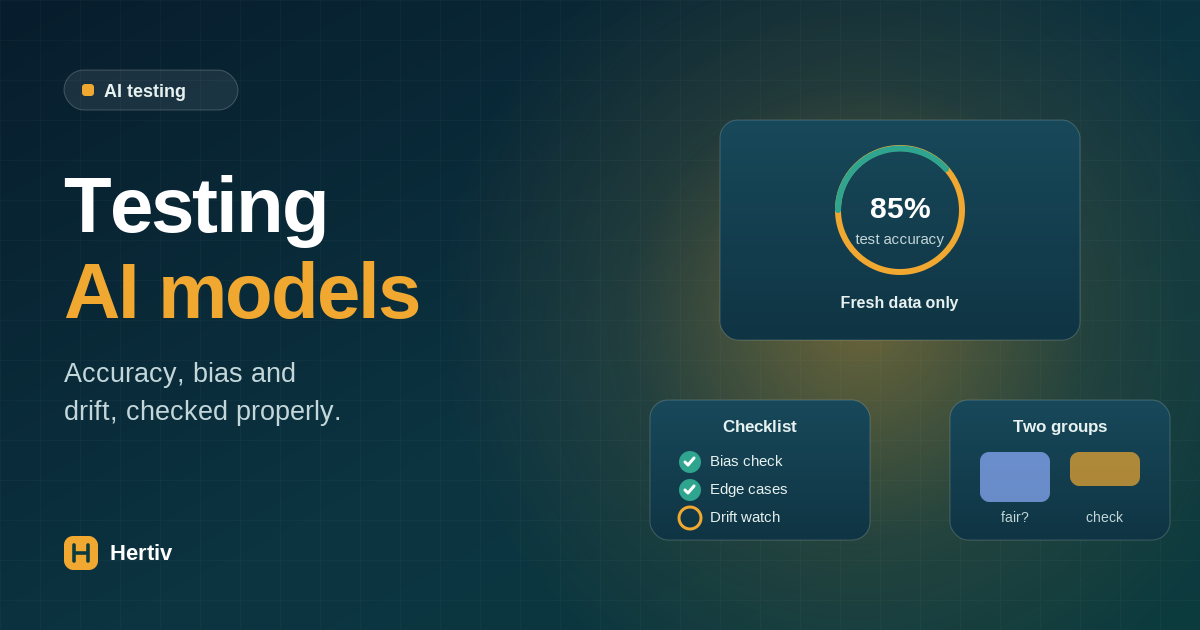
On the test set, the model is right on 1,700 of 2,000 cases, which is 85% accuracy. But the errors are not even: it misses 90 of the 300 good applications that should have been approved, which is a 30% miss rate on good applicants, while it wrongly approves only 10 of the 1,700 risky ones.
The team splits the result by region and finds the miss rate is 40% in one region and 20% in another. The training data had fewer examples from the first region, so the model learned less about it. The team collects more labelled examples from that region, retrains, and the miss rate falls to 25% in both regions.
The numbers are invented to show the arithmetic, not a real result. The point is that the overall score hid the real problem, and only the split by group found it. An average that looks fine can still be unfair.
What are the common mistakes?
The most common mistakes when testing AI models are testing on training data, trusting one overall score, and never testing again after launch.
- Testing on training data. A model that has seen the test data will score well and fail in production. Keep the test set locked.
- Trusting one overall score. An average hides the worst group. Always split the result by the groups that matter.
- Ignoring leakage. Duplicated records and shared identifiers let the test answer leak into training. Check for them before you trust a score.
- Skipping edge cases. A model that works on clean data and fails on messy data is not ready. Probe with noise, typos and missing fields.
- No monitoring after launch. Drift is slow and silent. Without a weekly check against a fixed reference set, nobody notices the model getting worse.
Key takeaways
- Never test on data the model trained on
- One overall score hides the worst group
- Leakage makes a bad model look accurate
- Probe messy, unusual and missing inputs
- Monitor weekly against a fixed reference set
Frequently asked questions
What is the difference between testing and evaluating an AI model?
Testing checks the model on fresh data before launch, using fixed metrics and a locked test set. Evaluation is the wider, ongoing job of judging whether the system serves its purpose, including user feedback and business results.
How much test data do I need?
It depends on the task and the cost of a mistake. A few hundred well-chosen cases can catch the main problems, but a model that decides who gets a loan needs far more, and the test set must cover the groups that matter.
What is data leakage in AI testing?
Leakage happens when information from the test set slips into training, often through a duplicated record, a shared identifier or a feature known only after the outcome. The model scores well in testing and fails in production.
How do I test a model for bias?
Measure the error rate for each group that matters, and test pairs of cases that differ only in one group attribute. If the answer changes, the model is using that attribute, whether or not it was meant to.
What is model drift?
Drift is the slow change in live data so it no longer matches the training data. The model gets worse over time even though the code never changed. A weekly check against a fixed reference set catches it early.
Should I test the model or the whole system?
Both. The model needs its own tests on fresh data, and the system needs tests on the full flow: inputs, model, checks and human review. A good model in a bad system still fails users.


