What Is Machine Learning, and How Does It Work?
Machine learning is software that finds patterns in data and uses them to make predictions. Learn how it learns, what data it needs and where it is used.
On this page
Short answer
Machine learning is a way of building software that learns patterns from data instead of following rules written by hand. A model is trained on examples, such as past support tickets or past sales, and then uses what it learned to predict an outcome for new cases it has never seen.
What is machine learning?
Machine learning is a branch of artificial intelligence in which a program improves its performance on a task by learning from examples, rather than by following fixed rules written by a programmer. The program, called a model, is shown data and adjusts itself until its predictions match the examples well enough to be useful.
The difference from normal software is who writes the rules. In normal software, a programmer writes each rule: if the amount is over a limit, flag the transaction. In machine learning, the programmer writes the learning process, and the model works out the rules from the data, including rules no person would have written by hand.
Machine learning works best on tasks with plenty of examples and a clear outcome to predict, such as sorting messages, spotting fraud or forecasting demand. It works badly where data is scarce, the outcome is unclear, or the answer must be explained step by step. For real-world uses, see machine learning use cases in production.
How does machine learning learn?
Machine learning learns by adjusting its internal settings to reduce its errors on training data. The model makes a prediction, compares it with the known answer, and changes its settings a little so the next prediction is closer. Repeating this thousands of times turns a rough guess into a useful model.
There are three main ways to learn, and the choice depends on what kind of data you have:
| Approach | What the data looks like | Typical task |
|---|---|---|
| Supervised learning | Examples with known answers | Sorting, predicting, scoring |
| Unsupervised learning | Examples with no labels | Grouping, finding patterns |
| Reinforcement learning | Rewards for good actions | Game play, control, routing |
Supervised learning is the most common in business, because most tasks have past examples with known outcomes: past tickets and their categories, past customers and whether they left. Unsupervised learning finds groups in data nobody labelled, such as customer segments. Reinforcement learning trains by trial and reward, and suits problems where the model acts and the world answers back.
What role do data and features play?
Data decides how good a model can be. A model trained on clean, relevant examples will beat a clever model trained on messy or biased data, so most of a machine learning project is spent on the data, not on the model itself.
Features are the inputs the model sees: for a support ticket, the words in the message, the product, the customer plan and the time of day. Choosing good features matters more than choosing a fancy model, because a model can only learn from what it is given.
A feature that leaks the answer, such as a field that is only filled in after the outcome, will make the model look perfect in testing and fail in real use.
Data quality problems show up as model problems. Missing values, duplicate records and labels that different people applied differently all teach the model the wrong thing. Before training, a team should check the data for these issues and fix them, rather than hoping the model will sort them out.
How do you train, test and deploy a model?
You train, test and deploy a model in stages, and the test stage is what keeps a bad model from reaching users. The data is split into a training set, which the model learns from, and a test set, which the model never sees during training and is used only to judge it.
A workable sequence:
- Define the outcome. State exactly what the model predicts and how success will be measured.
- Prepare the data. Clean it, split it into training and test sets, and check for leaks.
- Train a simple model first. A simple model sets a baseline that a complex model must beat.
- Test on unseen data. Measure the model on the test set, not on the data it trained on.
- Deploy behind a check. Ship the model to a small share of users and watch its real behaviour.
- Monitor and retrain. Data changes over time, so check the model regularly and retrain it when it drifts.
Testing a model properly is a skill of its own. For the testing side, see how to test AI models.
Where is machine learning used?
Machine learning is used wherever there are enough past examples to learn from and a prediction that saves time or money. The uses below are the ones most teams meet first.
- Support and triage. Sorting incoming messages by topic and urgency, so the right team sees them first.
- Fraud and risk. Flagging unusual transactions or claims for review, based on patterns in past fraud.
- Recommendations. Suggesting products, articles or content a person is likely to want, based on past behaviour.
- Forecasting. Predicting demand, sales or churn from past trends and current signals.
- Documents and images. Reading text from documents, tagging photos or checking products on a line.
Each use has the same shape: a clear outcome, enough examples and a way to check whether the model's predictions were right. Where any of those is missing, the project is likely to struggle. For how it compares with analytics, see predictive analytics vs machine learning.
Example: a support-ticket classifier
Example (hypothetical): a support team receives 300 tickets a day and spends 2 minutes on each one just deciding which team should handle it. That is 300 x 2 = 600 minutes, or 10 hours a day spent on triage alone.
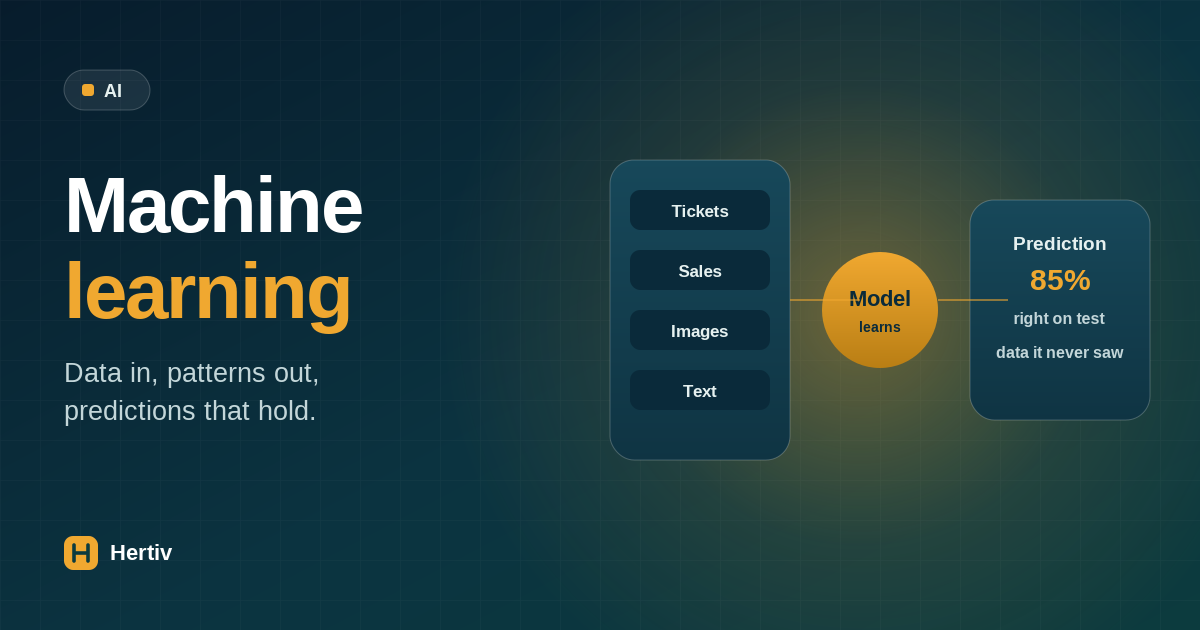
The team trains a classifier on 10,000 past tickets that were already labelled by topic. On a held-out test set of 2,000 tickets, the model sorts 1,700 correctly, which is 85 percent right. In daily use, that means 255 of the 300 tickets are sorted correctly and 45 are wrong.
A human re-checks the 45 wrong tickets at 2 minutes each: 45 x 2 = 90 minutes, or 1.5 hours a day. Manual triage took 10 hours a day, so the team saves 10 - 1.5 = 8.5 hours a day, while a human still checks every ticket the model got wrong. The saving comes from triage, not from answering the tickets themselves, which still need a person.
What are the common mistakes?
The most common machine learning mistakes are training on bad data, testing on the same data the model learned from, and shipping a model nobody monitors. Each one turns a promising project into a quiet failure.
- Testing on training data. A model tested on data it already saw looks perfect and fails on new cases, so always keep a separate test set.
- Leaking the answer. A feature that is only known after the outcome teaches the model to cheat, not to predict.
- Skipping the baseline. Without a simple model to compare against, you cannot tell whether the complex one is worth its cost.
- Ignoring drift. Customer behaviour changes, so a model that was right last year may be wrong now.
- Treating the model as finished. A deployed model needs monitoring, retraining and an owner, like any other system.
Key takeaways
- Machine learning finds patterns in data instead of following hand-written rules
- Supervised learning needs labelled examples; unsupervised learning finds groups on its own
- Data quality and good features matter more than the choice of model
- Always test on data the model has never seen, and ship behind a check
- A deployed model needs monitoring and retraining, because data changes over time
Frequently asked questions
What is the difference between AI and machine learning?
Artificial intelligence is the broad field of building systems that behave intelligently. Machine learning is one part of it: systems that learn from data. Not all AI uses machine learning, and not all machine learning is used for the tasks people call AI, but most modern AI products rely on machine learning.
Do I need a lot of data for machine learning?
It depends on the task. A simple classifier can work with a few thousand labelled examples, while a model that reads images or text may need far more. The key is not only the amount but whether the examples cover the cases the model will meet in real use.
What is a feature in machine learning?
A feature is one input the model sees, such as the words in a message, a price, a date or a customer plan. Good features carry the signal the model needs. A model can only learn from the features it is given, so choosing them well matters more than tuning the model.
How long does it take to build a machine learning model?
A first version for a well-defined task often takes a few weeks: most of the time goes to preparing data and defining success. Complex models, or tasks with messy data, take longer. The first version should be simple, so the team learns whether the idea works before investing more.
Can machine learning work without labelled data?
Yes, unsupervised learning finds groups and patterns in data with no labels, such as customer segments or unusual transactions. It cannot predict a specific outcome, since there is no known answer to learn from, so it suits exploration and anomaly spotting rather than prediction.
How do you know if a machine learning model is good?
Judge it on data it has never seen, using a measure that matches the business goal: accuracy for sorting, error size for forecasting, or the share of fraud caught. Also check it in real use, since a model that scores well in testing can still fail when the data changes.


