AI-Native SDLC: How Software Gets Built Now
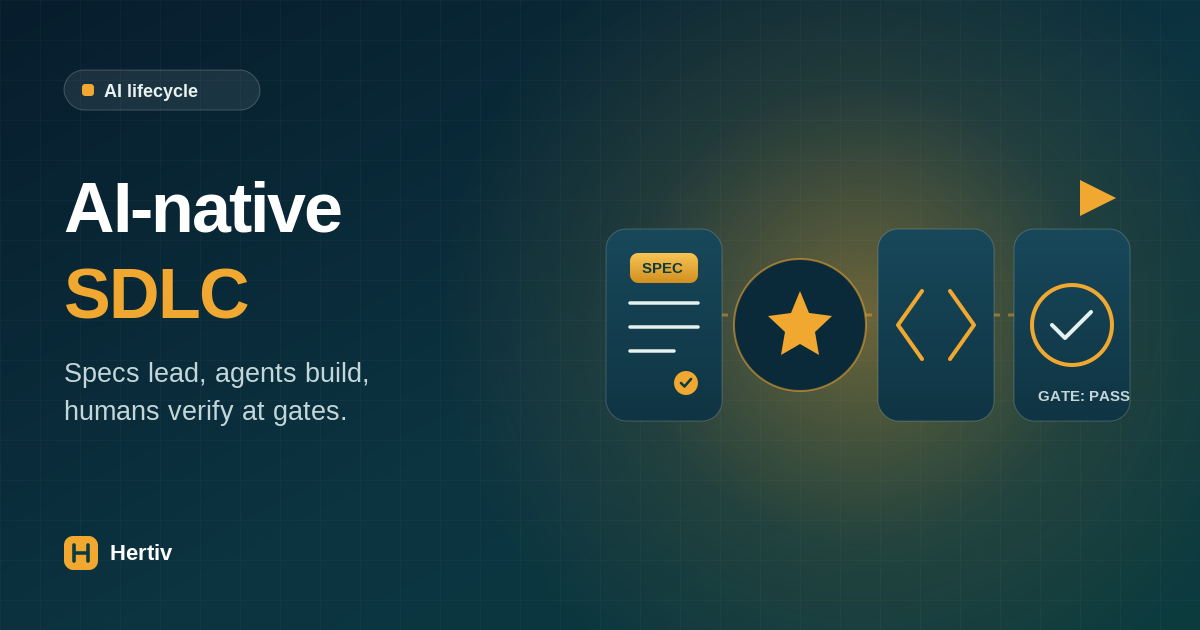
An AI-native SDLC rebuilds the software lifecycle around AI agents: the spec leads, agents draft, and humans verify at gates. Here is how each phase changes.
On this page
Short answer
An AI-native software development lifecycle is a way of building software in which AI agents draft the work in every phase, from requirements to testing, while people write the specification and verify the result at defined gates. The phases themselves change, because a model writes code, tests and docs far faster than a person, so the slow work becomes deciding what to build and proving it is right.
What is an AI-native SDLC?
An AI-native software development lifecycle is a way of building software in which AI agents do the drafting work in every phase, from requirements to testing, while people write the specification and verify the result at defined gates. The spec becomes the source of truth.
The difference from a normal lifecycle is where the model sits. Normally a developer writes the code and the model suggests. In an AI-native lifecycle, the model writes the first version of the code, the tests and the docs, and the developer reviews, corrects and approves.
That shift changes each phase. Requirements become a spec the model can read, design becomes decisions the model can follow, and testing becomes a check that model output matches the spec. The table shows the change phase by phase, with the gate where a person stays in charge.
| Phase | Old way | AI-native way | Human gate |
|---|---|---|---|
| Requirements | Tickets | Written spec | Approve the spec |
| Design | Diagrams | Decision list | Approve the design |
| Build | Developer writes code | Agent drafts code | Review the diff |
| Test | Developer writes tests | Agent drafts tests | Approve the test plan |
| Deploy | Manual steps | Agent drafts notes | Approve the release |
| Maintain | Fixes when reported | Agent drafts fixes | Approve the fix |
None of this removes the developer. It moves the developer to the parts a model cannot do: deciding what the software should do, judging whether the result is right, and taking responsibility when it is not. See how an AI SDLC squad is organised for the team shape that fits.
How does each phase change?
Each phase changes in the same way: the model produces the first version, and a person checks it against the spec. Requirements become a short written document with acceptance criteria the model can test against, instead of a ticket with two lines and a meeting to explain it. A vague requirement produces vague code, so the spec has to carry the detail the meeting used to carry.
Design becomes a list of decisions: which database, which API shape, which parts are allowed to change. The model can follow those decisions, but it cannot make them, because a design decision is a trade-off between cost, risk and speed, and only a person can own that trade-off. The design doc gets shorter and more precise, because it is written for a reader that does exactly what it says.
Build and test change the most. The agent drafts the code and the tests together, runs them, and fixes the failures it can explain. The developer reviews the diff, not the keystrokes, and the review is about whether the code does what the spec asked for. Deployment and maintenance change the least: the agent drafts release notes and triages incoming bugs, but the release decision and the fix approval stay with people.
What is spec-driven development?
Spec-driven development is the practice that makes an AI-native lifecycle work: the specification is written first, in enough detail that a model can build from it, and the spec is treated as the thing that gets reviewed, not the code. If the spec is wrong, the code will be wrong in exactly the way the spec asked for.
A good spec for this way of working has four parts: what the feature does, what it must not do, how you will know it works, and what it is allowed to touch. The third part matters most, because it becomes the acceptance test. When the model finishes, the test either passes or it does not, and that answer is objective in a way a code review never is.
The spec also has to state its limits. It should name the systems the agent may change and the ones it must not, the data it may read, and the actions that need a human before they happen.
Without those limits, an agent with broad access will do something reasonable-looking and wrong, and nobody will notice until a customer does. For teams scoping a first project, an AI proof of concept is a cheap way to test whether specs written this way hold up.
Where do humans stay in charge?
Humans stay in charge at the gates: the spec approval, the design approval, the code review, the test-plan approval and the release approval. Each gate is a real decision, not a rubber stamp, and each one has a named person who owns it. If a gate has no owner, it is not a gate; it is a hope.
The gates work because they are small and frequent. A spec of one page can be reviewed in twenty minutes, and a diff of two hundred lines can be reviewed properly. A spec of twenty pages and a diff of two thousand lines cannot, and the reviewer will approve both without reading them. Keep the work small enough that the gate can actually hold.
Humans also stay in charge of the things a model cannot judge: whether the feature is worth building, whether the trade-off is acceptable, and whether the risk is worth it. A model can tell you that a change will take three days; it cannot tell you whether those three days are worth spending.
That judgement is the job, and it does not get automated away. See AI-powered software development for how teams organise the review work.
How do you move a team to an AI-native SDLC?
You move a team to an AI-native SDLC one phase at a time, starting with the phase where the model already helps and the gate already exists. Most teams start with build and test, because code review is a gate they already have, and the model draft slots into it without changing anything else.
- Pick one team and one service. A small team with a well-understood service learns faster than a whole department, and its mistakes stay small.
- Write specs for two features. Give each spec acceptance criteria the model can test against, and review the specs before any code is written.
- Let the agent draft, and review the diff. Measure how long the review takes and how many issues it catches, so you know whether the gate is holding.
- Add test drafting next. Let the agent draft tests from the spec, and check whether the tests catch a deliberately broken change.
- Write down the gates. Name the owner of each gate, what they check, and what happens when the check fails.
- Expand one phase at a time. Move to design or maintenance only when the phases you already changed are steady.
Expect the first month to feel slower. Writing good specs takes time, and reviewing model output is a skill to learn. The saving arrives later, when the spec is written once and the model produces the code, the tests and the docs from it. An AI readiness assessment shows which gaps to close first.
Example (hypothetical): a team cuts review time
Example (hypothetical): a team of six developers merges about 24 pull requests a week, and each one takes around 30 minutes to review properly. That is 24 times 30, or 720 minutes, which is 12 hours of review a week across the team.
The team moves to an AI-native flow. The agent drafts each change from a written spec and writes a short summary of what changed and why, with links to the spec lines it followed. The reviewer reads the summary, checks the diff against the spec, and runs the tests the agent drafted. The review now takes about 8 minutes per request: 24 times 8 is 192 minutes, or 3 hours and 12 minutes a week.
The saving is 720 minus 192, or 528 minutes, which is 8 hours and 48 minutes a week. The team spends part of that saving writing better specs, which is where the time went, and keeps the rest. The review is also more consistent, because every change now arrives with a summary and a spec to check against, instead of a bare diff and a ticket title.
What are the common mistakes?
Most failed AI-native lifecycles fail for the same reasons as the old one, only faster. The model produces work quickly, so a bad spec becomes bad code, bad tests and bad docs in an afternoon, where the old lifecycle would have taken a week to make the same mistakes.
- Writing a vague spec and expecting the model to fill in the gaps
- Approving diffs without reading them because the model usually gets it right
- Letting the agent change systems the spec never mentioned
- Skipping acceptance tests because the code looks correct
- Changing every phase at once instead of one at a time
- Measuring speed instead of whether the gates are holding
The pattern behind all six is the same: the model is fast, and fast work that nobody checks is just a faster way to ship a mistake. A short spec, a named gate owner, and a review small enough to actually read catch most of it before a customer ever notices.
If the review is too big to read, the work is too big to merge. Custom software development teams can help set up the gates for a team that is starting out.
Key takeaways
- The spec leads: the model builds from it, and the spec is what gets reviewed.
- Each phase changes the same way: the model drafts, a person verifies at a gate.
- Keep every gate small enough that a person can actually check it.
- Acceptance criteria in the spec become the objective test of the result.
- Move one phase at a time, starting where a gate already exists.
- Measure whether the gates hold, not how fast the model writes.
Frequently asked questions
What is an AI-native SDLC?
An AI-native software development lifecycle is one in which AI agents draft the work in every phase, from requirements to testing, while people write the specification and verify the result at defined gates. The spec becomes the source of truth, and code is treated as something the model produces from it.
Is an AI-native SDLC the same as using AI coding tools?
No. AI coding tools help a developer write code faster inside the old lifecycle. An AI-native SDLC changes the phases themselves: the spec leads, agents draft the code, tests and docs, and humans verify at gates. The tools are part of it, but the lifecycle is the change.
Do developers still write code in an AI-native SDLC?
Yes, but less of it, and in different places. Developers write the spec, review the diff, fix the cases the model cannot explain, and own the decisions. The typing moves to the model; the judgement stays with the developer.
What is the biggest risk of an AI-native SDLC?
The biggest risk is a vague spec, because the model will build exactly what the spec asked for, including its gaps. The second risk is rubber-stamp review, where diffs are approved without being read. Both are fixed by short specs and gates small enough to check.
How long does it take to move to an AI-native SDLC?
A single team can change one phase, usually build and test, within a few weeks. Changing the whole lifecycle takes months, because writing good specs and reviewing model output are skills the team has to learn. Move one phase at a time rather than all at once.
Does an AI-native SDLC work for regulated software?
It can, because the gates and the spec create a clear audit trail: what was asked for, what was built, who approved it and what the tests showed. Regulated teams usually keep more gates and smaller changes, but the structure fits regulation better than an undocumented process does.