AI Mortgage Underwriting Fraud Detection: What It Catches
AI helps underwriters catch income lies, occupancy fraud and fake appraisals before a loan funds. Here is how the checks work and where a human stays in charge.
On this page
Short answer
AI mortgage underwriting fraud detection is the use of software to check a mortgage application for signs of fraud before the loan is approved. It compares the borrower's stated income, job, debts and property value against bank records, tax data, employment databases and public records, then flags mismatches for an underwriter to review. It catches patterns a person would miss, but it does not decide whether the loan is approved.
What is AI mortgage underwriting fraud detection?
AI mortgage underwriting fraud detection is software that checks a mortgage application for fraud signals while the underwriter is still reviewing it. It reads the application, the supporting documents and the data the lender already holds, then compares them against outside sources to find claims that do not line up.
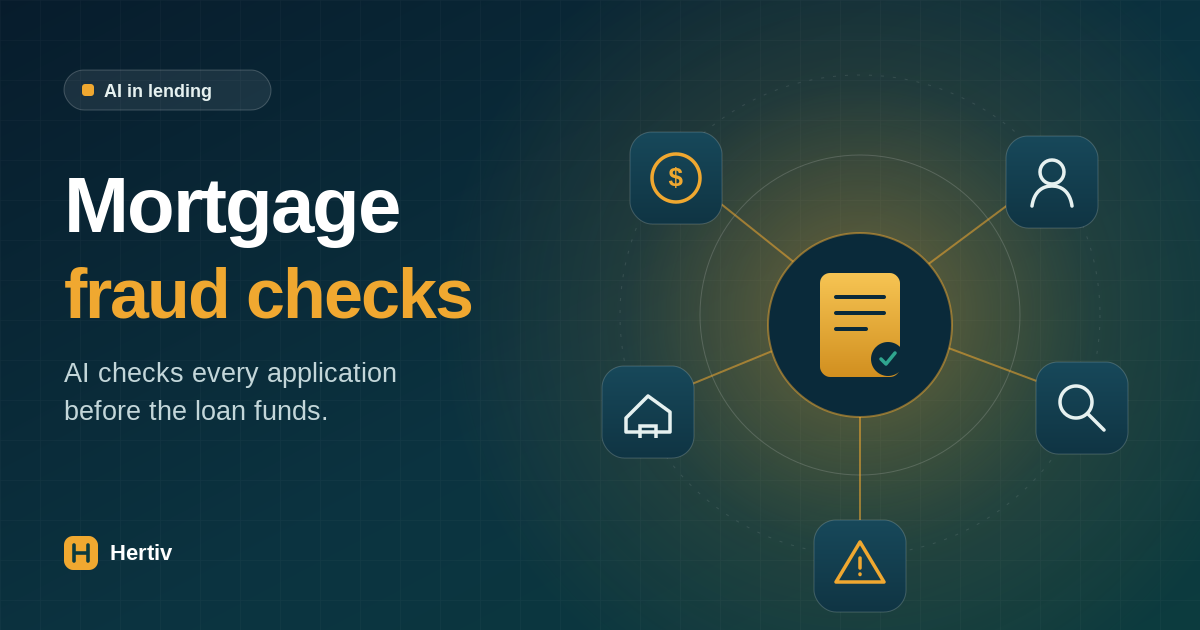
The checks cover the five places fraud usually hides. The table below lists each one, what the borrower claims, and what the AI compares it against.
| Fraud type | What is claimed | What the AI checks |
|---|---|---|
| Income fraud | Higher pay than earned | Bank deposits and tax records |
| Employment fraud | A job that does not exist | Employer databases and payroll data |
| Occupancy fraud | Primary home, really a rental | Address history and utility records |
| Appraisal fraud | Inflated property value | Recent sales and valuation models |
| Identity fraud | A borrowed or fake identity | Identity records and application history |
A flag is not a verdict. It means the application needs a closer look from a person, and the underwriter decides what happens next. Document forgery itself is a separate check; see AI-powered document fraud detection for how altered documents are spotted.
Which fraud schemes show up in underwriting?
Income fraud is the most common scheme. A borrower inflates salary, adds a second job that does not exist, or shows bank deposits that are really transfers from family or another loan. The AI spots it by comparing stated pay with deposits, tax records and the employer's payroll range for that role.
Occupancy fraud happens when a borrower claims a home as a primary residence to get a lower rate, then rents it out. The AI checks address history, utility accounts and whether the borrower already owns a home nearby, which together make the pattern visible.
Appraisal fraud and straw buyers are the expensive ones. In appraisal fraud the property value is pushed up so the loan covers more than the home is worth, often with a friendly appraiser. A straw buyer is a real person who applies in their own name while someone else controls the property and the money. Both need a person to investigate; the AI only raises the flag.
How does the AI check an application?
The AI check runs in three layers. First it reads the application and the documents: income, job, debts, assets and the property details. Then it pulls outside data: bank transactions, tax records, employer databases, public property records and the lender's own history of past applications.
Second, it cross-checks. Stated income is compared with deposits and tax figures. The employer's name is checked against business registries and payroll data. The property address is checked against recent sales, valuation models and whether the same property appeared in other applications recently.
Third, it scores the application. Each mismatch adds to a risk score, and patterns across applications matter too: the same phone number, employer or bank account appearing in several applications is a stronger signal than any single mismatch. High scores go to a fraud review queue, while clean applications move on. The same layered idea is used in fraud detection using machine learning for transaction fraud.
How does a fraud check run in practice?
A fraud check runs alongside underwriting, not after it. The underwriter still owns the decision; the AI works as a second pair of eyes that never gets tired and never skips a file.
- Collect the application. The borrower submits income, job, debts, assets and property details, and the lender pulls a credit report.
- Run the automated checks. The AI compares the application with bank, tax, employer and property data, and scores each mismatch.
- Route the flags. Clean applications continue to normal underwriting. Flagged ones go to a reviewer with the reasons listed.
- Verify with the borrower. The reviewer asks for proof: pay slips, employer confirmation, bank statements or an explanation of a deposit.
- Decide and record. The underwriter approves, asks for more proof, or declines. Every flag and decision is logged for audit.
- Feed the outcome back. Confirmed fraud and false alarms both go back into the system, so the checks get sharper over time.
The whole check usually runs in minutes, which is why it fits inside underwriting instead of sitting after it. The slow part is the human follow-up, not the software.
What can AI not prove about a borrower?
AI can show that two records disagree, but it cannot prove why. A deposit that does not match stated income might be fraud, or it might be a gift, a bonus, or a transfer the borrower forgot to mention. Only a person asking the borrower can settle that.
It also cannot see what is not in the data. A borrower who uses a real employer and real pay slips but lies about occupancy leaves no mismatch in the income data. Appraisal fraud needs a valuer to visit the property, and a straw buyer looks clean on paper until someone checks who actually lives there.
There are also limits on the data itself. Employment databases do not cover every job, tax records lag by months, and some records are wrong. A flag based on stale or wrong data is a false alarm, and too many false alarms make underwriters ignore the system. Mortgage servicing faces the same data problem; see AI in mortgage loan servicing for how lenders handle it after the loan is made.
Example (hypothetical): a lender reviews 240 applications
Example (hypothetical): a small lender receives 240 mortgage applications in a month. Checking each one by hand takes about 30 minutes, which is 240 times 30 minutes, or 120 hours of underwriter time.
With AI checks, 204 applications pass with no flags and move straight to normal underwriting. The other 36 are flagged, and a reviewer spends 30 minutes on each, which is 36 times 30 minutes, or 18 hours. The team also spends 4 hours a month checking the AI's settings and reviewing false alarms, so the total is 22 hours.
That saves about 98 hours a month. Of the 36 flags, 12 turn out to be real fraud and 24 are false alarms, so the team learns to expect roughly two false alarms for every real case, and to treat every flag as a question rather than an answer.
What are the common mistakes?
Most problems with fraud detection come from trusting the score too much, or from feeding it bad data. The mistakes below are the ones that cost lenders the most.
- Treating a high risk score as proof of fraud instead of a reason to ask questions
- Checking documents but never checking the borrower behind them
- Using stale tax and employment data and trusting the result
- Letting false alarms pile up until underwriters ignore the flags
- Running fraud checks only after approval instead of during underwriting
- Keeping no audit trail of which flags were checked and how they were resolved
Key takeaways
- AI compares what a borrower claims with bank, tax, employer and property records.
- Income, employment, occupancy, appraisal and identity fraud are the five schemes to watch.
- A flag is a question for a person, not a verdict on the application.
- Patterns across applications, such as a shared phone number, are stronger than one mismatch.
- False alarms are normal; a system that never flags anything is checking too little.
Frequently asked questions
What is mortgage underwriting fraud?
Mortgage underwriting fraud is a false statement on a mortgage application, such as inflated income, a fake job, a home claimed as a primary residence that is really a rental, or an inflated property value. It matters because the lender prices the loan on facts that are not true, and the loan is more likely to default.
How does AI detect mortgage fraud?
AI compares the application with outside data: bank deposits against stated income, employer databases against the claimed job, address history against the claimed residence, and recent sales against the appraised value. Mismatches add to a risk score, and high scores go to a human reviewer.
Can AI approve or decline a mortgage on its own?
No. AI flags applications that need a closer look, but the underwriter makes the decision. The borrower gets a chance to explain a mismatch, and the lender keeps an audit trail of every flag and decision.
What is occupancy fraud?
Occupancy fraud is claiming a home as a primary residence to get a lower interest rate, then renting it out or using it as an investment property. Lenders check address history, utility accounts and whether the borrower already owns a home nearby to spot it.
How common are false alarms in fraud detection?
False alarms are normal and expected. In a typical month a lender might see two false alarms for every real fraud case, because deposits, bonuses and gifts often look like income fraud at first glance. The review step exists to sort real cases from explainable ones.
Does fraud detection slow down mortgage approval?
The automated checks usually run in minutes, so they fit inside underwriting rather than adding a separate step. The slow part is the human follow-up on flagged files, which is why lenders triage flags instead of checking every application by hand.