AI in Mortgage Loan Servicing: What It Does Today
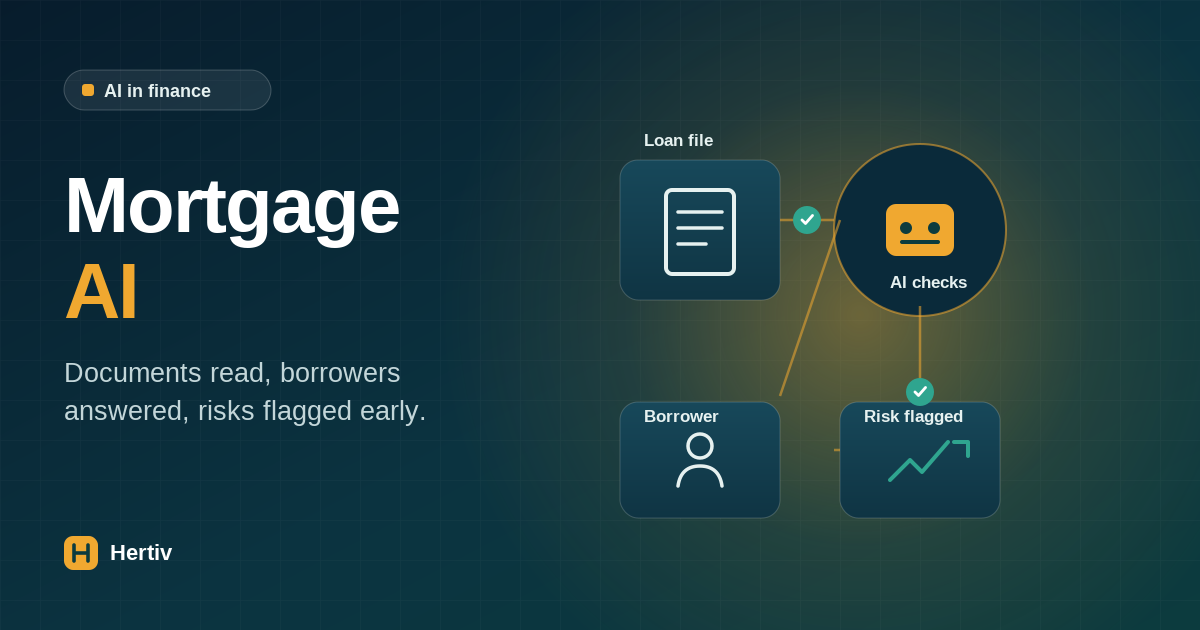
AI in mortgage loan servicing reads documents, answers borrower questions and flags risky accounts. Here is what it does well, and where humans stay in charge.
On this page
Short answer
AI in mortgage loan servicing is software that reads loan documents, answers borrower questions, and watches payment and escrow data for problems. It handles routine work such as document checks, payment reminders and hardship intake, while people decide exceptions, complaints and foreclosure steps. The gains are speed and consistency, not replacing the servicer.
What is AI in mortgage loan servicing?
AI in mortgage loan servicing is software that reads loan documents, answers borrower questions and watches payment, escrow and insurance data for problems. It works inside the servicer's existing systems, taking over routine checks and drafts while people keep the decisions that affect a borrower's home.
Servicing covers everything after a loan closes: collecting payments, managing escrow, handling insurance and tax bills, answering borrower questions and working with borrowers who fall behind. Much of that work is reading documents and following rules, which is where AI helps most.
| Task | What AI does | Who checks it |
|---|---|---|
| Document intake | Reads and sorts payoff, insurance and tax papers | Servicing staff |
| Borrower questions | Drafts answers from loan records | Agent before sending |
| Payment monitoring | Flags missed or partial payments | Collections team |
| Escrow review | Checks tax and insurance bills against escrow | Servicing staff |
| Hardship intake | Collects income and hardship details | Loss mitigation team |
| Compliance checks | Checks letters and notices against rules | Compliance staff |
The pattern is the same in each row: AI prepares, a person decides. That split matters because servicing is regulated, and a wrong letter or a missed deadline can cost a borrower their home.
What does AI do with loan documents?
AI reads the documents that arrive during servicing, such as insurance renewals, tax bills, payoff statements and hardship letters. It pulls out the fields that matter, such as amounts, dates and policy numbers, and files each document against the right loan.
The gain is that a document no longer waits in a queue for someone to open it. A servicer that receives thousands of papers a month can sort and check them the same day, and staff spend their time on the ones the system flags as unclear or mismatched.
The check step stays human. When a tax bill does not match the escrow balance, or an insurance policy has lapsed, the file goes to a person. Document AI tools handle the reading; people handle the judgement.
How does AI help borrowers get answers?
Borrowers ask the same questions again and again: what is my payoff amount, why did my payment change, where do I send an insurance update. An AI assistant can draft answers from the loan record and the servicer's own procedures, then hand the draft to an agent to check and send.
The assistant works best when it can see the loan record and is told to say when it does not know. A borrower who gets a wrong payoff figure is worse off than one who waits for a person, so the handoff rule matters more than the speed of the answer.
Voice and chat assistants are the usual front door, but the same pattern works over email. Teams building this often start with AI agents for finance teams, where the handoff and logging rules are already worked out.
How does AI spot payment problems early?
AI watches payment patterns and flags accounts that change: a payment that arrives late twice, a partial payment, or an escrow shortfall after a tax rise. It does not decide what happens next; it puts the account in front of a person sooner than a monthly report would.
Early contact matters because a borrower who is one payment behind is easier to help than one who is six behind. The servicer can offer a repayment plan or a hardship review while the gap is still small.
The risk is over-flagging. A model that flags every small change floods the team with false alarms, so servicers tune the rules and review which flags led to real help. The goal is fewer, better flags, not more of them.
Example (hypothetical): a servicer clears a document backlog
Example (hypothetical): a servicer with 40,000 loans receives 6,000 documents in a month. Staff can review about 100 documents a day each, so four staff working 20 days a month clear 8,000 documents, which is more than the inflow, but only just.
With AI reading and sorting first, the same four staff check only the 1,200 documents the system flags, about 15 a day each, and the rest are filed automatically. The backlog clears in the first week instead of the last, and staff spend their time on mismatches rather than opening envelopes.
The numbers are invented to show the arithmetic, not a real servicer. The point is that AI changes which documents need a person, not how many documents arrive. The document AI use cases article shows the same pattern in other industries.
What are the common mistakes?
The most common mistakes are launching without a human check, training on dirty loan data, and automating decisions that belong to people.
- No human check on outgoing answers. A wrong payoff figure or a wrong letter damages trust and can break rules.
- Training on messy records. If loan records are incomplete or out of date, the model learns the wrong patterns.
- Automating hardship decisions. Who gets help, and on what terms, is a judgement call that needs a person.
- Ignoring letter and notice rules. Servicing letters follow strict rules on timing and content, and AI output must be checked against them.
- Measuring speed instead of outcomes. Faster answers mean little if more of them are wrong.
How should a servicer start with AI?
A servicer should start with AI by picking one workflow, proving it with human review, and expanding only after the pilot passes. The steps below keep the risk small.
- Pick one workflow. Document intake is the usual first pick, since the outcome is easy to check.
- Assemble a sample. Gather real documents with known correct answers, so you can measure accuracy.
- Run a pilot with full human review. Every output is checked by a person until the error rate is known.
- Measure accuracy and time. Track how many documents were right, how many needed fixing, and how much staff time was saved.
- Expand one workflow at a time. Add borrower questions or payment flags only after the first workflow is trusted.
Before the pilot, an AI readiness assessment can show whether the loan records and the data access are ready. Skipping that step is how pilots fail on data, not on the model.
Key takeaways
- AI prepares the work in mortgage servicing; people keep the decisions
- Document intake is the usual first win, since outcomes are easy to check
- Borrower answers from AI always need a human check before sending
- Early payment flags help borrowers sooner, when the gap is still small
- Start with one workflow, measure accuracy, then expand
Frequently asked questions
What is mortgage loan servicing?
Mortgage loan servicing is the work after a loan closes: collecting payments, managing escrow for tax and insurance, answering borrower questions, and working with borrowers who fall behind. The servicer is usually a different company from the lender that made the loan.
Can AI decide whether to foreclose on a borrower?
No. Foreclosure and hardship decisions involve judgement, borrower circumstances and strict rules, so they stay with people. AI can prepare the file and flag the account, but the decision and the communication are human work.
Does AI replace servicing staff?
No. AI takes over routine reading, sorting and drafting, which frees staff for the cases that need judgement: mismatched documents, hardship reviews and complaints. Teams that deploy it usually redeploy staff rather than remove them.
What data does AI need to work in servicing?
It needs clean loan records, sample documents with known correct answers, and the servicer's own procedures for letters and notices. If the records are incomplete or out of date, the model will produce wrong answers, so data cleanup comes first.
How do servicers keep borrower data safe with AI?
They limit what the AI tool can see, log every access, keep borrower data inside approved systems, and require a data agreement with any vendor. Access controls and logging matter as much as the model itself.
How long does it take to start using AI in servicing?
A narrow pilot, such as document intake, usually takes a few weeks when the data is ready. Moving to production adds integration, staff training and compliance review, which take longer than the model work itself.


