AI-Powered Document Fraud Detection: What It Catches
AI document fraud detection checks a file for tampering, fake details and mismatched records. Here is what it catches and how the checks work.
On this page
Short answer
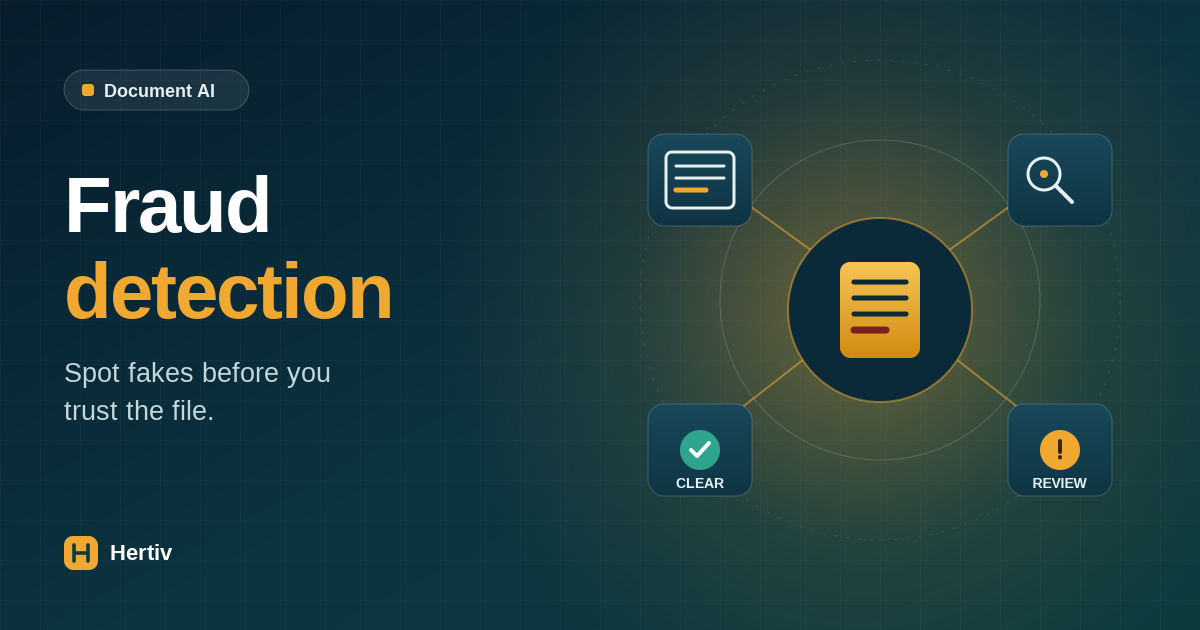
AI-powered document fraud detection is software that screens a document for tampering, forgery or false information before anyone relies on it. It checks the visible content, the hidden file data and the details against other records, then flags files for a person to review.
What is AI-powered document fraud detection?
AI-powered document fraud detection is software that checks a document for signs of tampering, forgery or false information before anyone relies on it. It reads the file the way a person would, then adds checks no person can do quickly, such as comparing pixel patterns, reading hidden file data and matching details against other records.
The checks cover identity documents, invoices, bank statements, certificates and contracts. A forged passport, an altered invoice total or a payslip built from copied parts can all pass a quick visual look, so the software looks for the small inconsistencies that give a fake away.
It is a screening tool, not a verdict. When the software flags a file, a person still decides what happens next, and when it clears a file, that means no problem was found, not that the document is genuine beyond doubt. For teams that process documents at scale, document AI covers the wider job of reading and sorting files.
Which document fraud cases can AI spot?
AI document checks catch the fraud types that leave traces in the file itself. The most common cases fall into a few groups, and each one leaves a different kind of evidence.
| Fraud type | What changes in the file | What the AI checks |
|---|---|---|
| Altered amounts | Numbers edited after the file was issued | Font, spacing and pixel edges around the change |
| Copied identity photo | Photo pasted in from another document | Edges, lighting and compression around the photo |
| Fake document | Whole file built from a template | Layout, fonts and security marks against genuine samples |
| Mismatched details | Name or dates differ across files | Details compared across the whole set of files |
| Reused document | Same file submitted twice | File hash and content match against earlier files |
A single check rarely proves fraud on its own. The strength of the approach is that several small signals add up, so a file that fails two or three checks is worth a closer look even when each signal looks minor alone.
How does the AI check a document?
A document fraud check works in three layers, and each layer answers a different question about the file. The first layer reads the visible content, the second reads the file itself, and the third checks the details against other records.
- Visual layer. Looks for edits in the image: fonts that change mid-line, edges that do not match, shadows that point the wrong way, and text that sits on a different background from the rest of the page.
- Metadata layer. Reads the data the file carries with it: when it was created, which software made it, and whether the edit history matches the story the document tells.
- Cross-check layer. Compares names, dates and amounts with other files in the same case, and flags details that contradict each other.
Models learn these patterns from samples of genuine and forged documents. That training data matters: a model trained only on passports will miss invoice fraud, and a model trained on one country's documents may misread another's. The checks also link to wider fraud work, such as fraud detection using machine learning, which covers transaction patterns rather than files.
How does a document fraud check run in practice?
A typical check runs in minutes and follows the same order every time, so results can be compared across files and teams. The steps below describe a common setup for a lender, insurer or hiring team.
- Collect the file and the details it should match, such as the name, date and amount on the application.
- Run the visual and metadata checks and score each one, so the reviewer can see which checks failed.
- Compare the details with other records in the same case, and flag anything that contradicts them.
- Route clear files through, and send flagged files to a reviewer with the reasons attached.
- Record the decision and the reason, so the same file is not checked from scratch twice.
The reviewer sees the flagged checks, not just a single score. That matters because a flag on metadata means something different from a flag on a mismatched date, and the fix is different too.
What can AI not prove about a document?
AI document checks have clear limits, and teams that ignore them make bad decisions in both directions. A clean result is not proof that a document is genuine, and a flag is not proof that it is fake.
- A perfect forgery made from a genuine blank form can pass visual checks.
- A genuine document scanned badly can fail them, especially when the scan is skewed, dark or low resolution.
- A document can be real while the facts in it are false, such as a genuine payslip from a job that ended months ago.
That is why the check is one input among several. Identity verification, a phone call to the issuer, or a check against an official register can settle what the software cannot. An AI fraud detection agent can run these follow-up checks, but the final call still belongs to a person.
Example (hypothetical): a lender checks 300 loan files
Example (hypothetical): a small lender receives 300 loan applications in a month, each with an identity document, a payslip and a bank statement, so 900 files in total. A reviewer reading each file for 10 minutes would need 150 hours, which is more than a full working month for one person.
With AI checks, the software screens all 900 files first and flags 60 for review, about 7 in every 100. A reviewer then spends 20 minutes on each flagged file, which is 20 hours, and the other 840 files pass through. Of the 60 flagged files, 12 turn out to be altered and 48 are genuine files with scan problems or odd layouts.
The arithmetic is the point: 150 hours of reading becomes 20 hours of review, and the 12 altered files are found because the software looked at every file, not because a reviewer got lucky. The 48 false alarms are the cost, and they are why a person still reviews every flag.
What are the common mistakes?
The most common mistakes come from treating the software as a judge instead of a screen. Teams either trust it too much or ignore it when it is inconvenient.
- Rejecting every flagged file without review, which turns false alarms into lost customers.
- Accepting every cleared file without question, which misses the forgeries the checks cannot see.
- Training the model on one document type and using it on another.
- Keeping no record of why a file was flagged, so the same mistake repeats.
- Checking documents once and never re-checking when a case changes.
A document check works best when the rules are written down, the reviewer sees the reasons behind each flag, and the team reviews its own decisions every month.
Key takeaways
- AI document checks look for tampering, fake details and mismatched records in a file.
- Visual, metadata and cross-check layers each answer a different question.
- A flag means review, not rejection, and a clean result is not proof of genuineness.
- False alarms are part of the cost; reviewers need to see the reason behind each flag.
- The checks work best when the rules are written down and decisions are recorded.
Frequently asked questions
Can AI detect a forged passport?
It can spot many signs of a forged passport, such as pasted photos, inconsistent fonts and altered data pages, but it cannot prove a passport is genuine. A clean result means no problem was found, and border or identity checks still rely on official verification as well as the software.
Does document fraud detection read personal data?
Yes, it reads the details in the document to check them, which is why teams should limit access, store files securely and delete them when the check is done. Data rules differ by country, so the team running the checks should know which rules apply.
How accurate is AI document fraud detection?
Accuracy depends on the document type, the quality of the scan and the training data behind the model. Vendors sometimes publish test results, but those numbers come from their own test sets, so teams should run their own trial on real files before trusting a score.
Can it check handwritten documents?
It can check some handwritten documents, but handwriting varies more than print, so the results are less reliable. Most teams use AI checks on printed and digital documents, and route handwritten files to a person for review.
What happens when a document is flagged?
A flagged document goes to a reviewer, who sees which checks failed and why. The reviewer may ask for a new copy, contact the issuer, or compare the file with other records before deciding whether to accept it or reject it.
Is document fraud detection the same as KYC?
No. KYC, or know your customer, is the wider process of confirming who a customer is, and document checks are one part of it. A document check tests whether a file looks genuine, while KYC also covers identity, sanctions and risk.