AI SDLC Squad: What It Is and How to Run One
An AI SDLC squad is a small team that uses AI across the software development life cycle. Here is who sits in it, how it works and how to set one up.
On this page
Short answer
An AI SDLC squad is a small cross-functional team that uses AI tools across the software development life cycle, from requirements and design through coding, testing and release. It owns one product area, sets the rules for AI use, and measures whether the tools actually help.
What is an AI SDLC squad?
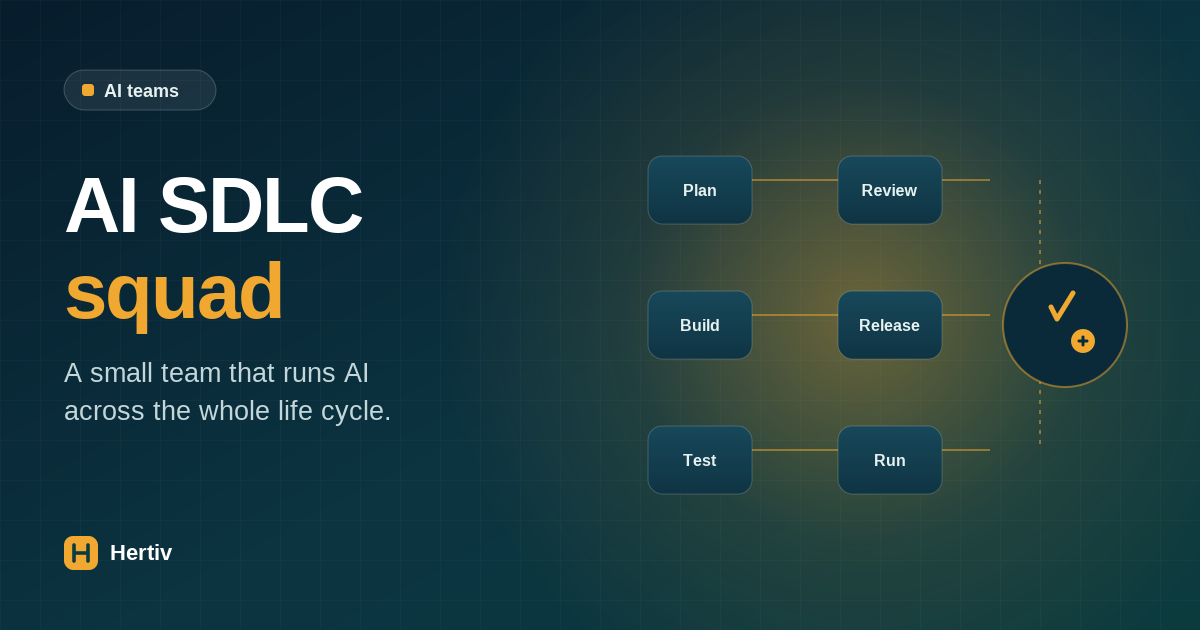
An AI SDLC squad is a small cross-functional team that uses AI tools across the software development life cycle, from requirements and design through coding, testing and release. The squad owns one product area and uses AI to speed up the routine parts of each phase while people keep the decisions that need judgement.
Unlike a general AI task force, the squad is tied to the life cycle itself: it picks the AI tools, sets the rules for using them, and measures whether they help. A typical squad has a product owner, two or three engineers, a tester and someone who owns quality or security, all working on the same product.
The idea grew out of two trends. First, AI coding assistants and test generators became good enough to change daily work. Second, teams found that handing everyone a tool without a plan created uneven results, so a dedicated squad was a better way to learn what works and spread it.
Who sits in an AI SDLC squad?
The squad is small on purpose, usually four to seven people, and each member brings a different part of the life cycle with them.
| Role | What they own | How AI helps them |
|---|---|---|
| Product owner | Requirements and priorities | Drafting and checking user stories |
| Engineers | Design and code | Code suggestions and reviews |
| Tester | Test coverage and quality | Test generation and bug triage |
| Quality or security lead | Standards and risk | Scanning code and configs |
| Ops or release owner | Builds and deployment | Release notes and incident drafts |
One member should own the AI tooling itself: which tools are approved, what data they can see, and how their output is checked. Without that owner, the squad drifts into each person using a different tool with different rules. For the life cycle basics, see the software development life cycle.
How does the squad use AI in each phase?
The squad maps AI tools to the phases of the life cycle, so each phase gets help where it saves the most time and the least risk.
In requirements, AI drafts user stories and acceptance criteria from notes and tickets, and the product owner edits them into shape. In design, it suggests patterns and flags missing edge cases in a draft design. In coding, assistants suggest code and explain unfamiliar code, while reviewers use AI to summarise large changes before reading them.
In testing, AI generates test cases from requirements and groups failing tests by likely cause. In release, it drafts release notes and checks configurations against policy. The rule in every phase is the same: AI drafts, a person decides. Nothing ships without a human review, and the squad tracks how often AI suggestions are accepted or corrected.
How do you set up an AI SDLC squad?
You set one up by picking a single product area, staffing it with people who already work there, and giving it a short trial with clear measures.
- Pick one product area. Choose a team with steady work and a backlog, not the busiest or most troubled one.
- Staff it from the existing team. Move four to seven people into the squad rather than hiring a new group.
- Choose one or two approved tools. Fewer tools means clearer rules and easier measurement.
- Write the usage rules. Decide what data the tools can see, what must never be pasted in, and who reviews output.
- Run a six-week trial. Measure time saved, defects found and review effort, then decide whether to keep, change or stop.
- Share what works. The squad documents its rules and results so other teams can copy them.
Start small and measure honestly. A squad that proves its value on one product is easier to copy than a company-wide rollout that nobody asked for. For implementation steps, see how to implement the software development life cycle.
Example (hypothetical): a squad cuts review time in half
Example (hypothetical): a 40-person software company forms an AI SDLC squad of five people around its billing product. Before the squad, code review took about 10 hours a week across the team, and writing tests for a new feature took about 6 hours.
The squad adopts one coding assistant and one test generator, with rules that no customer data goes into either tool and every AI suggestion is reviewed by a person. After six weeks, review time falls to about 5 hours a week because the assistant summarises changes and flags obvious issues first. Test writing falls to about 3 hours per feature because the generator drafts the routine cases and the tester adds the edge cases.
The team saves roughly 8 hours a week on those two tasks. The squad also finds that AI-generated tests catch about the same number of defects as hand-written ones, but only when the tester reviews them. The company keeps the squad and copies its rules to a second product team.
What are the common mistakes?
The most common mistakes are giving the squad no clear owner, letting tools run without rules, and judging success by speed alone.
- No tooling owner. Without one person owning the approved tools and rules, each member uses something different.
- No data rules. Pasting customer data or secrets into an AI tool creates a risk that is hard to undo.
- Skipping review. AI output that ships without a human check will eventually ship a bug.
- Measuring only speed. Faster code that creates more defects is not a win; track quality too.
- Rolling out too fast. Copying the squad to every team before the first trial finishes spreads bad habits.
A squad works when it is small, measured and honest about what AI does well and where it still needs people. For building AI tools with care, AI agent development covers how teams design agents with human oversight.
How do you know if the squad is working?
You know the squad is working when review time and defect rates both move in the right direction, and the team trusts the tools enough to keep using them.
Useful signals include the share of AI suggestions accepted after review, the time spent on code review per change, the number of defects found in testing rather than after release, and how often the squad's rules are followed without reminders. Track these weekly during the trial and monthly after that.
Also ask the team directly. If engineers say the tools save time on routine work but add review burden elsewhere, that is useful evidence. A squad that listens to its own members will adjust its rules faster than one that only watches the numbers. If the measures do not improve after six weeks, change the tools or the rules before expanding.
Key takeaways
- An AI SDLC squad is a small team that applies AI across the whole life cycle, not just coding
- Four to seven people cover product, engineering, testing, quality and release
- AI drafts in every phase; a person reviews and decides before anything ships
- Start with one product area, one or two approved tools and a six-week trial
- Measure review time and defect rates, not speed alone
Frequently asked questions
What does SDLC mean?
SDLC stands for software development life cycle, the sequence of phases a software product goes through: requirements, design, coding, testing, release and maintenance. An AI SDLC squad applies AI tools to each of those phases rather than to coding alone.
How big should an AI SDLC squad be?
Four to seven people is a good size. That is enough to cover product, engineering, testing, quality and release without becoming a separate department. Larger squads tend to lose the close working habits that make the model work.
Does an AI SDLC squad replace developers?
No. The squad changes what developers spend time on, not whether they are needed. AI drafts code, tests and documents, while people make design decisions, review output and own quality. Teams that skip the review step usually regret it.
What data rules should a squad follow?
Decide in advance what the AI tools may see. Customer data, passwords, keys and unpublished business details should stay out unless the tool is approved for them. Write the rules down and check them when a new tool is added.
Which AI tools does a squad use?
Most squads start with a coding assistant and a test generator, since those cover the largest share of routine work. Add tools for requirements, design or release only after the first two are working well and measured.
How long before a squad shows results?
A six-week trial is usually enough to see whether review time and defect rates are moving. If the measures do not improve in that time, change the tools or the rules before expanding the squad to other teams.