Software Development Life Cycle: The 7 Phases Explained
The software development life cycle is the seven-phase path from an idea to working software. Here is what happens in each phase, and where teams usually go wrong.
On this page
Short answer
The software development life cycle (SDLC) is the ordered set of phases a team follows to turn an idea into working software: planning, analysis, design, development, testing, deployment and maintenance. Each phase has a clear output, such as a requirements list or a tested release, and the next phase starts only when that output is ready. The cycle repeats as the software changes.
What is the software development life cycle?
The software development life cycle is the ordered path a team follows to build software, from the first idea to a working product that users can rely on. It breaks the work into phases, and each phase has a job to do and an output to hand over before the next phase starts.
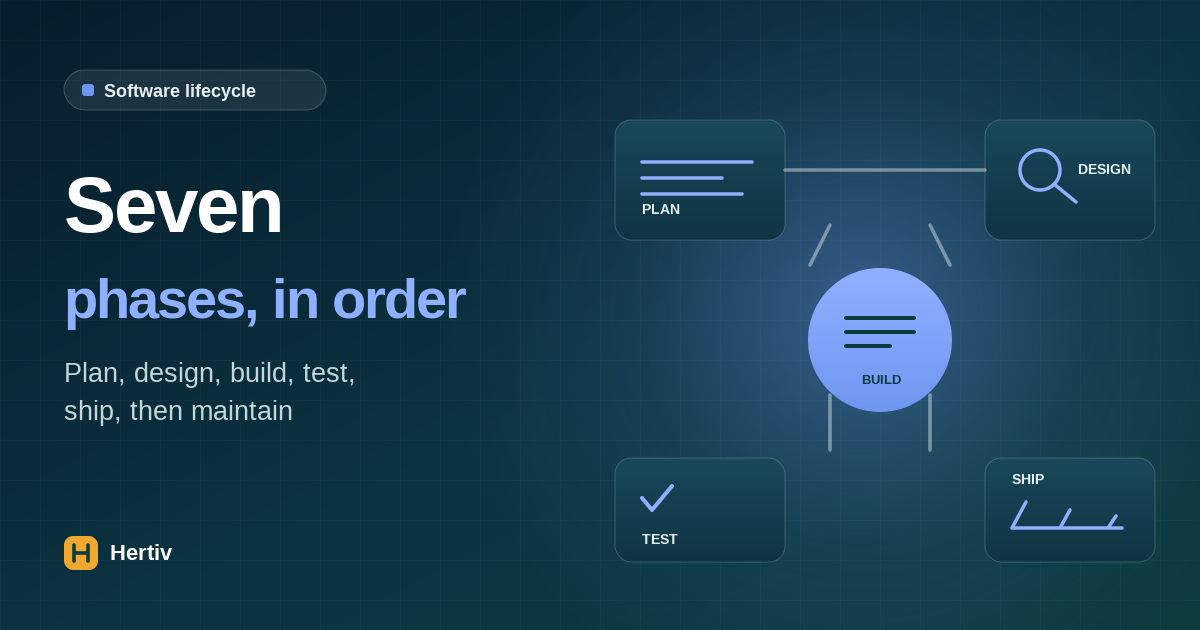
The seven phases are planning, analysis, design, development, testing, deployment and maintenance. A team may run them once from start to finish, or loop through them in short rounds, but the order stays the same: the team agrees what to build, works out how it should behave, builds it, checks it, releases it, and then keeps it running.
The point of the cycle is to catch problems early, when they are cheap to fix. A missing requirement found during planning costs a meeting to fix. The same gap found after release costs a rebuild, a patch and unhappy users. The SDLC is the habit of checking the work at each step instead of only at the end.
What happens in each phase?
Each phase of the SDLC answers a different question, and each one produces something the next phase can use. The table below shows the seven phases in order.
| Phase | Main question | Output |
|---|---|---|
| Planning | Is this worth building, and with what resources? | A short plan with scope, budget and dates |
| Analysis | What must the software do, exactly? | A requirements list everyone agrees on |
| Design | How will it be built? | Screen designs, data models and technical choices |
| Development | Who builds what, and in which order? | Working code, built in small pieces |
| Testing | Does it do what the requirements asked for? | A list of defects, fixed and re-checked |
| Deployment | How do users get it safely? | A live release with a way to roll back |
| Maintenance | What breaks, and what changes next? | Fixes, small improvements and the next plan |
Planning is the shortest phase and the one teams skip most often. A plan does not need to be long. It needs to say what the software will do, who it is for, what it will cost, and when it will be ready, so that nobody starts building before those answers exist.
Analysis is where most projects are won or lost. The team talks to the people who will use the software, writes down what they need, and agrees which needs are in the first version. A requirement that is vague at this stage becomes a defect later, because two people will read it in two different ways.
Which SDLC model should a team use?
The SDLC model is the shape of the cycle: whether the team runs the phases once, or loops through them many times. The choice depends on how clear the requirements are and how much change the team expects.
- Waterfall. The phases run once, in order, and each one finishes before the next starts. It suits work with fixed requirements, such as regulated systems, where change is expensive and the plan must be agreed up front.
- Agile. The team loops through short rounds of design, build and test, and shows working software every few weeks. It suits work where the requirements will change as users see the product, which is most business software.
- Spiral. The team builds in rounds, and each round starts by listing the biggest risks and testing them first. It suits large, risky projects where an early mistake would be very costly.
- V-model. Each development step has a matching test step, planned at the same time. It suits work where testing must be thorough and traceable, such as safety-related software.
Most small teams today use an Agile shape, because it gives users something to react to early. But the model matters less than the discipline: every model fails if the team skips the analysis, the testing or the maintenance. For a closer look at how teams pick between approaches, software development methodology compares the main options side by side.
How do the phases fit together in practice?
In practice the phases overlap more than the diagram suggests. Testing starts while development is still running, because waiting until the end means finding defects when there is no time left to fix them. Design changes as the team learns what is hard to build, and the plan changes as the team learns how long things take.
The loop back is the important part. When testing finds a problem in the design, the team goes back to the design phase and fixes it there, rather than patching the code and hoping. When users ask for a change after release, the request goes back through planning and analysis, so the team can judge whether it fits and what it costs.
This is also why the SDLC is a cycle and not a line. Maintenance is not the end of the work; it is the start of the next round, with a list of fixes and improvements that becomes the next plan. For teams working in short rounds, what is agile software development explains how the loop works week by week.
Example (hypothetical): a clinic booking app through the SDLC
Picture a small clinic that wants a booking app so patients can book appointments online instead of phoning. The team has two developers and one designer, and the clinic wants the first version live in ten weeks.
The team plans the work in hours. Planning takes 40 hours, analysis 80 hours, design 120 hours, development 480 hours, testing 160 hours and deployment 40 hours, which adds up to 920 hours. At $80 an hour, the build costs $73,600, before hosting and the clinic's own time.
During analysis the team finds that the clinic's receptionists need a way to block out lunch breaks and holidays, which the first plan had missed. Fixing that in analysis takes one afternoon of discussion. Finding it after release would have meant rebuilding the booking screen and retraining the staff.
Testing finds 24 defects, and the team fixes 22 of them before launch. The other two are small display issues that the clinic agrees can wait for the first maintenance round. The app launches on time, and the maintenance list for the next round already has its first items.
What are the common mistakes?
The most common mistakes in the SDLC are skipping a phase, writing requirements that nobody can test, and treating maintenance as an afterthought.
- Skipping analysis. Building starts before the team agrees what the software must do. The result is rework, because the team builds the wrong thing and finds out late.
- Requirements nobody can test. A requirement such as "the app should be fast" cannot be checked. Write it as a number, such as "the booking screen loads in under two seconds", so testing can pass or fail it.
- Testing only at the end. Defects found in the last week have no time left for a proper fix. Test each piece as it is built, and keep a running list of what still fails.
- No rollback plan. A release with no way back turns a bad deploy into a long outage. Every deployment should have a tested way to return to the previous version.
- Forgetting maintenance. Software that nobody maintains breaks quietly: passwords expire, libraries age, and small bugs pile up. Budget time for maintenance from the first week, not the first failure.
Teams that keep the cycle short avoid most of these mistakes, because the feedback comes while the work is still fresh. A two-week round gives the team a chance to correct course twelve times a year, instead of once.
How to run the SDLC on a small team
A small team can run the full SDLC without heavy paperwork, as long as each phase leaves a short written record. The steps below fit a team of two to six people.
- Write a one-page plan. Scope, users, budget and dates, agreed with the people paying for the work.
- List the requirements and rank them. Mark each one as must-have, nice-to-have or later, and write each one so it can be tested.
- Sketch the design before coding. Screens, data and the main technical choices, reviewed by the whole team.
- Build in small pieces and test each one. No piece is finished until its tests pass and someone else has looked at it.
- Deploy in small steps. Release to a few users first, watch it for a day, then release to everyone, with a rollback ready.
Keep the records short. A requirements list, a few screen sketches, a test list and a release note are enough for a small project. The record exists so that a new team member can understand what was decided and why, months later. For help picking the shape of the cycle, agile vs scrum project management explains the two most common small-team approaches.
Key takeaways
- The SDLC has seven phases: planning, analysis, design, development, testing, deployment and maintenance
- Each phase has a written output, and the next phase starts only when that output is ready
- Waterfall suits fixed requirements; Agile suits work that will change as users see it
- The hypothetical clinic app took 920 hours, or $73,600 at $80 an hour
- The most common mistakes are skipping analysis, untestable requirements and no rollback plan
Frequently asked questions
What is the software development life cycle in simple terms?
It is the seven-phase path a team follows to build software: planning, analysis, design, development, testing, deployment and maintenance. Each phase has a clear output, and the cycle repeats as the software changes and users ask for more.
How long does the SDLC take?
It depends on the size of the software. A small app can run through the cycle in a few weeks, while a large system can take a year or more. The phases are the same either way; only the amount of work inside each phase changes.
Is the SDLC the same as Agile?
No. The SDLC is the set of phases, and Agile is one way of running them, in short repeated rounds. Waterfall is another way, running the phases once in order. Most teams today use an Agile shape, but they still follow the same seven phases.
What is the most important phase of the SDLC?
Analysis, because it decides what gets built. A mistake in analysis becomes a defect in every phase after it, while a mistake in a later phase is usually smaller and cheaper to fix. Teams that rush analysis pay for it in rework.
Do small teams need the full SDLC?
Yes, but in a light form. A small team still needs a plan, a requirements list, a design sketch, tests, a safe release and maintenance time. The records can be short, but skipping a phase entirely is what causes the rework.
What happens after deployment?
Maintenance. The team fixes defects, watches for problems, and collects the changes users ask for. Those changes become the plan for the next round of the cycle, so the software keeps improving instead of slowly breaking.


