Agile vs Scrum: How They Differ in Project Management
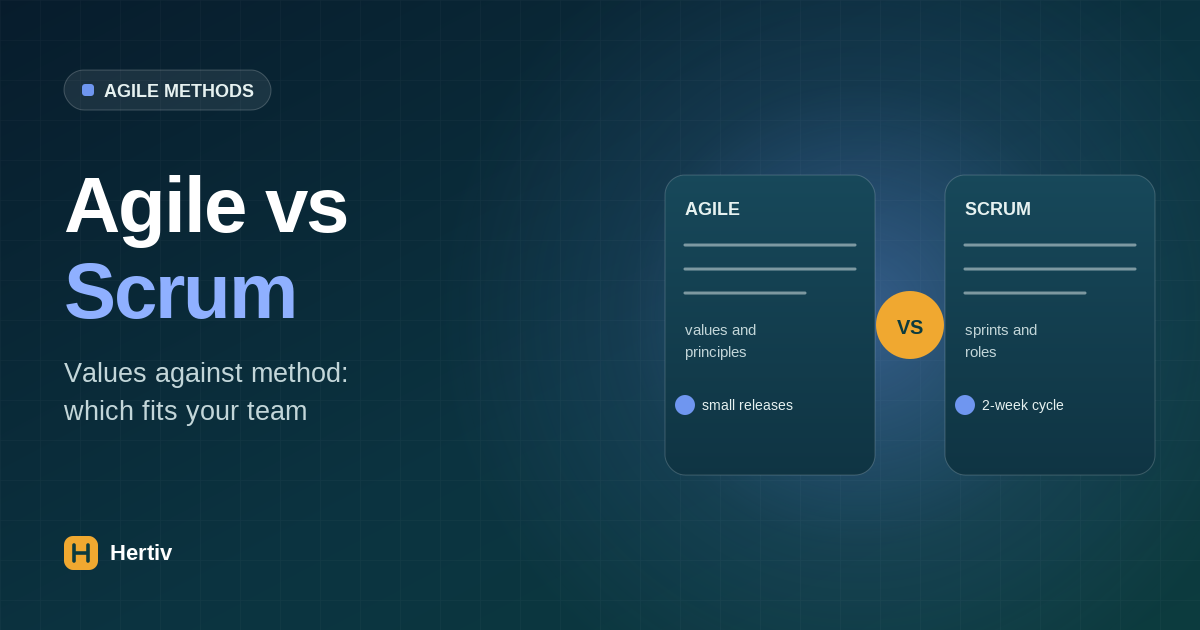
Agile is the philosophy of small releases and feedback; Scrum is one method that puts it into practice with sprints and roles. Here is how to choose.
On this page
Short answer
Agile is a way of working based on small releases and feedback, while Scrum is one specific method for practising it, with fixed sprints, defined roles and regular reviews. The right choice depends on the shape of the work and the team.
What is the difference between Agile and Scrum?
Agile is a way of working that values small releases, feedback and change, while Scrum is one specific method that puts Agile into practice with fixed-length sprints, defined roles and regular ceremonies. Agile is the philosophy; Scrum is one way to run it.
That distinction matters because teams often say they are Agile when they only follow Scrum rituals, or say they are doing Scrum when they have no sprints at all. The first case can work if the values are real; the second is usually a sign that the team has picked the label without the practice.
Other Agile methods exist too, such as Kanban, which limits work in progress and releases continuously, and Extreme Programming, which focuses on engineering practices. Scrum is the most widely used, which is why it is the usual comparison point. For the background, what Agile software development is explains the values behind all of these methods.
How do Agile and Scrum compare?
Agile and Scrum compare as a broad approach against a specific framework: Agile sets the values, Scrum sets the rules for roles, events and artefacts that a team follows day to day.
| Area | Agile | Scrum |
|---|---|---|
| What it is | Values and principles | A framework with rules |
| Work rhythm | Any, often continuous | Fixed sprints, usually 2 weeks |
| Roles | Not defined | Product owner, Scrum master, team |
| Planning | As needed | Sprint planning each sprint |
| Review | When useful | Sprint review and retrospective |
| Flexibility | High, any method fits | Lower, the rules are the point |
The table shows why Scrum can feel rigid to a team that only wants the Agile values. The rules are there to make the work visible and to force regular decisions, which is useful for teams that struggle with either. A team that already ships in small steps with good feedback may not need the full ceremony.
When should you use Scrum?
Scrum suits teams that build a product in steps, need regular feedback from users, and can commit to a fixed sprint. It works best when the work can be split into small pieces, the team is stable, and someone owns the priority of the work.
A product team building a new app is a good fit: each sprint delivers a usable piece, the product owner reorders the backlog after each review, and the retrospective catches process problems early. A team that maintains many small systems, or one that is constantly interrupted by urgent work, will find the fixed sprint harder to keep.
Scrum also needs a real product owner. Without someone who can say no to new requests and set the priority, the sprint becomes a list of whoever shouted loudest, and the method loses its value. If no one can own the backlog, a lighter method such as Kanban may fit better.
When should you use Agile without Scrum?
Agile without Scrum suits teams that need the values but not the fixed sprint, such as support teams, operations teams and teams with unpredictable work. Kanban is the usual choice here: work flows through a board, limits keep the load visible, and releases happen when the work is done.
This route also fits teams that already ship continuously. If a team deploys several times a day and reviews work as it lands, a sprint review adds little. The team can keep the Agile habits, such as small releases, user feedback and regular reflection, without the sprint ceremony.
The risk is drift. Without the fixed events, a team can slowly stop reviewing, stop reflecting and stop releasing in small steps, while still calling itself Agile. A light rhythm, such as a weekly review and a monthly retrospective, keeps the habits alive without the full Scrum calendar.
Example (hypothetical): a team that picked the wrong one
Example (hypothetical): a five-person team builds a booking tool for small hotels. It picks Scrum and runs two-week sprints. Each sprint delivers a usable piece, the product owner reorders the backlog after the review, and the team ships a first version in 10 weeks, or five sprints.
The same company also has a support team of three people who handle urgent hotel problems. It tries Scrum too, but the sprints keep breaking: urgent tickets arrive daily, and the team cannot finish a sprint without dropping planned work. After three broken sprints, the support team switches to Kanban, with a board, a limit of six open tickets per person, and a weekly review.
The result is clear. The product team keeps Scrum and ships in five sprints, or 10 weeks, while the support team clears tickets faster with Kanban and no broken sprints. The arithmetic is simple: 5 sprints times 2 weeks is 10 weeks for the product team, and the support team handles about 30 tickets a week with a limit that keeps the queue visible.
What are the common mistakes?
The most common Agile and Scrum mistakes are copying the rituals without the values, skipping the retrospective, and letting the sprint become a deadline.
- Scrum in name only. Running stand-ups and calling the work sprints, while never releasing anything small or asking users for feedback, is not Agile at all.
- Skipping the retrospective. The retrospective is where the team fixes its own process, and skipping it means the same problems repeat every sprint.
- Treating the sprint as a deadline. A sprint is a plan, not a promise. If the team is punished for missing it, it will pad estimates and stop being honest.
- No product owner. Without someone who owns the priority, the backlog fills with every request and the team builds the wrong things.
- Too many meetings. Scrum adds planning, review and retrospective time. If those meetings have no decisions, they are a cost with no return.
How do you choose between Agile and Scrum?
You choose between Agile and Scrum by looking at the work, the team and the need for feedback.
- Check the work shape. If the work splits into small, planned pieces, Scrum fits. If it arrives unpredictably, Kanban or another Agile method fits better.
- Check the team. A stable team with a product owner can run Scrum. A team that changes often, or one without a clear owner, will struggle with it.
- Check the feedback loop. If users can review a sprint every two weeks, Scrum gives a useful rhythm. If feedback is continuous, a lighter method may do.
- Start small. Try one method for four weeks, review it honestly, and change what is not working. The method should serve the team, not the other way round.
- Keep the habits. Whatever you choose, keep small releases, user feedback and regular reflection, because those are the parts that make Agile work.
For teams that need help setting up the process, custom software development teams often start with a short discovery phase that picks the working method before the build begins.
Key takeaways
- Agile is the philosophy; Scrum is one specific method that puts it into practice
- Scrum uses fixed sprints, defined roles and regular ceremonies; Agile does not require them
- Scrum fits product teams that can plan in steps; Kanban fits unpredictable, interrupt-driven work
- A sprint that never produces something a user can try is following the calendar, not the method
- Keep small releases, user feedback and regular reflection, whatever method you choose
Frequently asked questions
Is Scrum the same as Agile?
No. Agile is a set of values and principles about small releases, feedback and change. Scrum is one framework that puts those values into practice with sprints, roles and ceremonies. A team can be Agile without Scrum, but it cannot do Scrum without the Agile values behind it.
What is a sprint in Scrum?
A sprint is a fixed period, usually one or two weeks, in which a team completes a set of work and produces something usable. At the end of the sprint the team reviews the result with stakeholders and holds a retrospective to improve how it works.
Who is the product owner in Scrum?
The product owner is the person who owns the backlog and decides what the team builds next. They talk to users and stakeholders, set priorities and accept or reject the work at the end of a sprint. Without a real product owner, Scrum loses its direction.
Can a small team use Scrum?
Yes, if the work fits. A team of three to nine people can run Scrum well, as long as someone owns the backlog and the team can commit to a sprint. Very small teams or teams with constant interruptions often find a lighter method such as Kanban easier to keep.
What is Kanban, and how is it different from Scrum?
Kanban is an Agile method that visualises work on a board, limits how much work is in progress and releases continuously, without fixed sprints. Scrum uses fixed sprints and defined roles, while Kanban focuses on flow and is better for unpredictable work.
How long should a sprint be?
Most teams use one or two weeks. Shorter sprints give faster feedback but more planning overhead, while longer sprints give more time to build but slower feedback. Two weeks is the usual starting point, and teams adjust it after a few sprints.


