What Is Agile Software Development, and How Does It Work?
Agile software development builds software in small, repeated cycles, delivering working software often. Learn the values, the practice and the trade-offs.
On this page
Short answer
Agile software development is a way of building software in short, repeated cycles called sprints or iterations, where a team delivers working software every one to four weeks and adjusts its plans based on feedback. It values working software, close collaboration with users, and responding to change over following a fixed plan. Scrum and Kanban are the two most common ways teams put it into practice.
What is agile software development?
Agile software development is a way of building software in small, repeated cycles, with working software delivered often and plans adjusted as the team learns. Instead of writing a full plan up front and building everything before anyone sees it, an agile team builds a small piece, shows it to users, and uses what it learns to decide what to build next.
The idea grew out of frustration with the older approach, where a project was planned in detail, built over many months, and only tested with real users at the end. When the users finally saw it, the needs had often changed, and fixing the mismatch was slow and costly. Agile tries to shorten that feedback loop so the team learns in weeks, not months.
Agile is not a single method. It is a set of values and principles, and several methods put them into practice, most commonly Scrum and Kanban. A team that says it works in an agile way usually means it plans in short cycles, delivers working software often, and changes direction based on feedback.
What are the values behind agile?
The values behind agile come from the Agile Manifesto, a short document written in 2001 by a group of software practitioners. It states four preferences that guide how agile teams work.
- Individuals and interactions over processes and tools. The people doing the work, and how they talk to each other, matter more than the process they follow.
- Working software over detailed documentation. A feature users can try is worth more than a long document describing it.
- Customer collaboration over contract negotiation. Working with the customer through the project beats agreeing everything up front and then arguing about the contract.
- Responding to change over following a plan. Plans are useful, but they should change when the team learns something new.
These are preferences, not rules. Agile teams still use processes, write documents and make plans. The point is that when the two sides conflict, the team favours the people, the working software, the customer and the change. That preference is what makes agile feel different from a plan-driven project.
How does agile work in practice?
Agile works in practice through short cycles, a shared list of work, and regular meetings that keep the team honest about progress. The most common method is Scrum, where the cycle is called a sprint and usually lasts one to four weeks.
At the start of a sprint, the team picks a small set of items from the backlog, which is the ordered list of everything the product might need. The team builds those items, and at the end of the sprint it shows working software to the people who will use it. Then the team holds a retrospective, a short meeting about what went well and what to change, and plans the next sprint.
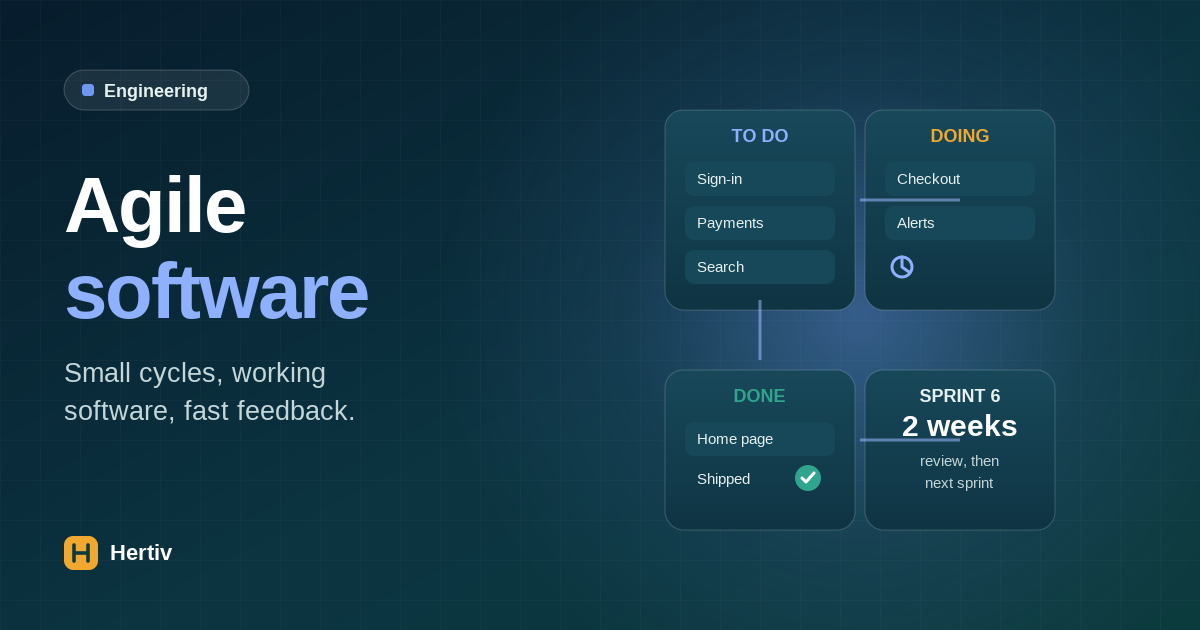
Kanban works differently: instead of fixed sprints, work flows through a board with columns such as to do, doing and done, and the team limits how many items are in progress at once. Both methods share the same idea: small batches, visible work and frequent feedback. Daily stand-ups, short meetings where each person says what they did, what they will do and what is blocking them, are common in both.
Agile vs waterfall: how do they differ?
Agile and waterfall differ most on when the plan is fixed and when users see working software. Waterfall plans the whole project up front, then builds it in sequence: requirements, design, code, test, launch. Agile plans a little, builds a little, and repeats.
| Aspect | Agile | Waterfall |
|---|---|---|
| Planning | Short cycles, plans adjust often | Full plan agreed up front |
| Working software | Delivered every one to four weeks | Delivered near the end |
| Change | Expected and welcomed | Costly once building starts |
| Feedback | Every cycle, from real users | Mainly at the end, from testing |
| Best for | Needs that change as you learn | Fixed needs and fixed scope |
Waterfall is not always wrong. When the requirements are truly fixed, such as building to a known standard, a plan-driven approach can be simpler and easier to price. Agile earns its keep when the team is learning what users need as it builds, which is most software products. For a comparison of delivery approaches, DevOps practices often run alongside agile teams to keep releases frequent.
Example (hypothetical): shipping in two-week sprints
Example (hypothetical): a team is building a booking app with a backlog of 48 items, from sign-in to payments. It works in two-week sprints and completes 8 items per sprint, so the whole backlog takes 48 divided by 8, which is 6 sprints, or 12 weeks.
After the second sprint, users try the app and ask for a change: they want to pay by card at booking time, not later. In a waterfall plan, that change would arrive after months of building and would be costly to add. In the agile plan, the team adds the payment item to the backlog, drops two lower-value items, and the backlog stays at 48 items.
The team still finishes in 6 sprints, because the total work did not grow; it changed shape. The point of the example is not the arithmetic, which is invented, but the mechanism: small cycles let the team swap work in and out without restarting the project, and users see the result every two weeks instead of waiting for a launch date.
What are the common mistakes?
The most common mistakes in agile projects are calling a project agile without changing how it works, skipping the feedback, and treating the sprint as a deadline machine.
- Agile in name only. Renaming the plan a backlog and the meetings stand-ups changes nothing if the team still plans everything up front and shows users nothing until launch.
- No real feedback. Sprints only help if users actually see the software each cycle. A demo to the team is not feedback from users.
- Skipping the retrospective. Teams that never stop to fix how they work repeat the same problems every sprint.
- Overloading the sprint. A sprint packed with more work than the team can finish teaches the team to cut corners, not to work faster.
- Ignoring quality. Moving fast without tests or reviews creates bugs that slow every later sprint. Speed without quality is debt, not progress.
Another mistake is treating agile as an excuse for no planning. Agile teams plan constantly, in small pieces: each sprint starts with a plan, and the product backlog is a plan too. The difference is that the plan is allowed to change, not that there is no plan at all.
How do you start with agile?
You start with agile by shrinking the batch size and making the work visible, not by buying a new tool or renaming every meeting. A small team can start in a week.
- Write the backlog. List everything the product might need, in order of value, with the most valuable items first and described in most detail.
- Pick a cycle length. Two weeks is a common choice: long enough to build something real, short enough to learn quickly.
- Hold the three meetings. Plan the sprint, hold a short daily stand-up, and end with a review and a retrospective.
- Show working software. At the end of each sprint, show the software to real users and write down what they say.
- Fix one process problem per sprint. Use the retrospective to change one thing about how the team works, and check next sprint whether it helped.
The first sprint will feel rough, and that is normal. The measure of success is not a perfect process but a shorter feedback loop: users see the software sooner, and the team learns faster than it did before. Teams that need help setting this up often start with custom software development support for the first few sprints.
When is agile not the right fit?
Agile is not the right fit when the requirements are truly fixed, the scope cannot change, and the cost of changing direction is higher than the cost of learning late. Building to a fixed standard, such as a payment system that must match a published specification, often suits a plan-driven approach better.
Agile also struggles when there is no one to give feedback. If users cannot see the software each cycle, or if the customer will not engage until launch, the feedback loop that makes agile work is missing. In that case the team is doing waterfall with shorter meetings.
A third case is a team with no stable membership. Agile depends on a team that works together, learns together and improves its own process. If the people change every week, the shared understanding that agile relies on never builds up. In all three cases, the honest answer is to pick the approach that fits the situation, not the one that sounds modern.
Key takeaways
- Agile builds in short cycles and learns from feedback each time
- The four values favour people, working software, customers and change
- Scrum uses fixed sprints; Kanban uses a flowing board
- Waterfall suits fixed scope; agile suits needs that change as you learn
- Start small: a backlog, two-week sprints, and real user feedback
Frequently asked questions
What is the difference between agile and Scrum?
Agile is the set of values and principles, while Scrum is one method that puts them into practice. Scrum adds specific roles, events and rules, such as sprints, a product owner and a retrospective. A team can be agile without using Scrum, and it can use Scrum badly while ignoring the agile values.
How long is an agile sprint?
A sprint usually lasts one to four weeks, and two weeks is the most common choice. The length should be short enough that feedback arrives quickly, and long enough that the team can finish something real. Teams pick a length and keep it steady, so the rhythm becomes predictable.
Does agile mean no documentation?
No. Agile values working software over detailed documentation, which is a preference, not a ban. Agile teams still write documents where they are needed, such as for compliance, safety or handover. The rule is to write the documentation that helps, and skip the documentation nobody reads.
Can agile work for large projects?
Yes, but it needs extra structure. Large projects split into several teams, each running its own sprints, with shared planning to keep the pieces aligned. The risk is that coordination meetings grow faster than the work, so large agile projects need discipline about keeping teams independent.
Is agile only for software?
Agile started in software, but the ideas of small batches, visible work and frequent feedback are used in marketing, product design and operations too. The values transfer well wherever the work involves learning what users need as you go, rather than following a fixed specification.
What is a retrospective?
A retrospective is a short meeting at the end of a sprint where the team talks about what went well, what went badly and what to change next. It is the main way an agile team improves its own process, and teams that skip it tend to repeat the same problems every sprint.


