AI Recruiting Agent: What It Does and Where It Stops
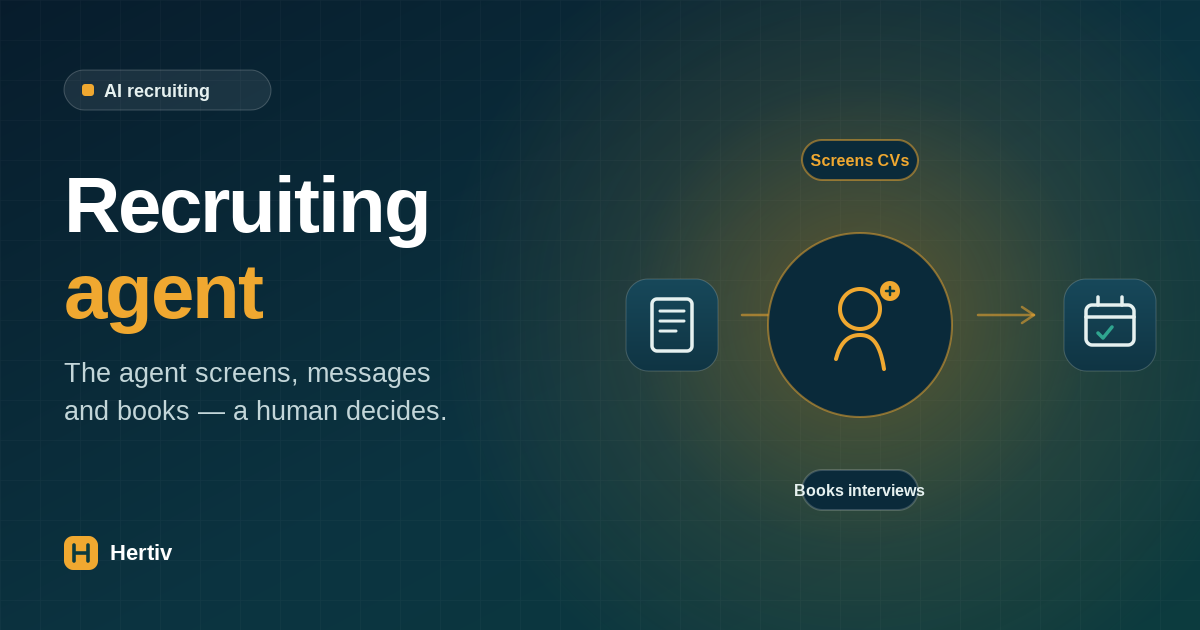
An AI recruiting agent screens CVs, messages candidates and books interviews, but it cannot judge people. See what it does well, and where a human stays in charge.
On this page
Short answer
An AI recruiting agent is software that carries out early hiring tasks on its own: it reads CVs, ranks applicants against the job, messages candidates, answers their questions and books interviews. It works from the job description and your hiring rules, and a recruiter reviews its shortlist before anyone is rejected or invited. It speeds up the first pass; it does not make the hiring decision.
What is an AI recruiting agent?
An AI recruiting agent is software that carries out early hiring tasks on its own, from reading CVs to booking interviews, working from the job description and the hiring rules you set. It is not a person and it does not decide who gets hired; it prepares the shortlist and the schedule so a recruiter can spend time on the people, not the paperwork.
It differs from a job board and from a plain applicant tracking system. A job board lists the role, and a tracking system stores the applications. A recruiting agent acts: it reads each application, scores it, messages the candidate and books the interview, then logs everything it did.
What it touches, and who checks it:
| Task | What the agent does | Who checks it |
|---|---|---|
| Screen CVs | Reads each CV and ranks it against the job | Recruiter |
| Message candidates | Sends updates and answers questions | Recruiter |
| Book interviews | Offers times and sends invites | Candidate and recruiter |
| Answer questions | Replies about pay, location and process | Recruiter |
| Spot patterns | Flags where candidates drop out | Hiring manager |
The agent is only as good as the rules you give it. A vague job description produces a vague shortlist, and a shortlist nobody reviews is not a saving, it is a risk. For the wider HR picture, see AI use cases for HR.
What does an AI recruiting agent do day to day?
Day to day, an AI recruiting agent handles the repetitive first pass: every new application is read, scored and sorted within minutes of arriving, instead of sitting in an inbox until a recruiter has a free hour.
Screening is the main job. The agent reads each CV, checks it against the must-have skills and experience in the job description, and ranks the applicants. It can also flag CVs that are missing a key detail, so the recruiter can ask for it instead of guessing.
Messaging is the second job. The agent sends acknowledgements, answers common questions about pay, location and the process, and nudges candidates who have not replied. Candidates get a reply the same day, which is the part they notice most.
Scheduling is the third job. The agent offers interview times from the hiring team's calendars, books the slot the candidate picks, and sends reminders. That removes the back-and-forth emails that used to take days. The recruiter still runs the interview itself.
How does an AI recruiting agent work?
An AI recruiting agent works by turning the job description and your hiring rules into a scoring guide, then applying that guide to every application the same way, and logging each step.
- Read the job. The agent takes the must-have skills, experience and location from the job description and your notes.
- Parse each CV. It pulls out skills, roles, dates and qualifications from each application, whatever the format.
- Score and rank. It scores each applicant against the must-haves and ranks the list, with a short note on why each person scored as they did.
- Message the candidates. It sends updates, answers questions from a script you approved, and asks for missing details.
- Book the interviews. It offers times, books the slot and sends reminders to the candidate and the interviewers.
- Log everything. Every score, message and booking is recorded, so a recruiter can check why any candidate was ranked where they were.
The log is what makes the agent usable in hiring. If a candidate asks why they were not shortlisted, the recruiter can point to the score and the rule behind it, instead of guessing after the fact.
Where does an AI recruiting agent help most?
An AI recruiting agent helps most where the volume is high and the first pass is repetitive: graduate schemes, retail and warehouse hiring, support roles and any job that draws hundreds of applications for a handful of places.
High-volume hiring is where the saving shows. When four hundred people apply for ten roles, a recruiter cannot read every CV with care in a reasonable time, so good candidates are missed and replies are slow. The agent reads all four hundred and the recruiter reads the top sixty.
It also helps where speed matters to the candidate. A same-day acknowledgement and a quick answer to a pay or location question keeps good candidates in the process, while a week of silence loses them to another employer.
It helps least where the judgement is the job: senior hires, creative roles and any role where the CV tells only part of the story. There the first pass is the work, and handing it to an agent saves little. AI agents for HR covers how these agents fit into the wider HR stack.
How to start with an AI recruiting agent
Start with one role and one clear rule set, not with the whole hiring plan. The steps below keep the first run small enough to check.
- Pick one high-volume role with a clear job description and must-have list.
- Write the scoring rules in plain words: what counts, what does not, and what is a deal-breaker.
- Run the agent on past applications first and compare its shortlist with the hires you actually made.
- Set the review step: a recruiter reads the shortlist and the near-misses before anyone is contacted.
- Go live on the one role, track reply times and drop-out rates, and fix the rules before you expand.
The past-applications test in step three is the most useful part. If the agent would have rejected people you actually hired, the rules are wrong, and it is cheaper to learn that on old applications than on live ones.
What are the limits and risks?
An AI recruiting agent stops at judgement: it can rank CVs against written rules, but it cannot tell whether a person will do the job well, work well with the team, or grow into the role.
Bias is the first risk. If the scoring rules favour one kind of background, the agent will apply that favour to every application, at speed. Check the shortlist for patterns, and check who the agent rejects as well as who it keeps.
Keyword gaming is the second risk. Candidates learn what the agent looks for, so CVs start to match the words rather than the work. A recruiter reading the shortlist is the check against that, and the rules need updating as candidates adapt.
Candidate experience is the third risk. An agent that sends cold, generic messages or asks the same question twice makes the employer look careless. Keep the messages short, name a person to contact, and let candidates reach a human easily.
Data rules are the fourth risk. CVs hold personal data, so the agent must store it where your data rules allow, keep it only as long as needed, and let candidates ask what was kept. For the HR side of that, see AI for HR, recruiting and staffing.
Example (hypothetical): a 300-person company hires 40 people
Example (hypothetical): a 300-person company opens 40 roles and receives 400 applications. Reading each CV by hand takes about 6 minutes, so the first pass takes 400 times 6 minutes, which is 2,400 minutes, or 40 hours of recruiter time.
The company adds an AI recruiting agent. The agent reads all 400 CVs and ranks them, and the recruiter reviews the top 60 at about 5 minutes each. Review takes 60 times 5 minutes, which is 300 minutes, or 5 hours.
The first pass now takes 5 hours instead of 40, saving about 35 hours. The recruiter uses that time on interviews and on the near-misses, which is where the judgement sits. The saving only holds because the recruiter still reads the shortlist: an unreviewed ranking is a guess with neat formatting.
What are the common mistakes?
The most common AI recruiting agent mistakes are skipping the review step, writing vague rules, and letting the agent message candidates with no human check on the words it sends.
- Auto-rejecting without review. A candidate the agent rejects is gone; a recruiter should see the near-misses before anyone is turned away.
- Vague scoring rules. Rules such as "good communicator" cannot be scored, so the agent guesses. Write rules a person could apply.
- Letting the agent message unchecked. Read the message templates before they go out, and check the first week of live messages.
- Ignoring who gets rejected. Check the rejected pile for patterns; bias shows up there first.
- Buying for every role at once. Start with one high-volume role and prove the rules before you expand.
- Keeping CVs too long. Set a retention rule and stick to it, or the agent becomes a data problem.
Key takeaways
- A recruiting agent runs the first pass: screening, messaging and scheduling
- It ranks against rules you wrote; vague rules produce a vague shortlist
- It helps most on high-volume roles where the first pass is repetitive
- A recruiter must review the shortlist and the near-misses
- Check who the agent rejects, not just who it keeps
- Test the agent on past applications before it touches live ones
Frequently asked questions
What is an AI recruiting agent?
An AI recruiting agent is software that carries out early hiring tasks on its own: reading CVs, ranking applicants against the job, messaging candidates, answering their questions and booking interviews. It works from the job description and your hiring rules, and a recruiter reviews its shortlist.
Can an AI recruiting agent hire someone?
No. It can prepare a shortlist, message candidates and book interviews, but the hiring decision stays with people. Interviews, judgement about fit and the final offer are human work, and any agent that claims otherwise should not be trusted with hiring.
Does an AI recruiting agent replace recruiters?
No. It replaces the repetitive first pass, not the recruiter. Recruiters still write the rules, review the shortlist, run the interviews and make the decision. The agent gives them time back for the parts of hiring that need judgement.
How do you stop an AI recruiting agent being biased?
Write scoring rules in plain words, test the agent on past applications, and check who it rejects as well as who it keeps. If the shortlist shows a pattern, fix the rules. Keep a human review step on every shortlist and re-check the rules regularly.
What data does an AI recruiting agent need?
It needs the job description, a clear must-have list, and the applications themselves. It also needs your rules for messaging and scheduling, and access to interviewer calendars. Keep CVs only as long as your data rules allow.
How long does it take to start using one?
A first run on one high-volume role can be set up in a few weeks when the job description and rules are clear. Most of the time goes into writing the rules and testing the agent on past applications, not into the software itself.