AI Recruitment Statistics: What the Surveys Actually Say
AI recruitment statistics vary widely by survey, from about one in four employers to nearly three in four. Here is what the main surveys found, and how to read them.
On this page
Short answer
AI recruitment statistics show adoption rising fast but measured very differently across surveys: iHire found 25.9% of US employers using AI in hiring in 2025, while SHRM found 27% of organisations using AI in recruiting. The gap comes from who was asked and what was counted.
What do the surveys say about AI in hiring?
AI recruitment statistics come from surveys, and the surveys disagree. The published figures run from about one in four employers to nearly three in four, and all of them are real results from real samples. They measure different things, which is why a single number for AI in hiring is hard to defend.
The table below lists the main recent surveys, what they asked, and what they found. Every figure names its source, its sample and its date, so the reader can check it rather than take a headline number on trust.
| Survey | Who was asked | Finding |
|---|---|---|
| iHire, State of Online Recruiting 2025 | 529 US employers, July 2025 | 25.9% use AI in hiring, up from 14.7% in 2024 and 4.9% in 2023 |
| SHRM, State of AI in HR 2026 | 1,908 HR professionals, Dec 2025 | 27% use AI in recruiting; 39% use AI somewhere in HR |
| Resume Builder, Oct 2024 | 948 business leaders | 83% said they would use AI to review resumes by the end of 2025 |
| LinkedIn, Future of Recruiting 2025 | 1,271 talent professionals, 23 countries | Teams using generative AI save about 20% of their work week |
| Greenhouse, Nov 2025 | Hiring managers and job seekers | 70% of hiring managers say AI helps them decide faster and better |
Read the table as a range, not a single answer. The low end comes from surveys of employers; the high end comes from surveys of individual hiring managers and recruiters, who often use general AI tools on their own.
How many employers actually use AI in hiring?
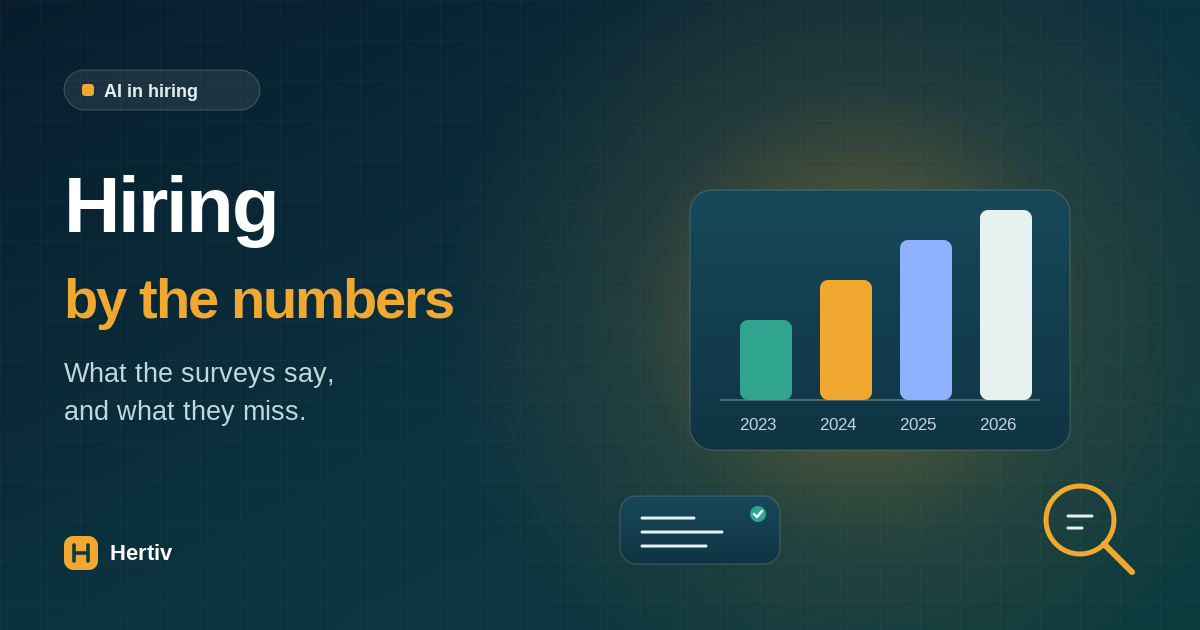
The most careful employer-level figure comes from iHire's 2025 State of Online Recruiting report, based on 529 US employers surveyed in July 2025. It found 25.9% of employers using AI in their recruitment efforts, compared with 14.7% in 2024 and 4.9% in 2023. That is a rise of 21 percentage points in two years.
SHRM's State of AI in HR 2026 report, based on a December 2025 survey of 1,908 HR professionals, found a similar level: 27% of organisations use AI in recruiting, and 39% use AI somewhere in HR. Recruiting is the single most common place AI shows up in HR, ahead of every other use.
Other surveys land higher because they ask different people. Resume Builder's October 2024 survey of 948 business leaders found 83% saying they would use AI to review resumes by the end of 2025, but that is a plan for the future, not current use. Surveys of individual recruiters run higher still, because many use general tools such as ChatGPT on their own, without their employer having any AI hiring policy.
What do recruiters use AI for?
Writing is the most common use. In iHire's 2025 survey, the most popular AI uses were writing job ads at 73.0%, composing messages to candidates at 68.6%, sending messages to candidates at 49.6%, and screening resumes at 32.1%. The pattern is clear: teams start with drafting, then move to screening.
Screening is where the numbers get more careful. Resume Builder's survey found that 83% of companies said they would use AI to review resumes by the end of 2025, but iHire found only 32.1% actually screening resumes with AI in mid-2025. The gap between plans and practice is part of the story, and a statistic that ignores it misleads.
The time saving is real but modest. LinkedIn's Future of Recruiting 2025 survey of 1,271 talent professionals found that recruiting teams using generative AI save about 20% of their work week, which is roughly one full day. That saving comes mostly from drafting and scheduling, not from decisions about who to hire. For the tools behind these numbers, see best recruiting automation tools.
What do candidates experience?
Candidates meet AI earlier than most employers admit. Greenhouse's May 2026 survey found that 63% of US job seekers have been interviewed by AI, and 70% of them were not told beforehand. The same survey found that 38% of job seekers have quit a hiring process over how AI was used.
Trust runs in opposite directions. In Greenhouse's November 2025 survey, 70% of hiring managers said AI helps them make faster, better decisions, while only 8% of job seekers said AI makes hiring fairer. That gap is the most important number in this article: the people choosing the tools trust them far more than the people being judged by them.
Bias is the reason for the gap. Resume Builder's survey found that 67% of companies using AI acknowledge their tools could introduce bias into hiring decisions, yet they continue to use them. A hiring team that cannot explain how its tool treats candidates differently is carrying a risk it has already noticed.
For the wider question of whether AI replaces jobs or changes them, see why half your workforce could be AI.
Why do the numbers disagree?
The numbers disagree because the surveys ask different people different questions at different times. iHire asked employers whether they use AI in hiring; SHRM asked HR professionals whether their organisation uses AI in recruiting; Resume Builder asked business leaders what they plan to do. Those are three different questions, and they give three different answers.
Sample size matters too. SHRM's 1,908 HR professionals give a steadier figure than a survey of a few hundred managers, and a survey of workers who know their company's hiring practices measures something different from a survey of the people who buy the tools. The honest way to quote a hiring statistic is to name the survey, the sample and the date, every time.
Timing matters as well. Adoption is rising fast enough that a 2024 figure is already out of date: iHire's employer share went from 4.9% in 2023 to 14.7% in 2024 to 25.9% in 2025. Any article that quotes a hiring statistic without a date is quoting a number that has already moved.
Example (hypothetical): checking a vendor's claim
Example (hypothetical): a hiring manager is shown a vendor slide claiming that 83% of companies use AI to screen resumes. She checks the source and finds it is Resume Builder's October 2024 survey of 948 business leaders, and the figure is what companies said they would do by the end of 2025, not what they were doing.
She then checks iHire's 2025 survey of 529 US employers, which found 32.1% actually screening resumes with AI in July 2025. The vendor's 83% is a plan; the 32.1% is current practice. The gap is 50.9 percentage points, which is larger than either number on its own.
She asks the vendor for its own evidence instead: how many of its customers screen resumes with its tool today, and what the false rejection rate is. The vendor cannot answer either question, so she runs a two-week trial with 40 real applications, half screened by the tool and half by a recruiter, and compares the shortlists before deciding. The trial costs two weeks; a bad hire costs far more.
What are the common mistakes?
The most common mistakes are quoting a plan as if it were current use, quoting a number without its survey, and trusting a vendor's headline figure.
- Plans quoted as use. A survey that says companies will use AI by next year is not evidence that they use it now. Check whether the figure is a plan or a fact.
- Numbers without sources. A hiring statistic without a survey name, sample size and date cannot be checked, and an unchecked number is not evidence.
- Vendor headlines. A vendor's survey usually measures the thing its product sells. Check the question before trusting the answer.
- Ignoring the candidate side. A statistic about employer adoption says nothing about candidate experience, and candidates are the ones who quit a process.
- One number for everything. Adoption, time saved, bias and fairness are four different measures. A single number cannot cover them all.
- Old numbers. Adoption rose from 4.9% to 25.9% in two years in iHire's series. A figure from 2024 is already out of date.
The right question is not what the average is, but what the survey measured and when. A hiring team that reads statistics that way will make better decisions than one that quotes the biggest number it can find. For how AI is used across HR, see AI use cases for HR.
Key takeaways
- Employer surveys put AI in hiring at about one in four; manager surveys run much higher.
- iHire found 25.9% of US employers using AI in hiring in 2025, up from 4.9% in 2023.
- Writing job ads and messages is the most common use; resume screening lags behind.
- 70% of hiring managers trust AI decisions, but only 8% of job seekers say it is fairer.
- Always quote the survey, the sample and the date, or the number means nothing.
Frequently asked questions
How many employers use AI in hiring?
iHire's 2025 survey of 529 US employers found 25.9% using AI in hiring, up from 14.7% in 2024 and 4.9% in 2023. SHRM's 2026 survey of 1,908 HR professionals found a similar level, at 27% using AI in recruiting.
What do recruiters use AI for most?
Writing job ads is the most common use, at 73.0% in iHire's 2025 survey, followed by composing messages to candidates at 68.6%. Screening resumes is less common, at 32.1%, though many companies say they plan to add it.
Do candidates trust AI hiring?
Mostly no. In Greenhouse's November 2025 survey, 70% of hiring managers said AI helps them decide faster and better, while only 8% of job seekers said AI makes hiring fairer.
How much time does AI save recruiters?
LinkedIn's Future of Recruiting 2025 survey of 1,271 talent professionals found that teams using generative AI save about 20% of their work week, roughly one full day, mostly from drafting and scheduling.
Do companies know AI hiring can be biased?
Yes. Resume Builder's survey found that 67% of companies using AI acknowledge their tools could introduce bias into hiring decisions, yet they continue to use them. A team that cannot explain how its tool treats candidates differently is carrying a risk it has already noticed.
Why do AI hiring statistics disagree?
Because surveys ask different people different questions. Employer surveys land near 26%, while surveys of individual managers run higher, and surveys about future plans run higher still. Always check the survey, the sample and the date before quoting a figure.