Could Half Your Workforce Be AI? What the Claim Means
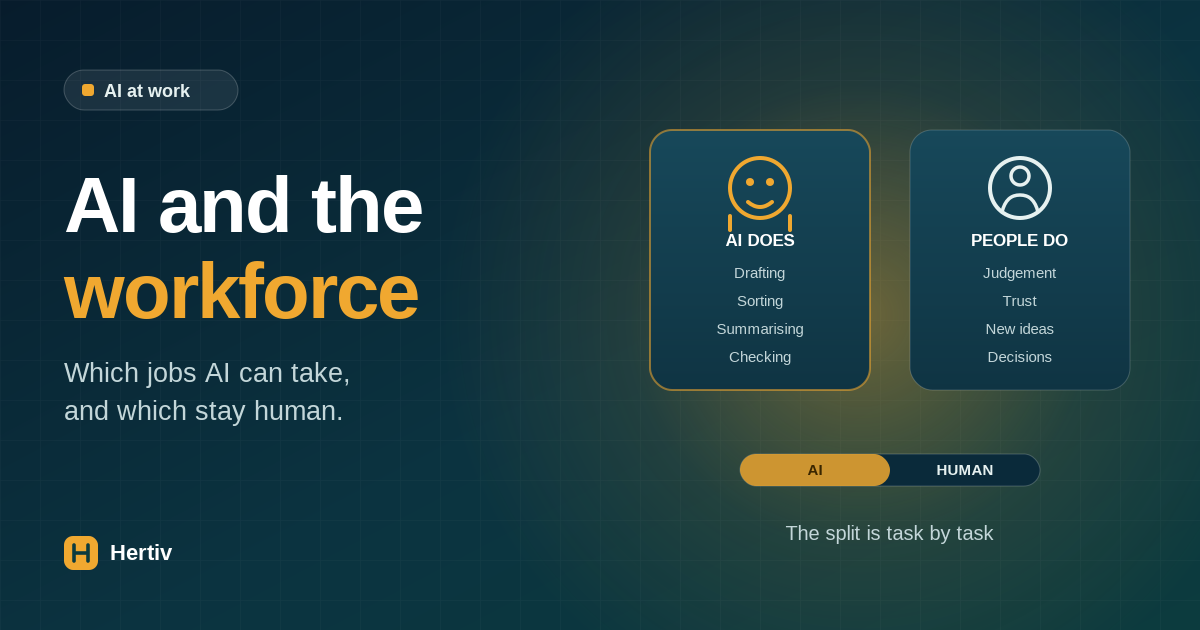
Some say half of all work could be done by AI. The honest answer is task by task: some work fits AI well, much does not, and the split decides what changes.
On this page
Short answer
The claim that half your workforce could be AI is a claim about tasks, not people. AI handles routine, rules-based work with clear inputs and outputs, such as drafting, sorting and summarising. Work that needs judgement, trust, physical skill or new ideas stays human. The real question is which tasks in your team fall on each side, and what that mix means for hiring and training.
What does 'half your workforce could be AI' mean?
The phrase 'half your workforce could be AI' is a claim about tasks, not a headcount plan. It says that a large share of the hours people work today goes on tasks that AI can already do: reading documents, drafting replies, sorting requests, summarising meetings and checking data against rules. It does not say that half of all people will be replaced, because most jobs mix many tasks, and only some of them fit AI.
The claim usually comes from task studies that break jobs into their parts and score each part for how easily a machine can do it. A job that is mostly routine paperwork scores high; a job that is mostly face-to-face judgement scores low. The headline number, half, is a rough average across many jobs, not a fact about any one team.
That distinction matters. If you read the claim as 'half our staff will go', you plan for the wrong thing. If you read it as 'half our task hours could change', you can look at your own team task by task and see where AI helps, where it does not, and where people need new skills.
Which tasks can AI take over today?
AI works best on tasks with clear inputs, clear outputs and plenty of examples to learn from. Drafting a first version of a document, sorting incoming requests, summarising a long thread, transcribing a call and checking a form against a checklist all fit that shape, because the task is defined and the result can be checked quickly.
| Task type | Example | Why AI fits |
|---|---|---|
| Drafting | First draft of a reply or report | Clear format, easy to review |
| Sorting and routing | Triaging support tickets | Rules and labels are clear |
| Summarising | Meeting notes, long documents | Input is text, output is shorter text |
| Searching and finding | Pulling facts from files | Large volumes, exact recall |
| Checking | Forms against a checklist | Same rule applied every time |
These are also the tasks where AI saves the most time per hour spent, because they are frequent and repetitive. A support agent who answers the same five questions all day gains more from AI drafting than a manager who spends the day in negotiation. Start where the repetition is, and measure the hours saved before expanding further.
Which work stays human?
Work stays human when it needs judgement under uncertainty, trust between people, physical skill, or ideas that do not exist yet. A doctor deciding on a treatment, a negotiator reading a room, a plumber fixing a pipe in an old building and a designer inventing a new product all work with incomplete information and real consequences, and none of them follow a fixed script.
| Work type | Example | Why it stays human |
|---|---|---|
| Judgement | Approving a loan, hiring | Trade-offs with real consequences |
| Trust | Advising a client, care work | People trust people, not outputs |
| Physical skill | Repair, building, surgery | Hands in a messy real world |
| New ideas | Strategy, design, research | No past examples to copy |
| Responsibility | Signing off, owning a decision | Someone must answer for it |
Notice that the last row is the one AI can never take: responsibility. An AI system can draft a decision, but a person must own it. That is why the realistic future is not fewer people doing the same jobs, but people spending more of their time on the parts of the job where judgement and trust matter, and less on the paperwork around them.
How do you work out what AI could change in your team?
Work out what AI could change by listing the tasks your team actually does, then scoring each one, instead of guessing from headlines. A task audit takes a week and gives you a plan that fits your team rather than an average from a study of other companies.
- List the tasks. Ask each role to list what it does in a normal week, with rough hours per task.
- Score each task. Mark it as routine, judgement, physical or creative, and note whether the input and output are clear.
- Try AI on the routine ones. Run a small pilot on two or three tasks and measure the hours saved and the error rate.
- Redesign the role. Move the saved hours to the judgement and trust work that the role already contains.
- Plan the skills. Decide what training the team needs: reviewing AI output, writing good prompts, and checking facts.
Keep the pilot small and honest. If a task saves time but needs heavy checking, count the checking time too, or the saving is an illusion. An AI readiness assessment can structure this audit for teams that want an outside view before they commit.
What changes for managers, hiring and training?
For managers, the change is in what they check. When AI drafts the first version, the manager's job shifts from writing to reviewing: checking facts, tone and judgement in work that arrives faster and in larger volumes. Teams that do not change their review step end up approving AI output nobody has read, which is how errors reach customers.
For hiring, the mix of skills shifts. Roles need less typing and copying and more of the skills AI cannot supply: asking the right question, spotting a wrong answer, handling a difficult conversation and owning a decision. Job descriptions written five years ago often describe the routine half of the role and say nothing about the judgement half.
For training, the gap is practical. Staff need to learn how to check AI output, how to write a clear request, and when to trust the tool and when to do the work themselves. That training is short and concrete, and it matters more than any course on how the models work. AI agents for HR teams can take on the routine parts of hiring and onboarding while people keep the interviews and the decisions.
Example (hypothetical): a 40-person support team
Example (hypothetical): a support team of 40 people handles 2,000 tickets a week. About half of those tickets are routine: password resets, order status, delivery questions and simple how-to answers. The team pilots AI drafting on those routine tickets, with a person reviewing and sending every reply.
The arithmetic: 1,000 routine tickets a week at 6 minutes each is 100 hours a week. With AI drafting, the review and send step takes 2 minutes each, or about 33 hours a week, saving about 67 hours a week. Over a 48-week year that is about 3,200 hours, close to two full-time roles, which the team moves to the complex tickets that were waiting longest.
The result is not 20 people leaving. It is the same 40 people spending their week on the hard half of the work: complaints, edge cases and customers who need a person. The queue for complex tickets falls, and the routine tickets still get a human review before they go out.
That is the honest version of the 'half the workforce' claim: half the task hours change hands, and the people move to the work that needs them.
What are the common mistakes?
The most common mistakes are reading the claim as a headcount target, skipping the review step, and training nobody.
- Treating a headline as a plan. 'Half' is an average across many jobs, not a fact about your team. Audit your own tasks first.
- Removing the review step. AI output that nobody reads will reach customers with errors in it.
- Counting gross time saved. Subtract the checking time, or the saving is an illusion.
- Ignoring the judgement half. If people lose the routine work but gain no time for the hard work, nothing improves.
- No training. Staff need to learn how to check output and write clear requests; the tool alone is not enough.
The claim is a prompt to look at your own work, not a forecast to act on blindly. Teams that audit their tasks, pilot on the routine ones and move people to judgement work get the benefit without the disruption.
For a practical starting point, AI agent development covers how these pilots are usually built.
And the benefits of IT outsourcing show another way teams free up hours for the work that needs people.
Key takeaways
- 'Half the workforce' is a claim about task hours, not a headcount plan
- AI fits routine work with clear inputs and outputs, such as drafting and sorting
- Judgement, trust, physical skill and new ideas stay human
- Audit your own tasks before acting on any headline number
- Count checking time when you measure hours saved, or the saving is an illusion
- Move saved hours to the judgement work the role already contains
Frequently asked questions
Will AI replace half of all jobs?
No study says that. The claim is about tasks: a share of the hours in many jobs goes on routine work AI can already do. Most jobs mix routine and judgement tasks, so the realistic change is that people spend less time on the routine half and more on the work that needs judgement.
Which jobs are most affected by AI?
Jobs with a large share of routine text, data and sorting work are affected first: support, back-office processing, basic drafting and data entry. Jobs built on face-to-face trust, physical skill or new ideas change more slowly, because those parts do not fit AI well.
How do I work out what AI means for my team?
List the tasks each role does in a normal week with rough hours, then score each task as routine, judgement, physical or creative. Pilot AI on two or three routine tasks, measure the hours saved including checking time, and redesign the roles around what you learn.
Does AI save time if a person must check everything?
It can, but only if the checking time is much smaller than the doing time. Drafting a reply in two minutes and reviewing it in one minute still saves time. If checking takes as long as doing the task, the tool is not helping on that task.
What skills will staff need as AI takes routine work?
Staff need to check AI output for facts and tone, write clear requests, spot wrong answers, and handle the judgement and trust work that remains. Those skills are practical and short to teach, and they matter more than knowing how the models work.
Should we cut headcount when AI saves hours?
Not at once. The saved hours are usually best spent on the complex work that was waiting: complaints, edge cases and quality checks. Cut headcount only after the new way of working is stable and the remaining workload is clearly smaller.


