Generative AI in Marketing: What It Does and Where It Helps
Generative AI in marketing drafts copy, personalises messages and summarises campaign data. It works only when humans review the output first.
On this page
Short answer
Generative AI in marketing creates drafts of ad copy, product descriptions, emails and social posts, and tailors messages to customer segments. It saves time at the draft stage, but every claim must be checked by a human before it reaches customers.
What is generative AI in marketing?
Generative AI in marketing is the use of AI models that create text, images, video and audio to support marketing work, from drafting ad copy to personalising emails and summarising campaign results. It is a tool inside the marketing workflow, not a replacement for it.
Marketers use it where the work is repetitive and the output is reviewed before it reaches customers. A model can draft fifty versions of a product description in minutes, but a human still picks the version that fits the brand and checks the claims. The value is speed and volume at the draft stage, not unsupervised publishing.
The models work from examples and instructions. Give them a brand guide, past campaigns and product facts, and the drafts get closer to usable. Give them nothing, and the output reads like every other brand. The quality of the input decides the quality of the output.
| Marketing task | What the model does | Human check needed |
|---|---|---|
| Ad copy | Drafts variants from a brief | Claims, prices and tone |
| Product descriptions | Writes drafts from product facts | Features and prices |
| Email subject lines | Produces many options fast | Offer and promise |
| Social captions | Rewrites one idea per channel | Voice and accuracy |
| Campaign summaries | Turns numbers into plain language | Numbers and conclusions |
| Survey analysis | Groups open answers by theme | Interpretation and actions |
Generative AI also covers analysis: summarising survey responses, grouping support tickets by theme, and turning raw campaign numbers into a plain-language summary. For a closer look at where the technology holds up in production, see generative AI use cases that actually work.
How does generative AI help with content and copy?
Generative AI helps most with first drafts. It can produce product descriptions, blog outlines, social captions and ad variants quickly, which lets a small team test more ideas than it could write by hand.
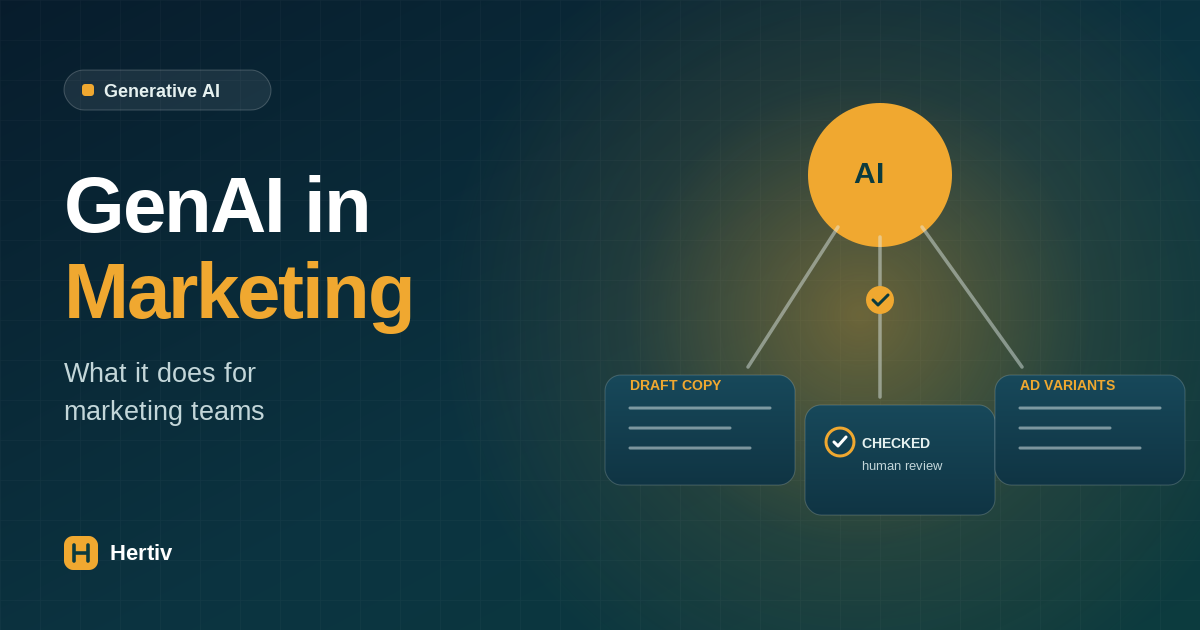
The pattern that works is draft, edit, approve. The model drafts, a marketer edits for voice and accuracy, and nothing publishes without a human sign-off. Teams that skip the edit step end up publishing copy with wrong prices, invented features or a tone that does not match the brand.
It also helps with repurposing. One webinar transcript can become a blog post, five social posts, an email and a FAQ page, each rewritten for its channel. That is useful because each channel wants a different length and angle, and rewriting by hand is slow.
The limits matter too. Models invent facts when they do not know them, so any claim about a product, a price or a result must be checked against a real source. A draft that states a feature you do not sell will damage trust faster than it saves time.
What can it do for personalisation and advertising?
Generative AI can tailor messages to segments without writing each one by hand. It can adjust a subject line for new customers versus returning ones, rewrite a product pitch for different industries, or produce ad variants for different regions, all from the same brief.
Personalisation works when the segments are real. A model can rewrite copy for ten segments, but if the segments are based on guesswork, the result is ten versions of a wrong message. Start with segments you already use and have data for, such as purchase history or location, and let the model vary the wording, not the targeting.
In advertising, the main gain is testing. Instead of running two ad variants, a team can run ten and learn faster which message works. The model generates the variants; the ad platform measures them; the team keeps the winners. That loop is where the value sits, not in any single generated ad.
Keep a human in the loop for anything that makes a promise. An ad that promises a discount, a result or a delivery time must be checked, because the model does not know your current offer. For the agent side of this work, see AI agents for marketing teams.
What about SEO, social media and email?
For SEO, generative AI can draft outlines, meta descriptions and first drafts of articles, but it cannot replace research. Search rankings depend on content that answers real questions better than competing pages, and a model that has not read your product or your customers will produce generic text that does not rank.
Use it to speed up the parts that are mechanical: turning a brief into an outline, drafting summaries, or rewriting a page for a new keyword. Keep the research, the examples and the final judgement with people who know the subject. Pages that read as if nobody checked them tend to perform poorly and age badly.
For social media and email, the gain is volume and consistency. A model can keep a posting schedule full and keep email drafts on brand, as long as someone reviews them. It can also summarise replies and comments so a team sees what customers are actually saying, instead of scrolling through hundreds of messages.
The risk is sameness. When every brand uses the same models with similar prompts, the output starts to sound alike. A distinct voice still comes from people: the stories, the examples and the opinions that only your team can write.
Example (hypothetical): a small ecommerce team drafts a campaign
Example (hypothetical): a team of four runs an online shop selling kitchen tools. It has 200 products, a mailing list of 8,000 people, and one person who writes all the marketing copy. A new range of 20 pans is launching in three weeks.
The team feeds the model the product facts, the brand guide and three past campaigns that performed well. The model drafts 20 product descriptions, 10 email subject lines and 30 social captions in an afternoon. The copywriter spends the next two days editing: fixing three wrong prices, removing two invented features, and rewriting the captions that sound flat.
The team then tests. It sends two subject lines to a small slice of the list, 400 people each, and the winner goes to the remaining 7,200. The whole launch ships on time, and the copywriter spent the week editing and testing instead of writing 60 first drafts from scratch.
Nothing here was published unchecked. The model did the volume work; the humans did the judgement. That split is the point.
What are the common mistakes?
Most generative AI marketing failures come from publishing unchecked output or from expecting the model to do the thinking.
- Publishing drafts without review. A model will invent prices, features and claims. Every fact needs a check against a real source.
- No brand guide in the prompt. Without examples of your voice, the output reads like every other brand.
- Measuring output, not results. Counting posts produced says nothing. Track clicks, sign-ups or sales instead.
- Letting the model choose the audience. Targeting is a business decision. The model should vary wording, not decide who sees the ad.
- Ignoring data rules. Customer data fed into a model must follow your privacy policy and the law where you operate. Check what the tool stores and where.
- Replacing research with generation. A model cannot interview customers or read your sales calls. It can only rearrange what it is given.
How to start with a small pilot
Start with one workflow, one owner and one measure of success, rather than rolling generative AI across all marketing at once.
- Pick a draft-heavy task. Product descriptions, ad variants or email drafts are good first pilots because the output is reviewed before it reaches customers.
- Assemble the inputs. Gather the brand guide, product facts and three good examples of past work. The model is only as good as this material.
- Set the review rule. Decide who edits and who approves, and make it explicit that nothing publishes without both steps.
- Run a small test. Draft one campaign with the model and one without, then compare the time spent and the result. Use the same measure for both.
- Write down what worked. Keep the prompts, the edits and the results in one place, so the next campaign starts from what you learned.
If the pilot saves real time without hurting quality, expand to the next workflow. If it does not, the pilot cost little and taught you something. Testing the model itself matters too: the guide to how to test AI models covers how to build a small evaluation set before you trust a model with customer-facing work.
Key takeaways
- Generative AI in marketing works at the draft stage: copy, variants, summaries and personalisation
- The pattern is draft, edit, approve; nothing should publish without human review
- Its main advertising gain is testing more variants faster, not any single generated ad
- Models invent facts, so prices, features and promises must be checked against real sources
- Start with one draft-heavy workflow, one owner and one measure of success
Frequently asked questions
Can generative AI write all our marketing copy?
No. It can draft copy quickly, but it invents facts and drifts from your brand voice when left alone. The workable pattern is model drafts, human edits and a clear approval step before anything publishes. Teams that skip review end up with wrong prices and invented features in public.
Does generative AI help with SEO?
It helps with the mechanical parts, such as outlines, meta descriptions and first drafts. It does not replace research: rankings depend on content that answers real questions better than competing pages, and that needs people who know the product and the customer.
How do we keep AI marketing copy on brand?
Give the model your brand guide, product facts and three good examples of past work, and keep a human editor on every draft. Without those inputs, output from the same models sounds alike across brands, and your voice disappears.
Is customer data safe in AI marketing tools?
It depends on the tool and your rules. Check what the tool stores, where it stores it, and whether it trains on your inputs. Customer data fed into a model must follow your privacy policy and the law where you operate.
What should we measure?
Measure outcomes, not output. Track clicks, sign-ups, sales or time saved on a real task, rather than counting posts produced. Pick one metric per workflow before the pilot starts, so you can tell whether the model helped.
When should we not use generative AI in marketing?
Avoid it where a wrong answer is costly and no human reviews the output, such as legal claims, medical advice or pricing promises. Also avoid it where the value is a distinct human voice, such as founder stories or opinion pieces.


