AI in Web3: What It Does and Where It Helps
AI in Web3 adds pattern-spotting to decentralised apps: it screens transactions, prices assets and helps communities govern. Here is where it helps.
On this page
Short answer
AI in Web3 means using machine learning inside decentralised products: smart contracts, wallets, marketplaces and DAOs. The AI reads on-chain and off-chain data, spots patterns a person would miss, and automates routine decisions such as flagging risky transactions or sorting governance proposals. It does not replace the blockchain rules; it works on top of them.
What is AI in Web3?
AI in Web3 is the use of machine learning inside decentralised applications, where the AI reads blockchain data and user activity and turns it into decisions, warnings or content. The blockchain still holds the rules and the records; the AI sits on top, watching what happens and acting on what it finds.
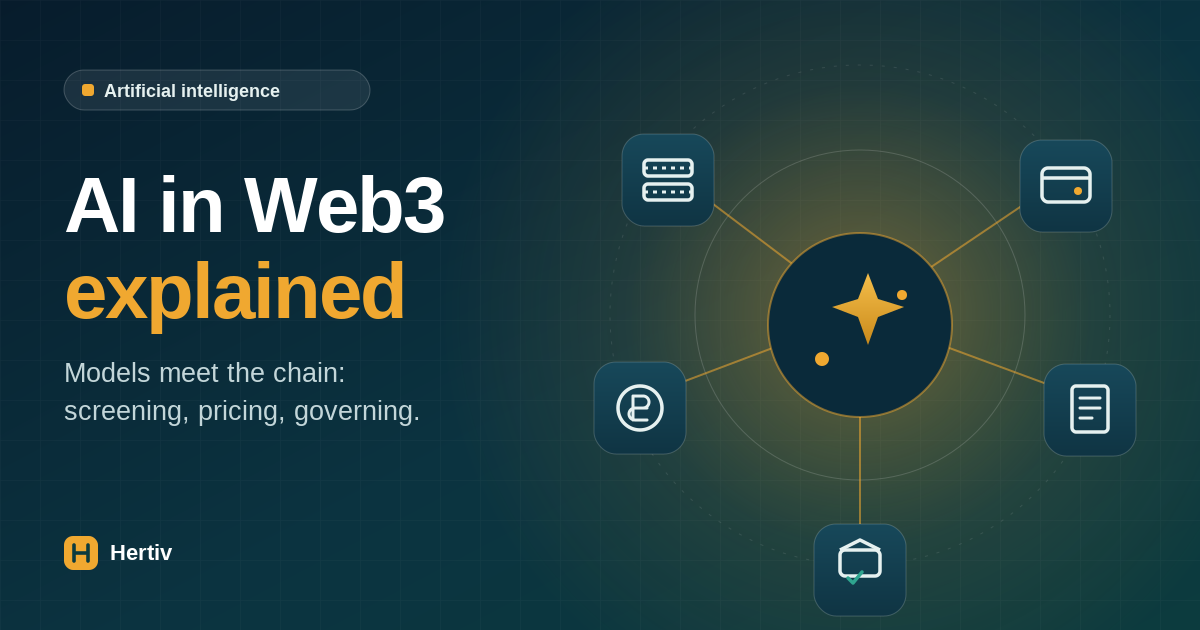
The table below shows the five jobs AI does most often in Web3 products today.
| Job | What the AI does | Where it runs |
|---|---|---|
| Fraud screening | Flags risky addresses and fake collections | Wallets and marketplaces |
| Trading and pricing | Spots unusual price moves and thin liquidity | Trading tools and bots |
| Content creation | Drafts art, descriptions and traits | NFT tools and games |
| Governance | Summarises proposals and sorts votes | DAO tools |
| Identity and access | Checks behaviour before granting access | Apps and agents |
The combination is new because the two technologies solve different problems. Blockchains give shared, tamper-resistant records without a central owner. Machine learning finds patterns in large amounts of data and makes predictions. Put together, a product can be open and checkable while still offering the smart features people expect from modern software.
If you are still deciding what belongs on-chain, how blockchain and Web3 work together explains the split between on-chain rules and off-chain services.
How does AI change smart contracts?
AI changes smart contracts by adding judgement before and after the contract runs. A contract itself is fixed code that executes the same way every time, which is a strength for trust and a weakness for anything that needs interpretation. AI can check the inputs a contract receives, flag unusual values, and summarise what a contract did in plain language.
One common pattern is a screening step. Before a transaction is submitted, an off-chain model checks the addresses involved, the size of the transfer and its history, then warns the user or blocks the action if the risk is high. Another pattern is monitoring: after deployment, a model watches contract events and raises an alert when behaviour drifts from normal.
AI cannot rewrite a deployed contract or override its rules. That limit matters: if the AI is wrong, the contract still executes as written. Teams that use AI with contracts keep the AI in an advisory role and leave the final decision to the contract code or to a human signer.
Where does AI help in decentralised finance?
In decentralised finance, AI helps most with pricing, risk and fraud. Lending protocols use models to estimate how likely a borrower is to repay, trading tools use them to spot unusual price moves, and wallets use them to warn about tokens that look like scams.
AI also helps with the volume of information. A trader or analyst cannot read every governance post, price feed and on-chain event by hand. Models can summarise proposals, track liquidity across pools and surface the few events that need a decision.
The risks are real. Models trained on past market data can fail when markets behave in a new way, and a model that many traders share can make the same mistake at the same time. DeFi teams that use AI usually pair it with hard limits, such as caps on position size and automatic pauses when prices move too far.
What can AI do for DAOs and NFT communities?
For DAOs, AI helps with the work that slows governance down: reading proposals, summarising long discussions and sorting votes. A member can ask a model what a proposal changes and get a short answer instead of reading pages of forum posts.
For NFT communities, AI helps with creation and safety. Generative tools can draft artwork, descriptions and traits, while detection models can flag copied art and fake collections before buyers spend money. Some marketplaces use AI to check that a listed item matches its description and history.
Community tools also use AI for moderation. Chat and forum messages can be screened for spam and scams, and new members can be checked against known bad actors. The goal is to reduce the manual work of moderators, not to hand decisions to a model without review.
What are the limits and risks of AI in Web3?
The main limits are data quality, centralisation and cost. AI needs good training data, and on-chain data is public but often messy, incomplete or biased toward the most active wallets. A model trained on that data can learn the wrong lessons.
Centralisation is a second risk. Running a model usually needs servers and APIs, which can reintroduce the single point of failure that Web3 tries to avoid. Some teams accept this trade-off for non-critical features and keep core rules on-chain.
Cost and privacy are further limits. Large models are expensive to run, and sending user data to a model can leak information that a decentralised product promised to protect. Teams should check where data goes, who can see it and what happens if the model provider changes its terms.
A related risk is model security itself, which is why AI security reviews matter before an AI feature goes live.
How to start adding AI to a Web3 product
Adding AI to a Web3 product works best as a small, measured pilot rather than a rebuild. Pick one job where a model can help and where a mistake is cheap.
- Pick one narrow job. Fraud screening or proposal summaries are good first jobs; pricing a whole market is not.
- Check the data. Confirm you have enough clean examples of the behaviour you want to detect or predict.
- Keep the AI off-chain. Run the model as a service and let the contract keep the rules and the records.
- Add a human review step. Let a person check flagged cases before any action is final.
- Measure and log. Track how often the model is right, how often it is wrong, and what each error costs.
- Publish the limits. Tell users what the AI does, what it cannot do, and where their data goes.
Ship the smallest version first, watch how it behaves on real data, and only then expand to more jobs. A team that follows this order learns what the model is good at before it depends on it. For a full build plan, the AI and Web3 execution playbook walks through the six phases from idea to live product.
Example (hypothetical): a small NFT marketplace adds AI checks
Example (hypothetical): a marketplace with 2,000 listings a week adds an AI check that screens new items for copied art and fake collections. The check runs before a listing goes live and flags about 40 items a week for a human reviewer.
The reviewer spends 10 minutes on each flagged item, which is 400 minutes, or about 7 hours a week. Before the check, the team found copied art only when a buyer complained, which took about 15 hours a week of support time and refund work. The check saves roughly 8 hours a week and catches most copies before a sale.
The team keeps a human in the loop because the model sometimes flags original art that looks similar to another work. Flagged items are reviewed within a day, and sellers can appeal a decision with a short form.
What are the common mistakes?
The most common mistakes are trusting the model too much, putting it in the wrong place, and forgetting that on-chain data is public.
- Letting the AI decide alone. A model that approves transactions without review will eventually approve a bad one.
- Putting AI logic in the contract. Contracts are expensive to change; keep the model off-chain where it can be updated.
- Training on biased data. On-chain data over-represents large, active wallets and can mislead a model.
- Ignoring privacy. Sending wallet history to a third-party model can expose user behaviour.
- Copying a model from another market. A fraud model trained on one chain or token rarely works unchanged on another.
Key takeaways
- AI works on top of blockchain rules; it does not replace them
- Fraud screening, pricing and governance summaries are the strongest AI jobs in Web3 today
- On-chain data is public but messy, so models need careful training and review
- Keep the model off-chain and a human in the loop for anything that moves money
- Start with one narrow pilot and measure errors before expanding
Frequently asked questions
What is the simplest way to describe AI in Web3?
AI in Web3 is machine learning added to decentralised apps: the blockchain keeps the records and rules, while the AI reads the data, spots patterns and automates routine jobs such as screening transactions or summarising governance proposals.
Can AI change a smart contract?
No. A deployed smart contract runs its code as written, and an AI model cannot rewrite it or override it. AI can check inputs, warn users and monitor events, but the contract itself stays fixed unless it was designed with an upgrade path.
Is AI in Web3 centralised?
Often, yes. Most models run on servers or third-party APIs, which adds a central point of failure to a decentralised product. Teams usually accept this for advisory features and keep core rules, funds and records on-chain.
How does AI help DAOs?
AI helps DAOs by summarising long proposals, sorting discussion threads and drafting vote summaries, so members can decide without reading pages of forum posts. It can also flag duplicate or conflicting proposals before a vote.
What is the biggest risk of AI in Web3?
The biggest risk is acting on a wrong model answer without review, for example approving a bad transaction or blocking a good one. Hard limits, human review and logging reduce that risk.
Do I need a blockchain to use AI in my product?
No. AI works fine without a blockchain, and most AI features do not need one. Add a blockchain only when you need shared, tamper-resistant records or rules that no single party controls.