How Blockchain and Web3 Work Together, Layer by Layer
Blockchain records ownership and settles value; Web3 is the apps, wallets and tokens built on that record. Here is how the layers fit and where each one stops.
On this page
Short answer
Blockchain and Web3 work together as infrastructure and application. The blockchain is the shared record: it stores who owns what, runs the rules in smart contracts, and settles transfers without a central operator. Web3 is everything built on that record, wallets that hold keys, apps that read and write to the chain, and tokens that carry ownership. The chain handles trust; Web3 handles the experience.
How are blockchain and Web3 related?
Blockchain and Web3 are related as infrastructure and application: the blockchain is the shared record underneath, and Web3 is the set of apps, wallets and tokens built on top of it. A blockchain on its own is a ledger with rules. Web3 turns that ledger into products people can use, such as a wallet that signs in, an app that sells a ticket, or a token that proves membership.
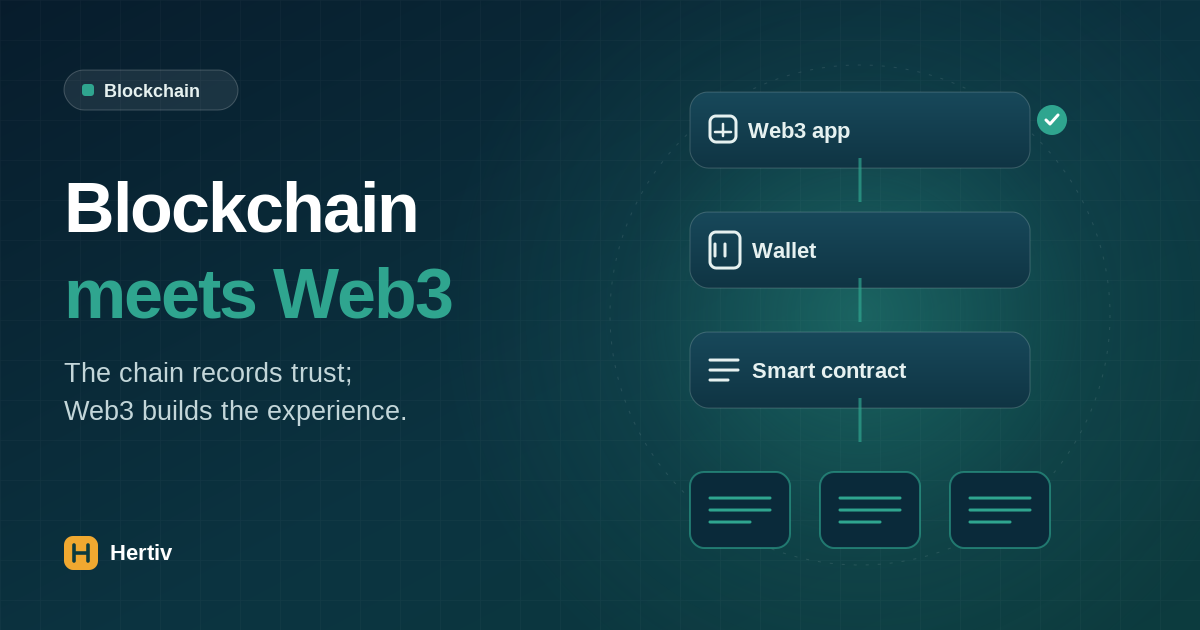
The stack has five layers, and each one does a different job. What is Web3 explains the top of the stack in more detail, but the shape is simple: the chain records, the contract enforces, the wallet proves, the app presents, and the token carries.
| Layer | What it does | Example |
|---|---|---|
| Blockchain | Records ownership and settles transfers | A payment that clears in minutes |
| Smart contracts | Run the rules automatically | A ticket sale that pays the seller at once |
| Wallets | Hold keys and prove identity | Signing in without a password |
| Web3 apps | Give people screens and flows | A marketplace, a game, a community page |
| Tokens | Carry ownership and access | A pass that opens a members area |
The split matters because each layer can change on its own. A team can rebuild its app without moving the record, and a chain can change its fees without changing the app. When people say Web3, they usually mean the whole stack, but the blockchain is only the bottom layer.
What does the blockchain do in a Web3 app?
The blockchain does three jobs in a Web3 app: it records who owns what, it runs the rules, and it settles the transfer. When a user buys a token, the chain records the new owner, the contract checks the payment, and the transfer is final once the block is confirmed. Nothing else in the stack can do that job, because no single company controls the record.
It does not store large files, run fast searches, or keep secrets. A photo, a video, or a private message lives off the chain, with only a short fingerprint of it recorded on the chain. Teams that try to put everything on the chain pay high fees and wait for slow confirmations.
That limit shapes every Web3 design. The chain holds the facts that must be shared and trusted, such as balances, ownership, and votes, while the app holds the rest. If a fact does not need shared trust, it does not belong on the chain.
What does Web3 add on top of the blockchain?
Web3 adds the parts people actually touch: wallets, apps, and tokens with meaning. A wallet turns a private key into a login, so a user can sign in and pay without creating an account. An app turns contract calls into screens, so buying a pass feels like buying anything online. Tokens turn the record into things people can hold, send, and use.
It also adds the social layer. Communities form around a token, creators sell directly to fans, and members vote on decisions with the tokens they hold. None of that lives in the chain itself: the chain only records the votes and the balances. The community, the rules, and the meaning sit in the Web3 layer above it.
That is why two Web3 apps can share one chain and feel nothing alike. The record is the same, but the wallets, the screens, and the community around it are different products.
How does a Web3 action move through the layers?
A simple Web3 action, such as buying a digital pass, moves through the layers in order. Each layer checks one thing, and the action only completes when every layer agrees.
- The user opens the app and connects a wallet, which proves who they are.
- The app shows the price and asks the user to approve the payment.
- The wallet signs the transaction, and the signed request goes to the chain.
- The smart contract checks the payment and whether any passes are left.
- The chain records the buyer as the new owner of one pass.
- The app reads the new record and shows the pass on screen.
If any step fails, the action stops and nothing is recorded. That is the point of the layers: the app cannot sell a pass the contract will not allow, and the contract cannot spend money the wallet did not approve. How smart contracts work covers the contract step in more detail.
Example: a shop sells digital passes for a concert
Example (hypothetical): a small venue sells 200 digital passes for a concert at 25 units each. A buyer connects a wallet, approves the payment, and the contract records the buyer as the owner of one pass. Total sales are 200 times 25, which is 5,000 units, and the venue sees each sale on the chain as it happens.
At the door, staff scan a code tied to the buyer's wallet, and the contract marks the pass as used. If a buyer resells a pass, the chain records the new owner, so the door list stays correct without anyone updating a spreadsheet. The app handles the screens, the wallet handles the signing, and the chain handles the record.
The venue also learns the limit of the stack. The pass artwork and the concert details live off the chain, because storing them there would cost far more than they are worth. Only the ownership record needs the chain.
What the blockchain cannot do for Web3
The blockchain cannot do three things well: store large files, answer fast questions, or keep data private. A chain is built to agree on a small shared record, not to serve as a hard drive or a search engine. Files, images, and chat history live in ordinary storage, with the chain holding only a short fingerprint that proves the file has not changed.
Speed is the second limit. A chain confirms blocks on its own schedule, so an app that needs an instant answer reads from a copy of the record instead of waiting for the chain. Privacy is the third: anything written to a public chain can be read by anyone, so personal details and prices that must stay private never go on the chain.
Good Web3 design respects those limits. The chain holds the facts that need shared trust, and everything else lives where it works best. Teams that ignore this end up with slow apps, high fees, and data they cannot take back. Teams still weighing the two models can compare them in the Web2 vs Web3 guide.
Common mistakes when mixing blockchain and Web3
The most common mistakes come from treating the layers as one thing. Teams put data on the chain that belongs in a database, build an app that only works with one wallet, or promise users ownership that the contract does not actually give.
- Putting every file on the chain instead of storing files off chain and recording a fingerprint
- Assuming the app is the product, so the tokens stop working when the app goes down
- Skipping a review of the contract before real money moves through it
- Promising instant settlement when the chain confirms on its own schedule
- Forgetting the off-chain parts, such as support, refunds, and legal terms
A short check before launch avoids most of this: list what lives on the chain, what lives off it, and what happens if the app goes down. If the record and the tokens survive without the app, the layers are in the right places.
Key takeaways
- Blockchain is the shared record underneath; Web3 is the apps, wallets and tokens built on it.
- The chain records ownership, runs the rules and settles transfers; it does not store files or keep secrets.
- A Web3 action passes through wallet, app, contract and chain, and stops if any layer refuses.
- Files, images and private data live off the chain, with only a fingerprint recorded on it.
- If the tokens and the record survive without the app, the layers are in the right places.
Frequently asked questions
Is Web3 the same thing as blockchain?
No. Blockchain is one layer: the shared record that stores ownership and settles transfers. Web3 is the whole stack built on it, including wallets, apps, smart contracts and tokens. A blockchain can exist without Web3 apps, but a Web3 app cannot work without a chain underneath.
Can a Web3 app work without a blockchain?
Not as a Web3 app. Without a chain there is no shared record, so ownership and settlement fall back to a company database. The app may look the same on screen, but the user no longer holds the record, and the operator can change it.
Why are Web3 transactions sometimes slow?
A chain confirms blocks on its own schedule, and a transaction is only final once it is in a block. Apps that need instant answers read from a copy of the record instead of waiting. The delay is the price of shared agreement rather than a bug.
What lives on the chain and what lives off it?
The chain holds facts that need shared trust: balances, ownership, votes and contract rules. Files, images, chat history and private details live off the chain, with only a short fingerprint recorded on it to prove nothing changed.
Do users need a wallet to use Web3?
Most Web3 apps ask users to connect a wallet, because the wallet holds the keys that prove identity and approve payments. Some apps hide the wallet behind an email login, but then the app holds the keys, and the user trusts the app instead of the chain.
What should a team check before building on Web3?
Check whether users actually need shared ownership or settlement, which chain their users already use, what the contract allows, and what happens if the app goes down. If the answer to the first question is no, a normal database is the simpler choice.


