Web2 vs Web3: How They Differ and When Each Fits
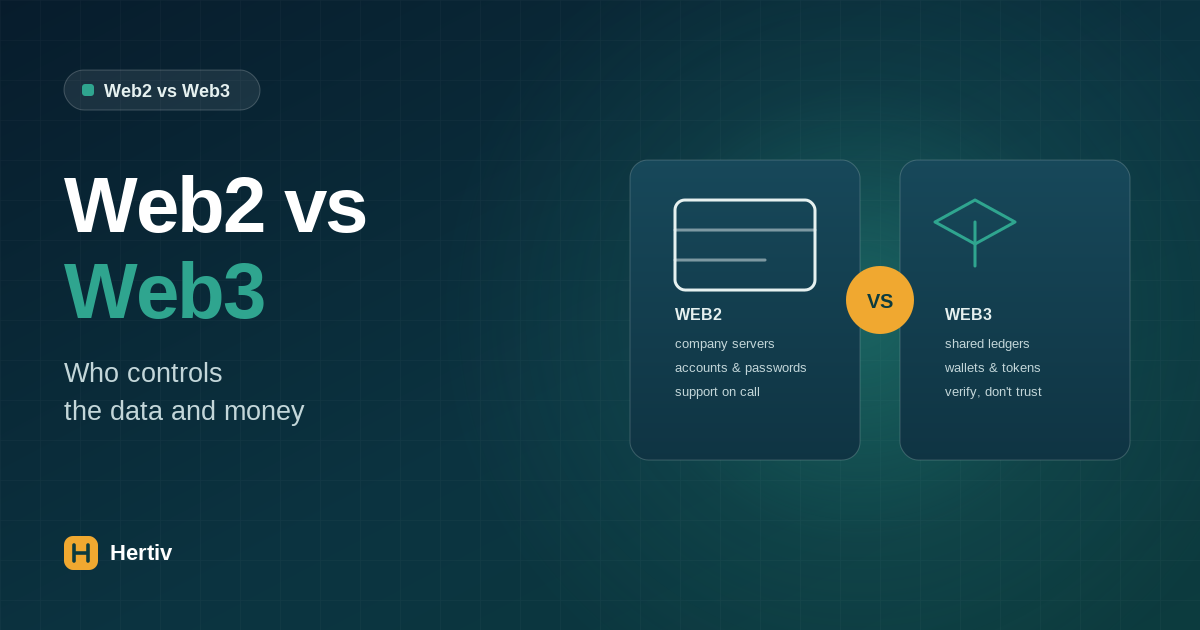
Web2 runs on company servers and accounts; Web3 runs on shared ledgers and wallets. The difference that matters is who controls the data, the identity and the money.
On this page
Short answer
Web2 is the internet built on company-run servers, accounts and databases, where the company controls the data and the rules. Web3 is the internet built on shared ledgers and wallets, where users hold their own assets and identity, and no single company controls the record. The real difference is who holds control, not which technology is newer.
What is Web2, and what is Web3?
Web2 is the internet most people use today: apps and sites run on servers owned by companies, users sign in with accounts, and the company stores the data, sets the rules and earns the revenue. Social networks, marketplaces and streaming services are all Web2 products.
Web3 is an approach to building internet products on shared, public ledgers. Users connect with a wallet instead of an account, hold their own assets as tokens, and interact with smart contracts that run the same way for everyone. No single company owns the ledger or can change the rules unilaterally.
The two are not separate internets. Most Web3 products still use Web2 infrastructure for hosting, search and notifications, and most Web2 companies now use some ledger-based features. The question is which parts of your product benefit from shared control, and which parts work better under one company.
How do Web2 and Web3 differ?
Web2 and Web3 differ in who controls identity, data, assets and rules. In Web2, the company controls all four. In Web3, the user holds identity and assets, the ledger holds the record, and the rules are set by code and community decisions.
| Area | Web2 | Web3 |
|---|---|---|
| Identity | Company account, password | Wallet, keys held by user |
| Data | Stored on company servers | Recorded on a shared ledger |
| Assets | Balance in company database | Tokens in user wallet |
| Rules | Set by the company | Set by code and governance |
| Payments | Cards and bank rails | Tokens and stablecoins |
| Trust | Trust the company | Verify on the ledger |
The trade-off is responsibility. Web2 gives users a password reset and a support team; Web3 gives users control and no one to call if they lose their keys. That difference shapes who each approach suits.
How does ownership work in each?
In Web2, ownership is a record in a company database. Your balance, your content and your reputation exist because the company says they do, and the company can change, freeze or remove them under its terms. This works well because the company also handles support, refunds and disputes.
In Web3, ownership is a token in a wallet you control. A token can move between apps, be sold, or be used as proof of membership without asking a company for permission. The ledger records the transfer, and anyone can check it. This suits assets that should move freely, such as tickets, collectibles and loyalty points.
The catch is that ownership in Web3 depends on the user keeping their keys safe. Lose the keys and the assets are gone, with no support team to recover them. Good Web3 products hide this complexity with wallets that offer recovery, but the responsibility still sits with the user in a way Web2 users are not used to.
What changes for developers?
For developers, Web3 changes where the logic lives and how users sign in. In Web2, the backend is a server you control, the database is yours, and users log in with email and password. In Web3, the backend includes smart contracts on a shared chain, the data is public, and users connect with a wallet.
Smart contracts cannot be changed easily once deployed, so testing and audits matter more than in Web2, where a fix can be shipped in minutes. Public data also means anyone can read the state of your app, which changes how you handle privacy: sensitive data stays off-chain, with only proofs or hashes on the ledger.
Most teams end up with a mix: a Web2 app for the interface, search and notifications, plus contracts for the parts that need shared control. What Web3 is and how it works covers the building blocks.
For the practical setup, how to create Web3 apps walks through the steps.
When should you choose Web2, and when Web3?
Choose Web2 when one company should control the product: internal tools, content platforms, and apps where users expect support, refunds and password resets. Web2 is faster to build, cheaper to run, and familiar to every user.
Choose Web3 when the value comes from shared control: assets that should move between apps, records that several companies must trust, or payments that should settle without a bank in the middle. Tokenised assets, shared loyalty points and cross-company settlement are the clearest cases.
Many products need both. A marketplace can run its listings and search on Web2 servers while settling payments in stablecoins and issuing tickets as tokens. The test is simple: if removing the company from the middle makes the product better for users, use Web3 for that part. If it makes the product harder to use, keep it on Web2.
Example (hypothetical): a team choosing between a Web2 app and a Web3 feature
Example (hypothetical): a team runs a ticketing app for small venues. Today it is pure Web2: users pay by card, tickets live in the company database, and support handles refunds. The team considers adding tickets as tokens so fans can resell them safely.
They test with one venue and 200 tickets. In the Web2 version, resale means emailing support, which takes 15 minutes per ticket. With tokens, a fan lists the ticket in the app, a buyer pays, and the transfer settles on-chain in under a minute, with the venue taking a 5% fee automatically: 200 tickets x $40 = $8,000 in sales, and $400 in venue fees, with no support time.
The team keeps the Web2 app for browsing, search and support, and adds the token feature only for resale. The lesson is the pattern: Web2 for the parts users expect a company to run, Web3 for the part where shared control makes the product better.
What are the common mistakes?
The most common mistakes are treating Web3 as a replacement for Web2, putting everything on-chain, and ignoring the user experience of wallets and keys.
- Rebuilding a Web2 app on-chain. Search, feeds and notifications work better on servers. Only the parts that need shared control belong on a ledger.
- Putting private data on a public chain. Ledger data is public. Keep sensitive data off-chain and store only proofs or hashes.
- Ignoring wallet friction. If users must install a wallet and buy tokens before seeing value, most will leave.
- Skipping audits. Contracts cannot be patched like servers. Audit before launch and plan for upgrades.
- Chasing the label. Adding a token because it sounds modern, without a reason users care about, adds cost and risk.
For a broader view of what works today, Web3 platforms worth building on compares the main options.
The Web2 side of the same product is covered by web app development.
Key takeaways
- Web2 means company control; Web3 means shared control through ledgers and wallets
- Ownership in Web3 is a token in the user's wallet — it moves freely, but lost keys cannot be recovered
- Smart contracts cannot be patched like servers, so audits and upgrade plans matter more
- Most products end up mixed: Web2 for interface and support, Web3 where shared control adds value
- Add one Web3 feature to a working Web2 product first, and expand only if users adopt it
Frequently asked questions
Is Web3 going to replace Web2?
No. Web3 changes who controls identity, assets and records, but most products still need company-run servers for search, notifications and support. The realistic outcome is a mix: Web2 where one company should run the product, Web3 where shared control makes it better.
Do users need crypto to use Web3 products?
Not always. Some products hide the chain behind familiar logins and pay gas fees for users, so the experience feels like a normal app. Others require a wallet and tokens. The smoother the onboarding, the more users stay — wallet friction is the most common reason people leave.
Is Web3 more secure than Web2?
It is different, not simply more secure. Web3 removes the single company database that attackers target, but it puts key management on the user and makes contract bugs harder to fix. Good design, audits and recovery options matter more than the label.
What is a wallet in Web3?
A wallet is software that holds a user's keys and tokens and lets them sign transactions. It replaces the account and password of Web2. Losing the keys usually means losing the assets, which is why recovery options and clear warnings matter in any Web3 product.
When does a token make sense?
A token makes sense when the asset should move between apps or owners without asking a company for permission — tickets, loyalty points, memberships and shared records are the clearest cases. If the asset only lives inside one app, a database balance is simpler and cheaper.
Can a Web2 company add Web3 features?
Yes, and most do it this way: keep the existing app and add one ledger-based feature, such as tokenised tickets or stablecoin payments. Starting with one feature inside a working product is cheaper and safer than rebuilding the whole app.


