AI and Web3 Execution Playbook: From Idea to Live Product
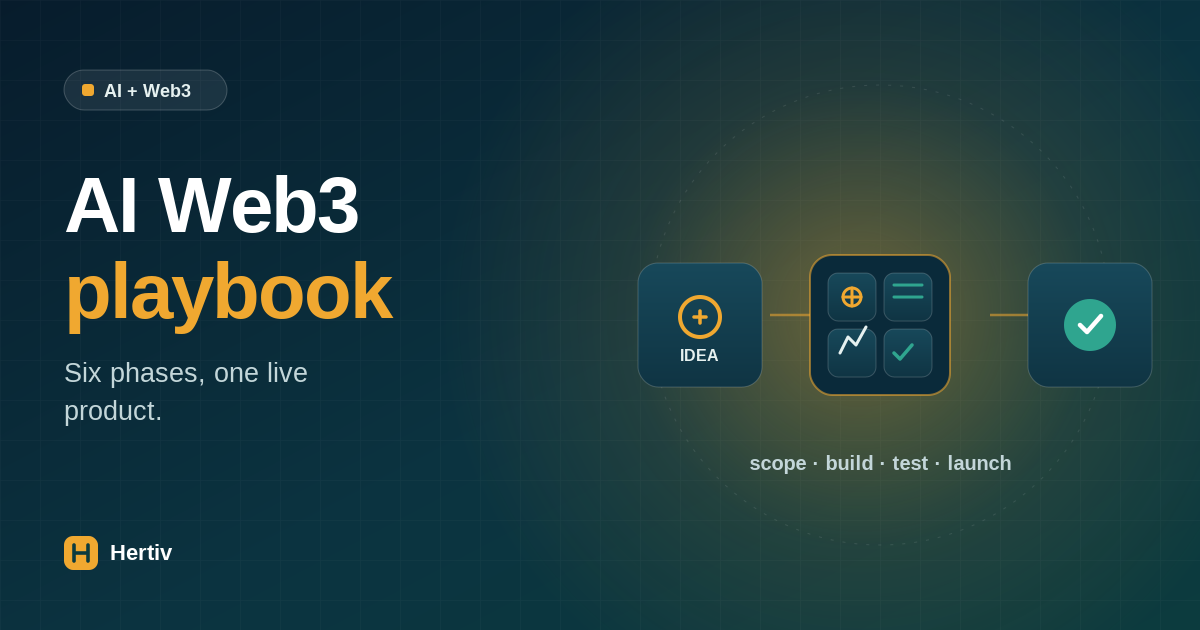
An AI and Web3 execution playbook turns a combined idea into a shipped product in six phases. Here are the phases and the checks that end each one.
On this page
Short answer
An AI and Web3 execution playbook is a step-by-step plan for building a product that combines AI models with blockchain parts such as wallets, tokens or smart contracts. It splits the work into six phases, scope, architecture, build, test, launch and run, with a clear check at the end of each phase. The point is to catch costly mistakes, such as the wrong on-chain split, before they reach users.
What is an AI and Web3 execution playbook?
An AI and Web3 execution playbook is a step-by-step plan for building a product that combines AI models with blockchain parts such as wallets, tokens or smart contracts. It turns a vague idea, such as an AI agent that pays for work on-chain, into a sequence of phases with owners, checks and a definition of done for each one.
The playbook exists because these projects fail in specific ways. A team picks the wrong split between on-chain and off-chain work, and the product becomes slow or costly to run. Or the AI part works in a demo but the contract that moves money was never tested with real edge cases. A playbook names those risks early, while they are still cheap to fix.
It is not a product spec and not a project plan in the usual sense. A spec says what the product does, and a plan says who does what by when. The playbook sits between them: it says which decisions must be made, in which order, and what evidence ends each phase. Teams that skip it usually rediscover the same decisions late, when changing them costs the most.
The six phases at a glance
The playbook has six phases, and each one ends with a check that must pass before the next phase starts. Skipping a check does not save time; it moves the failure into a later phase, where the same problem costs more to fix. The table below is the whole playbook on one page.
| Phase | What happens | Exit check |
|---|---|---|
| 1. Scope | Define the user, the job and the money flow | One-page scope everyone signs |
| 2. Architecture | Split on-chain and off-chain work | Diagram plus cost estimate |
| 3. Build | Models, contracts and app in slices | Working slice in a test environment |
| 4. Test | Contract checks, model checks, user tests | Pass list with no open blockers |
| 5. Launch | Deploy, watch, limit the blast radius | Live with caps and a rollback plan |
| 6. Run | Monitor, support, iterate | Dashboards and an incident plan |
The phases are short on purpose. A scope phase that drags on for a month usually means the team is avoiding a decision, not gathering information. Each phase should produce one artefact, the scope page, the diagram, the working slice, and the check is simply whether that artefact exists and holds up.
Scope and architecture: decide what goes on-chain
Scope starts with the user and the money flow, not with the technology. Who uses the product, what job does it do for them, and where does money move? An AI agent that pays freelancers needs a wallet, a payment path and a record of the work. An AI tool that reads documents needs none of those.
The scope page should fit on one page and name the user, the job and the money flow in plain words. If it needs a second page, the scope is not decided yet, and the next phase will inherit the confusion.
Architecture then splits the work between on-chain and off-chain. Put on-chain only what needs a shared, tamper-resistant record: ownership, payments and agreements. Keep off-chain what changes often or costs too much to store: model runs, large files and private data. The usual mistake is putting everything on-chain because it feels more Web3, which makes the product slow and costly to run.
The architecture artefact is a diagram plus a cost estimate. The diagram shows the model, the app, the wallet, the contracts and the data store, with arrows for each flow. The cost estimate covers transaction fees at expected volume, model running costs and storage. If the estimate is missing, the team has not really decided the split yet. For a starting point, launching a Web3 app covers the same ground from the app side.
Build and test: models, contracts and agents
Build in slices, not in layers. A slice is one user job working end to end, such as a user asking the agent a question and getting an answer that is paid for on-chain. Building the model first, then the contracts, then the app means nothing works until the end, and the integration problems arrive all at once. A slice a week keeps the integration honest.
Testing has three parts, and each one catches different failures. Contract checks look for the classic problems: re-entrancy, wrong permissions and arithmetic that rounds the wrong way. Model checks look for wrong answers, stale data and prompts that leak private information. User tests look for the product problems: confusing wallet steps, unclear fees and error messages that say nothing useful.
Contracts need a review by someone who did not write them, and the review should happen before launch, not after. A contract that moves money cannot be patched the way a web app can, so a bug found after deployment is a far bigger problem than a bug found in testing. Budget the review into the plan and treat it as a gate, not a nice extra.
The agent side needs the same discipline. Agentic AI development covers the guardrails that keep multi-step agents from acting beyond what the team intended.
Launch and run: ship it, then keep it working
Launch small and watch closely. Put a cap on how much value can move through the product in the first weeks, and keep a pause switch the team can use without deploying new code. The first users will find the problems the tests missed, and a cap limits what those problems can cost while the team fixes them.
Running the product means watching three things: the model, the chain and the users. Model monitoring looks for drifting answers and rising costs. Chain monitoring looks for failed transactions, stuck payments and unusual contract calls. User monitoring looks for where people drop off, which usually points at a wallet step or a fee that surprised them.
The run phase also needs an incident plan written down before the first incident. Who gets called, what can be paused, and how users are told what happened. A team that writes this plan during an incident will write it badly, and a team with no plan will spend the incident arguing about who decides. For payment flows specifically, how Web3 payments work is useful background.
Example (hypothetical): a loyalty-points project ships in twelve weeks
Example (hypothetical): a retailer wants a loyalty scheme where an AI agent suggests rewards and points move on-chain. The team budgets 1,200 hours across twelve weeks. Scope takes 120 hours, architecture 180, build 480, test 240, launch 120 and run setup 60. Added together, 120 plus 180 plus 480 plus 240 plus 120 plus 60 comes to exactly 1,200 hours.
The build is split into four weekly slices. Week one ships asking for points and seeing a balance. Week two adds the AI reward suggestion. Week three adds the on-chain points transfer. Week four ties the agent, the wallet and the contract together. Each slice works end to end, so the integration problems show up in the week they are created, not at the end.
Testing finds two real problems: a rounding error that gives one extra point per hundred redemptions, and a wallet step that half the test users cannot finish. Both are fixed before launch. The launch caps redemptions at 500 points per user for the first month, and the cap is lifted only after a month with no failed transactions.
What are the common mistakes?
The most common mistake is putting everything on-chain. Storing model outputs, large files or private data on-chain makes the product slow and costly, and the data cannot be deleted later. The rule is simple: on-chain for ownership, payments and agreements, off-chain for everything else.
- Skipping the architecture diagram and discovering the split too late.
- Building the model, the contracts and the app separately, then integrating at the end.
- Launching a money-moving contract without an independent review.
- Shipping without caps, a pause switch or a rollback plan.
- Writing the incident plan during the first incident.
Another mistake is treating the AI and the blockchain as two separate projects with two teams that rarely talk. The product is one thing to the user, and the handoff between the agent and the contract is where most failures live. One owner for the whole slice, from the user's question to the on-chain result, keeps that handoff visible.
Key takeaways
- A playbook splits an AI and Web3 build into six phases with a check at the end of each.
- Only ownership, payments and agreements belong on-chain; the rest stays off-chain.
- Build in weekly slices that work end to end instead of building in layers.
- Money-moving contracts need an independent review before launch, not after.
- Launch with caps, a pause switch and a written incident plan.
Frequently asked questions
What is an AI and Web3 execution playbook?
It is a step-by-step plan for building a product that combines AI models with blockchain parts such as wallets, tokens or smart contracts. It splits the work into six phases, scope, architecture, build, test, launch and run, with a clear check at the end of each phase.
What should go on-chain and what should stay off-chain?
Put on-chain only what needs a shared, tamper-resistant record: ownership, payments and agreements. Keep off-chain what changes often or costs too much to store, such as model runs, large files and private data.
Why build in slices instead of layers?
A slice is one user job working end to end, so integration problems show up in the week they are created. Building the model, then the contracts, then the app means nothing works until the end, and all the integration problems arrive at once.
Do smart contracts need an independent review?
Yes, when they move money. A contract cannot be patched like a web app, so a bug found after deployment is far more costly than one found in testing. Budget the review into the plan and treat it as a gate before launch.
How should the first launch be limited?
Put a cap on how much value can move through the product in the first weeks and keep a pause switch the team can use without deploying new code. Lift the cap only after a period with no failed transactions or stuck payments.
What does the run phase involve?
Watching the model for drifting answers and rising costs, the chain for failed transactions and stuck payments, and users for drop-off points. It also needs a written incident plan covering who gets called, what can be paused and how users are told.